Part II — The Deep Eclipses (#17–#26, 1845–2008)
Eclipse #17 — November 14, 1845 (Partial, mag. 0.922)
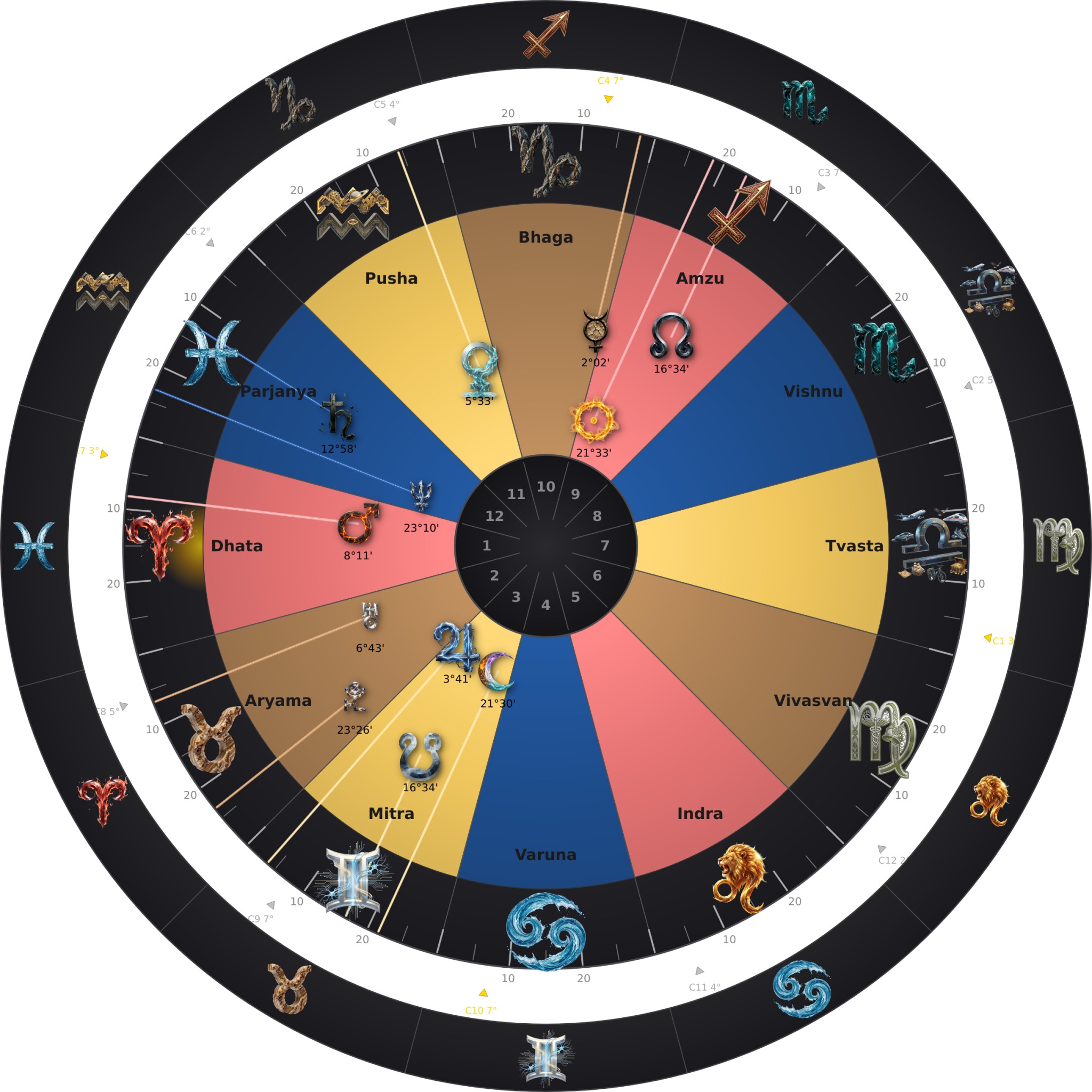
Tajika Aspects (19 within orb, 7 involve Sun/Moon)
| Pair | Aspect | Dist | Strength | Orb | Status | Relationship |
|---|---|---|---|---|---|---|
| Sun-Moon | ☍ Opposition | 0.0° | 59.9 VR (100%) | 13.5° | — | Openly Inimical |
| Ascendant-Mars | ☍ Opposition | 4.8° | 50.5 VR (84%) | 8.5° | — | Openly Inimical |
| Ascendant-Jupiter | △ Trine | 0.3° | 44.7 VR (75%) | 9.0° | — | Openly Friendly |
| Jupiter-Venus | △ Trine | 1.9° | 43.1 VR (72%) | 8.0° | Separating | Openly Friendly |
| Ascendant-Venus | △ Trine | 2.1° | 41.8 VR (70%) | 8.0° | — | Openly Friendly |
| Neptune-Pluto | ✶ Sextile | 0.3° | 39.8 VR (66%) | 8.0° | Applying | Secretly Friendly |
| Sun-Mercury | ☌ Conjunction | 10.5° | 39.0 VR (65%) | 11.0° | Separating | Neutral |
| Mercury-Uranus | △ Trine | 4.7° | 38.0 VR (63%) | 7.5° | Applying | Openly Friendly |
| Mars-Jupiter | ✶ Sextile | 4.5° | 34.0 VR (57%) | 8.5° | Separating | Secretly Friendly |
| Saturn-Uranus | ✶ Sextile | 6.2° | 31.7 VR (53%) | 8.5° | Separating | Secretly Friendly |
| Ascendant-Sun | □ Square | 11.9° | 24.9 VR (42%) | 12.0° | — | Secretly Friendly |
| Moon-Saturn | □ Square | 8.5° | 23.5 VR (39%) | 10.5° | Separating | Secretly Inimical |
| Sun-Saturn | □ Square | 8.6° | 22.1 VR (37%) | 12.0° | Separating | Secretly Inimical |
| Mars-Mercury | □ Square | 6.2° | 21.2 VR (35%) | 7.5° | Applying | Secretly Inimical |
| Sun-Neptune | □ Square | 1.6° | 16.6 VR (28%) | 11.5° | Applying | Secretly Inimical |
| Ascendant-Mercury | □ Square | 1.4° | 16.2 VR (27%) | 8.0° | — | Secretly Inimical |
| Venus-Uranus | □ Square | 1.2° | 16.2 VR (27%) | 7.5° | Applying | Secretly Inimical |
| Moon-Neptune | □ Square | 1.7° | 14.7 VR (24%) | 10.0° | Applying | Secretly Inimical |
| Mars-Venus | ✶ Sextile | 2.6° | 10.4 VR (17%) | 7.5° | Applying | Secretly Friendly |
Window: October 14 – December 14, 1845
The Irish Potato Famine Begins
The defining catastrophe of this eclipse window — and one of the great tragedies of the 19th century — was already unfolding as the Moon entered Earth's shadow. Since September, a mysterious blight (Phytophthora infestans) had been spreading through Ireland's potato fields with terrifying speed. Ireland's population of 8 million depended overwhelmingly on the potato: for the poorest third of the country, it was virtually the only food they ate. The blight turned healthy potatoes into black, putrid mush within days.
By November 19 — just 5 days after the eclipse — the Dublin Mansion House Relief Committee officially reported that more than one-third of Ireland's entire potato crop had been destroyed. The smell of rotting potatoes hung over the countryside. Families who had stored what seemed like a normal harvest opened their pits to find nothing but slime.
This was only the beginning. The British government's response was catastrophically inadequate. On October 31, Prime Minister Robert Peel convened an emergency Cabinet meeting, proposing to open Irish ports to grain imports and repeal the Corn Laws (tariffs that kept bread prices artificially high). His own Cabinet voted him down. The landed aristocracy's economic interests trumped the lives of Irish peasants. This political failure — the refusal to act when action was still possible — set the tone for years of governmental negligence. Over the next five years, approximately 1 million people starved to death while Ireland continued to export food to England. Another 1–2 million fled on overcrowded "coffin ships," many dying during the crossing. Ireland's population would not recover for over 150 years.
Texas, Manifest Destiny, and the Road to War with Mexico
Across the Atlantic, the United States was in the grip of expansionist fever. On October 13, voters in the Republic of Texas approved a constitution to join the United States — the culmination of years of political maneuvering that had pitted pro-slavery Southern interests (who wanted Texas as a slave state) against Northern abolitionists (who feared the expansion of slavery). On December 29, Texas was formally admitted as the 28th state. Mexico, which had never recognized Texas independence, considered the annexation an act of war. The Mexican-American War would erupt within months (May 1846), ultimately costing Mexico half its territory — what is now California, Nevada, Utah, Arizona, New Mexico, Colorado, and parts of Wyoming and Kansas.
President Polk made the stakes explicit on December 2, when he announced to Congress that the Monroe Doctrine must be "strictly enforced" and that the United States would aggressively expand westward. Manifest Destiny — the belief that American expansion across the continent was divinely ordained and inevitable — was now official national policy.
Battle of Vuelta de Obligado — Argentina's Day of National Sovereignty
On November 20, six days after the eclipse, an Anglo-French naval squadron of 11 warships attempted to force passage up Argentina's Parana River, seeking to break the commercial blockade imposed by dictator Juan Manuel de Rosas. Argentine General Lucio Mansilla had stretched chains across the river and positioned 2,000 troops and artillery batteries along the banks. His forces were vastly outgunned — the Allies had over 100 cannons to Argentina's 35 — but they fought for seven hours, reloading and firing even as their positions were demolished.
The Anglo-French forces technically won: they broke the chains and passed through. But the battle was a strategic disaster for Europe. The political backlash united all of South America behind Argentina, and both France and Britain were eventually forced to withdraw and acknowledge Argentine sovereignty over its internal rivers. November 20 is today celebrated as Argentina's Day of National Sovereignty — a symbol of resistance against European imperial overreach.
The First Anglo-Sikh War
On December 11, the Sikh Khalsa army — one of the most formidable military forces in Asia, disciplined and equipped with modern artillery — crossed the Sutlej River into British-controlled territory. The First Anglo-Sikh War had begun. What followed was some of the most brutal fighting the British East India Company had ever faced. At the Battle of Ferozeshah (December 21–22), both sides suffered enormous casualties in a confused two-day melee, with the outcome uncertain until the last hours. The British won, but only because of treachery within the Sikh command. The war's conclusion in 1846 led directly to British annexation of the Punjab — one of the last great independent kingdoms of India — and was a critical step in the consolidation of British imperial control over the entire subcontinent.
Science: The Mathematics That Found Neptune
Four days before the eclipse, on November 10, the French mathematician Urbain Le Verrier presented a remarkable paper to the Academie des Sciences in Paris. He demonstrated that no existing theory of planetary motion could account for the observed wobbles in Uranus's orbit. Something massive and unseen was pulling on Uranus — something that had to be there but had never been detected. Le Verrier calculated exactly where this invisible planet must be, and the following year (September 1846), astronomers pointed their telescopes to the predicted spot and found Neptune within one degree of where Le Verrier said it would be. It was one of the greatest triumphs of mathematical physics — a planet discovered not by looking through a telescope, but by the power of equations on paper.
Meanwhile, in Ireland, Lord Rosse's 72-inch "Leviathan" telescope at Birr Castle — the largest in the world — was revealing the spiral structure of galaxies for the first time. The Whirlpool Galaxy's arms were being sketched by human eyes as the potato blight consumed the countryside just miles away.
Eclipse #18 — November 25, 1863 (Partial, mag. 0.953)
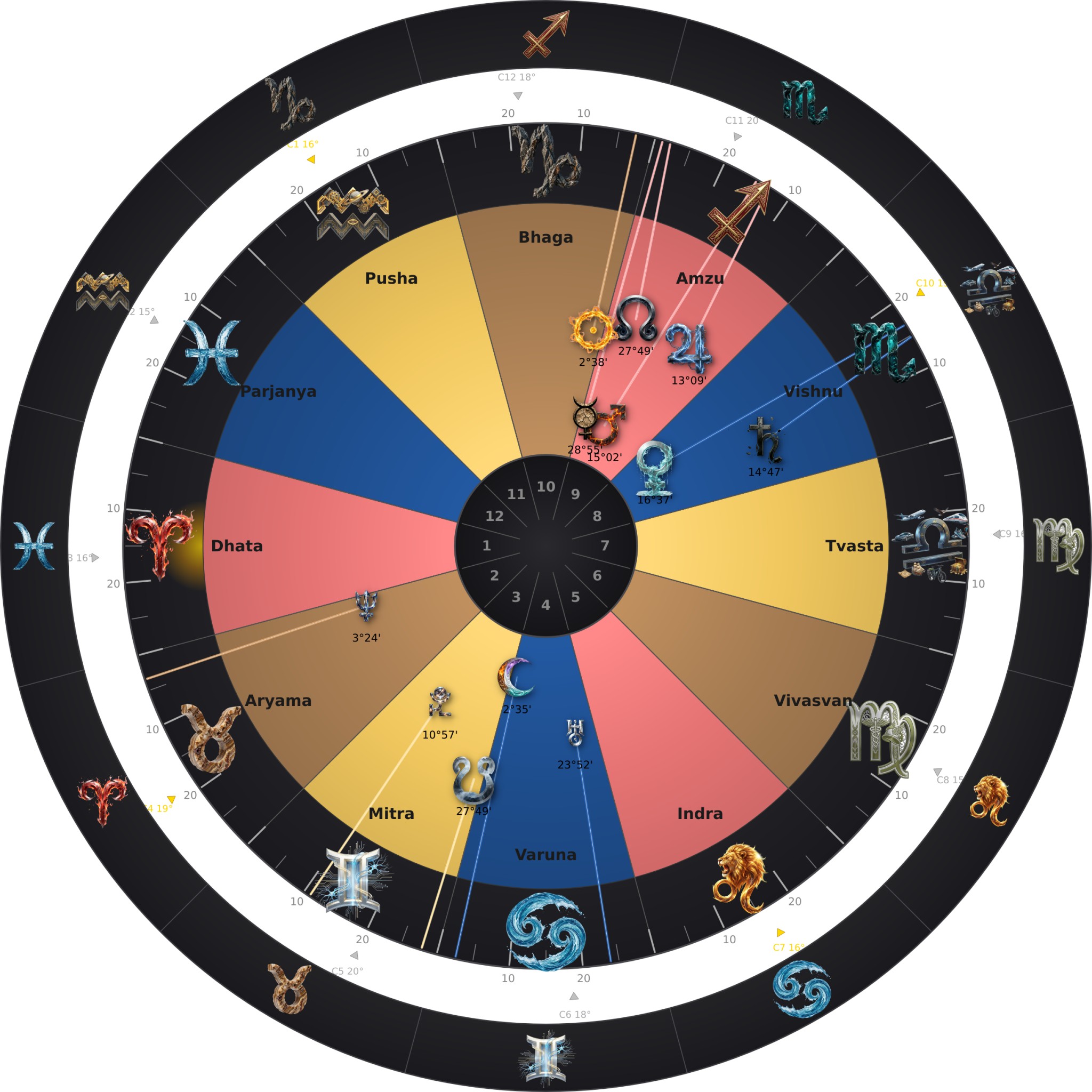
Tajika Aspects (16 within orb, 5 involve Sun/Moon)
| Pair | Aspect | Dist | Strength | Orb | Status | Relationship |
|---|---|---|---|---|---|---|
| Sun-Moon | ☍ Opposition | 0.0° | 59.9 VR (100%) | 13.5° | — | Openly Inimical |
| Venus-Saturn | ☌ Conjunction | 1.8° | 56.3 VR (94%) | 8.0° | Separating | Openly Inimical |
| Mars-Jupiter | ☌ Conjunction | 1.9° | 56.2 VR (94%) | 8.5° | Separating | Openly Inimical |
| Jupiter-Pluto | ☍ Opposition | 2.2° | 55.6 VR (93%) | 8.5° | Separating | Openly Inimical |
| Moon-Mercury | ☍ Opposition | 3.7° | 52.7 VR (88%) | 9.5° | Separating | Neutral |
| Sun-Mercury | ☌ Conjunction | 3.7° | 52.6 VR (88%) | 11.0° | Applying | Neutral |
| Mars-Pluto | ☍ Opposition | 4.1° | 51.8 VR (86%) | 8.0° | Separating | Openly Inimical |
| Sun-Neptune | △ Trine | 0.8° | 43.8 VR (73%) | 11.5° | Applying | Openly Friendly |
| Ascendant-Pluto | △ Trine | 5.5° | 39.5 VR (66%) | 8.5° | — | Openly Friendly |
| Mercury-Neptune | △ Trine | 4.5° | 38.3 VR (64%) | 7.5° | Applying | Neutral |
| Venus-Uranus | △ Trine | 7.2° | 37.8 VR (63%) | 7.5° | Applying | Openly Friendly |
| Ascendant-Saturn | □ Square | 1.6° | 16.6 VR (28%) | 9.0° | — | Secretly Inimical |
| Ascendant-Venus | □ Square | 0.2° | 15.0 VR (25%) | 8.0° | — | Secretly Inimical |
| Ascendant-Jupiter | ✶ Sextile | 3.3° | 10.5 VR (18%) | 9.0° | — | Secretly Friendly |
| Ascendant-Mars | ✶ Sextile | 1.4° | 10.2 VR (17%) | 8.5° | — | Secretly Friendly |
| Moon-Neptune | ✶ Sextile | 0.8° | 9.7 VR (16%) | 10.0° | Applying | Secretly Friendly |
Window: October 25 – December 25, 1863
The Gettysburg Address — 272 Words That Redefined a Nation
Six days before the eclipse, on November 19, 1863, Abraham Lincoln stood before a crowd of 15,000 at the dedication of the Soldiers' National Cemetery in Gettysburg, Pennsylvania. The main speaker, Edward Everett, had just delivered a two-hour oration. Lincoln spoke for roughly two minutes. He said 272 words.
Those 272 words transformed the meaning of the American Civil War. Before Gettysburg, the war was officially about preserving the Union — a legal and constitutional dispute. Lincoln reframed it as something larger: a test of whether a nation "conceived in Liberty, and dedicated to the proposition that all men are created equal" could survive. He reached back past the Constitution to the Declaration of Independence, making the promise of equality — not just union — the purpose of the war. "Government of the people, by the people, for the people" became perhaps the most quoted definition of democracy ever spoken.
Many in the audience barely registered the speech — it was over before some realized it had started. Newspapers were split: anti-Lincoln papers called it "silly" and "flat"; supporters recognized something transcendent had happened. Everett himself wrote to Lincoln the next day: "I should be glad if I could flatter myself that I came as near to the central idea of the occasion in two hours as you did in two minutes."
The Battle of Chattanooga — The Eclipse Day Battle
The eclipse fell on the last day of the Battle of Chattanooga (November 23–25), one of the most strategically decisive engagements of the Civil War. The Union Army of the Cumberland had been besieged in Chattanooga, Tennessee since September, starving on half rations after a devastating defeat at Chickamauga. Grant was sent to break the siege.
What unfolded over three days was extraordinary. On November 23, Union troops captured Orchard Knob in a demonstration-turned-assault. On November 24, General Hooker's forces fought the "Battle Above the Clouds" on Lookout Mountain — literally fighting in fog and mist so thick that soldiers on both sides could barely see each other, while thousands watched from the valley below, hearing gunfire from inside the clouds.
Then came November 25 — the eclipse day. Grant ordered a diversionary assault on the rifle pits at the base of Missionary Ridge while Sherman attacked the northern end. The diversionary assault was supposed to stop at the base. It didn't. In one of the most astonishing episodes of the entire war, the Union soldiers — humiliated by months of siege, hungry, and furious — spontaneously charged up the steep ridge without orders, climbing over rocks and fallen trees under murderous fire, driven by rage and momentum. Officers screamed at them to stop. They kept climbing. The Confederate defenders at the top, seeing thousands of men swarming up a slope that should have been impregnable, broke and fled.
Grant watched in disbelief, turning to General Thomas: "Who ordered those men up the ridge?" No one had. The Confederate Army of Tennessee shattered, opening the gateway to the entire Deep South. Without Chattanooga, there would have been no Sherman's March to the Sea, no Atlanta, no end to the war in 1865.
The First Thanksgiving
Lincoln had proclaimed October 3 a national day of Thanksgiving for the last Thursday of November — the first time it was established as a regular national holiday. The first Thanksgiving fell on November 26, one day after the eclipse. The timing was deliberate: Lincoln wanted Americans to pause, in the middle of the bloodiest war in their history, and give thanks for "the gracious gifts of the Most High God." It was an act of faith in the survival of the nation at the moment when that survival was far from certain.
A World at War — Elsewhere
The eclipse window was also shaped by conflicts across the globe. In Poland, the January Uprising against Russian imperial rule (begun January 22, 1863) was being crushed with extreme brutality — mass executions, deportations to Siberia, the banning of the Polish language from public life. Russia's suppression would consolidate imperial control over Poland for another 55 years.
In Mexico, a delegation had formally offered the crown to Archduke Maximilian of Austria (October 3), backed by French bayonets. Napoleon III's attempt to install a puppet emperor in the Americas was a direct challenge to the Monroe Doctrine — but the United States was too consumed by its own civil war to respond. The French-backed Mexican Empire would collapse once the Civil War ended and the U.S. could project power southward again.
In New Zealand, British forces captured Ngaruawahia, the capital of the Maori King Movement (December 8), after the decisive Battle of Rangiriri where 183 Maori warriors were captured. The governor declared "the neck of this unhappy rebellion is now broken."
Eclipse #19 — December 5, 1881 (Partial, mag. 0.975)
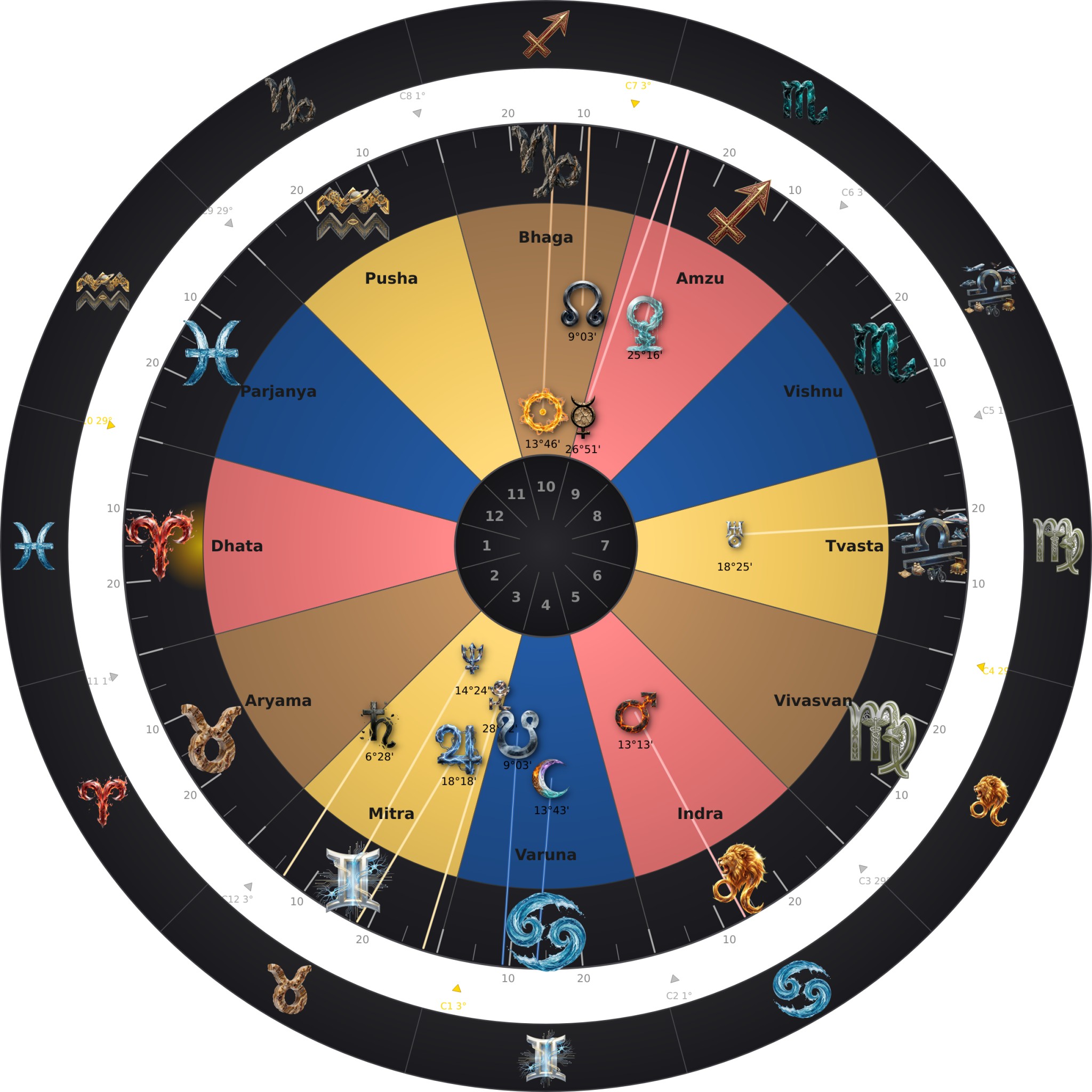
Tajika Aspects (20 within orb, 5 involve Sun/Moon)
| Pair | Aspect | Dist | Strength | Orb | Status | Relationship |
|---|---|---|---|---|---|---|
| Sun-Moon | ☍ Opposition | 0.0° | 59.9 VR (100%) | 13.5° | — | Openly Inimical |
| Mercury-Pluto | ☍ Opposition | 1.2° | 57.6 VR (96%) | 7.5° | Applying | Openly Inimical |
| Mercury-Venus | ☌ Conjunction | 1.6° | 56.8 VR (95%) | 7.0° | Separating | Openly Inimical |
| Venus-Pluto | ☍ Opposition | 2.8° | 54.4 VR (91%) | 7.5° | Applying | Openly Inimical |
| Jupiter-Neptune | ☌ Conjunction | 3.9° | 52.2 VR (87%) | 8.5° | Applying | Openly Inimical |
| Ascendant-Pluto | ☌ Conjunction | 5.7° | 48.5 VR (81%) | 8.5° | — | Neutral |
| Ascendant-Mercury | ☍ Opposition | 6.9° | 46.2 VR (77%) | 8.0° | — | Neutral |
| Jupiter-Venus | ☍ Opposition | 7.0° | 46.1 VR (77%) | 8.0° | Separating | Openly Inimical |
| Jupiter-Uranus | △ Trine | 0.1° | 44.8 VR (75%) | 8.5° | Separating | Openly Friendly |
| Saturn-Neptune | ☌ Conjunction | 7.9° | 44.1 VR (74%) | 8.5° | Separating | Openly Inimical |
| Ascendant-Moon | ☌ Conjunction | 9.9° | 40.1 VR (67%) | 10.5° | — | Openly Inimical |
| Ascendant-Sun | ☍ Opposition | 10.0° | 40.0 VR (67%) | 12.0° | — | Openly Inimical |
| Uranus-Neptune | △ Trine | 4.0° | 39.0 VR (65%) | 8.0° | Separating | Openly Friendly |
| Mars-Uranus | ✶ Sextile | 5.2° | 35.7 VR (60%) | 8.0° | Separating | Secretly Friendly |
| Moon-Uranus | □ Square | 4.7° | 19.7 VR (33%) | 10.0° | Applying | Secretly Inimical |
| Sun-Uranus | □ Square | 4.6° | 14.2 VR (24%) | 11.5° | Applying | Secretly Inimical |
| Mars-Saturn | ✶ Sextile | 6.8° | 11.1 VR (18%) | 8.5° | Applying | Secretly Friendly |
| Venus-Uranus | ✶ Sextile | 6.9° | 11.1 VR (19%) | 7.5° | Separating | Secretly Friendly |
| Mars-Neptune | ✶ Sextile | 1.2° | 9.6 VR (16%) | 8.0° | Separating | Secretly Friendly |
| Mars-Jupiter | ✶ Sextile | 5.1° | 8.3 VR (14%) | 8.5° | Separating | Secretly Friendly |
Window: November 5, 1881 – January 5, 1882
The Ring Theater Fire — Vienna's Night of Horror
Three days after the eclipse, on the evening of December 8, 1881, Vienna's elegant Ringtheater on the Schottenring was packed for the second-ever performance of Jacques Offenbach's opera Les Contes d'Hoffmann ("The Tales of Hoffmann"). The audience was dressed in their finest; the theater — one of Vienna's grandest — held over 1,700 people.
At approximately 6:45 PM, gas lamps behind the stage exploded. Flames raced through the fly tower and scenery with terrifying speed. The stage curtain — which should have contained the fire — caught and burned. Within minutes, the entire stage was an inferno. Panic erupted. The gas lights in the auditorium went dark. In total blackness, 1,700 people fought to reach the exits.
The exits were inadequate. Doors opened inward, jamming against the crush of bodies. Some exits were locked. Staircases became death traps as people were trampled or asphyxiated by smoke. The fire department took approximately 30 minutes to arrive. By then, the interior was a furnace.
The official death toll was 384, but investigations suggested the real number was between 620 and 850, with some estimates reaching 1,000. Bodies were so badly burned that many could never be identified. Emperor Franz Joseph I personally funded the construction of a memorial apartment building (the Sühnhaus) on the site. The disaster led to sweeping fire safety reforms across Europe — including requirements for outward-opening doors, emergency lighting, and fire curtains — regulations that persist to this day.
The "Slap of Tunis" — How Colonial Rivalry Built the Road to WWI
The broader political context of this eclipse was the European scramble for colonial territory, and one event in particular had consequences that echoed for decades. France had invaded Tunisia in spring 1881 and imposed a protectorate via the Bardo Treaty (May 12). By late December 1881, the last armed Tunisian resistance was being suppressed.
Italy was enraged. Italy had coveted Tunisia for years — there were more Italians living in Tunis than French — and they considered France's seizure a betrayal. Italian newspapers called it the "Schiaffo di Tunisi" (the Slap of Tunis). The humiliation drove Italy directly into the arms of Germany and Austria-Hungary: within five months, Italy signed the Triple Alliance (May 1882), the military pact that would form one of the two great power blocs of World War I. A colonial land-grab in North Africa in December 1881 thus drew a straight line to the trenches of 1914.
Meanwhile, in Russia, Tsar Alexander III — who had ascended in March 1881 after his father Alexander II was assassinated by a bomb thrown at his carriage — was reversing every liberal reform his father had attempted. Censorship was tightened, universities were brought under control, and the secret police expanded. Russia was being locked into the authoritarian course that would eventually produce the revolutionary explosion of 1917.
The Birth of the Electric Grid and the LA Times
The day before the eclipse, December 4, the first edition of the Los Angeles Daily Times rolled off the press — the paper that would grow into the largest newspaper in the Western United States, shaping the politics and culture of California for a century.
Just over a month later, on January 12, 1882, the Holborn Viaduct power station opened in London — the world's first public coal-fired electricity generating station. For the first time, buildings could be lit by electricity from a central source rather than individual generators. The electric grid — the infrastructure that would transform every aspect of modern life — was born.
Eclipse #20 — December 17, 1899 (Partial, mag. 0.992)
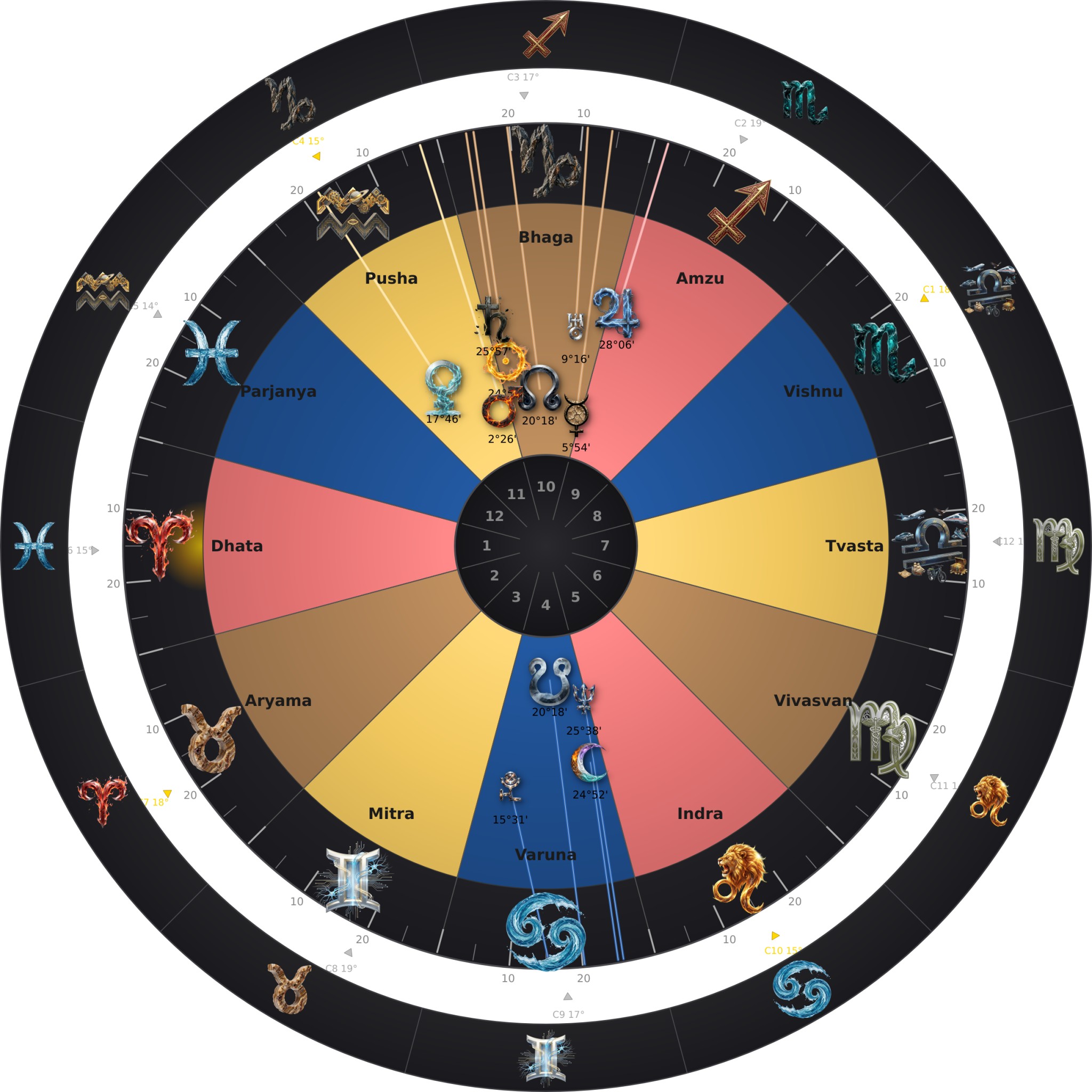
Tajika Aspects (21 within orb, 11 involve Sun/Moon)
| Pair | Aspect | Dist | Strength | Orb | Status | Relationship |
|---|---|---|---|---|---|---|
| Sun-Moon | ☍ Opposition | 0.0° | 59.9 VR (100%) | 13.5° | — | Openly Inimical |
| Saturn-Neptune | ☍ Opposition | 0.3° | 59.4 VR (99%) | 8.5° | Separating | Openly Inimical |
| Sun-Neptune | ☍ Opposition | 0.7° | 58.6 VR (98%) | 11.5° | Applying | Openly Inimical |
| Moon-Neptune | ☌ Conjunction | 0.7° | 58.5 VR (98%) | 10.0° | Applying | Openly Inimical |
| Sun-Saturn | ☌ Conjunction | 1.0° | 57.9 VR (97%) | 12.0° | Applying | Openly Inimical |
| Moon-Saturn | ☍ Opposition | 1.1° | 57.9 VR (96%) | 10.5° | Applying | Openly Inimical |
| Mercury-Uranus | ☌ Conjunction | 3.4° | 53.3 VR (89%) | 7.5° | Applying | Openly Inimical |
| Uranus-Pluto | ☍ Opposition | 6.2° | 47.5 VR (79%) | 8.0° | Applying | Openly Inimical |
| Mars-Saturn | ☌ Conjunction | 6.5° | 47.0 VR (78%) | 8.5° | Separating | Neutral |
| Mars-Neptune | ☍ Opposition | 6.8° | 46.4 VR (77%) | 8.0° | Separating | Neutral |
| Sun-Mars | ☌ Conjunction | 7.5° | 45.0 VR (75%) | 11.5° | Applying | Neutral |
| Moon-Mars | ☍ Opposition | 7.6° | 44.9 VR (75%) | 10.0° | Applying | Neutral |
| Mercury-Jupiter | ☌ Conjunction | 7.8° | 44.4 VR (74%) | 8.0° | Applying | Neutral |
| Moon-Pluto | ☌ Conjunction | 9.4° | 41.3 VR (69%) | 10.0° | Separating | Openly Inimical |
| Sun-Pluto | ☍ Opposition | 9.4° | 41.2 VR (69%) | 11.5° | Separating | Openly Inimical |
| Ascendant-Pluto | △ Trine | 2.8° | 40.8 VR (68%) | 8.5° | — | Openly Friendly |
| Ascendant-Moon | △ Trine | 6.6° | 38.4 VR (64%) | 10.5° | — | Openly Friendly |
| Ascendant-Neptune | △ Trine | 7.3° | 37.7 VR (63%) | 8.5° | — | Openly Friendly |
| Ascendant-Sun | ✶ Sextile | 6.6° | 34.5 VR (58%) | 12.0° | — | Secretly Friendly |
| Ascendant-Saturn | ✶ Sextile | 7.6° | 33.6 VR (56%) | 9.0° | — | Secretly Friendly |
| Ascendant-Venus | □ Square | 0.6° | 15.5 VR (26%) | 8.0° | — | Secretly Inimical |
Window: November 17, 1899 – January 17, 1900
The last partial eclipse before the series turns total. The final eclipse of the 19th century.
"Black Week" — The British Empire's Worst Military Humiliation
In the autumn of 1899, the mighty British Empire — at the zenith of its power, controlling a quarter of the world's land surface — went to war against two small Boer republics in South Africa (the Transvaal and the Orange Free State). The British public expected a quick victory. What they got instead was Black Week: the most devastating sequence of British military defeats since the Napoleonic Wars, culminating on the exact date of the eclipse.
The disasters came in rapid succession:
-
December 10 — Battle of Stormberg: Major-General Gatacre's forces marched through the night, got lost, and stumbled into a Boer ambush at dawn. Over 600 British soldiers were killed or captured. Gatacre had to retreat, abandoning his wounded.
-
December 11 — Battle of Magersfontein: Lord Methuen sent the Highland Brigade — some of the finest infantry in the British Army — in a frontal assault across open ground toward concealed Boer trenches. The Boers had dug in not on the hilltop (where the British expected them) but at the base of the hill, invisible in the pre-dawn darkness. When the Highlanders advanced in dense formation, the Boers opened fire at point-blank range. Nearly 1,000 men fell. The commanding general of the Highland Brigade, Andrew Wauchope, was killed leading from the front.
-
December 15 — Battle of Colenso: General Buller's attempt to cross the Tugela River to relieve the besieged garrison at Ladysmith was a fiasco. The Boers had prepared concealed positions along the river. British artillery was pushed too far forward and fell into a trap — 10 field guns were abandoned, a humiliation almost unprecedented in British military history. Over 1,100 casualties.
Total: 2,776 British soldiers killed, wounded, or captured in seven days.
On December 17 — the eclipse date — the shattered British command structure was reorganized. Field Marshal Lord Roberts was appointed as the new Commander-in-Chief, with Lord Kitchener as his Chief of Staff. The shock in Britain was profound. Queen Victoria, 80 years old, reportedly said: "We are not interested in the possibilities of defeat; they do not exist." But defeat was exactly what had happened, and the British public, which had been celebrating as if the war were a cricket match, was suddenly confronting the reality that a citizen army of Boer farmers could humiliate the greatest military power on Earth.
What Came After Black Week — The Long Reckoning
The aftermath of Black Week unfolded in phases, each more devastating than the last, and its consequences shaped the 20th century.
Phase 1: Roberts Restores Order (January–September 1900)
Roberts and Kitchener arrived at Cape Town on January 10, 1900, with massive reinforcements. Where there had been 12,546 British troops in South Africa at the outbreak of war, the total swelled to over 180,000. Roberts brought a new strategy: mobility and encirclement rather than the plodding frontal assaults that had produced Black Week. He moved inland with extraordinary speed. Kimberley was relieved on February 15. On February 27 — the anniversary of Britain's humiliation at Majuba Hill in the First Boer War — he captured Boer General Piet Cronje and 4,000 men at Paardeberg. Mafeking, whose 217-day siege had consumed the British public's imagination, was relieved on May 17, 1900, triggering scenes of near-hysterical celebration in London so extreme they gave the English language a new word: "mafficking." Pretoria, the Transvaal's capital, fell on June 5. By September, Roberts had formally annexed both Boer republics.
He returned to Britain a hero. The war, everyone believed, was essentially over. It was not even close to over.
Phase 2: The Guerrilla War and Scorched Earth (1900–1902)
A core of determined Boer commanders — Christiaan de Wet, Jacobus de la Rey, Jan Smuts, Louis Botha — refused to accept defeat. They dispersed into small, fast-moving mobile units called commandos: expert horsemen and marksmen who could cover 50–60 miles a day, harass supply lines, ambush columns, cut telegraph wires, and melt back into the veldt. The British Army — 240,000+ troops trained for set-piece battles — was maddened by its inability to close with an enemy that wouldn't stand and fight.
Kitchener, now in supreme command, responded with scorched earth. The logic was brutal: the commandos relied on their families and farms for food, horses, and shelter. Remove those, and the commandos could not fight. British troops burned approximately 30,000 Boer farmhouses and razed more than 40 towns. Livestock was slaughtered. Crops were burned. Orchards were cut down.
And then came the question of what to do with the women, children, and elderly left homeless in the middle of a war zone.
Phase 3: The Concentration Camps — Britain's Darkest Chapter
Kitchener's solution was to gather displaced civilians into guarded camps — and the word "concentration camp" was actually used at the time. By mid-1901, there were 45 white camps holding ~116,000 Boer civilians (mostly women and children) and 64 Black African camps holding over 107,000 people.
Conditions were catastrophic. Tents designed for eight held twenty. Rations were deliberately reduced for families of men still fighting — calculated collective punishment. Clean water was intermittent. Soap was rarely distributed. Medical facilities were wholly inadequate.
Disease swept through: measles, typhoid, dysentery, pneumonia. Children, weakened by malnutrition, died in staggering numbers. At the worst point, some camps had a death rate of 436 per 1,000 per year — nearly one in two. By the war's end, 27,927 white Boers had died in the camps — 22,074 of them children under 16. The Black camps were if anything worse, with an estimated 14,000–20,000 dead, though records were kept so poorly the true number may never be known.
The camps were exposed by Emily Hobhouse, a 40-year-old Cornish woman who sailed to South Africa, talked her way into the camps, and documented what she found: children dying of dysentery without medical attention, families with no bedding in freezing rain, a six-month-old baby starving to death. She compiled a 40-page report and delivered it to Parliament. The government's first response was dismissal — she was "pro-Boer," she was exaggerating. But Liberal opposition leader Sir Henry Campbell-Bannerman read her report and delivered one of the most searing phrases in British political history: "When is a war not a war? When it is carried on by methods of barbarism in South Africa."
The government sent its own commission — led by suffragist Millicent Fawcett, chosen precisely because she was a government loyalist. Fawcett toured the camps between August and December 1901, and confirmed everything Hobhouse had written, demanding immediate improvements. Hobhouse herself, returning to South Africa, was physically deported — expelled from the empire she was trying to hold to account.
The Military Reforms That Prepared Britain for WWI
Black Week's failures — officers chosen for social class rather than ability, troops advancing in close formation against concealed riflemen, artillery doctrine wrong, intelligence almost nonexistent — produced sweeping reforms. The Esher Committee (1903–04) abolished the position of Commander-in-Chief and created a professional General Staff. The Haldane Reforms (1906–12) reorganized the entire army into two forces: a small, highly professional British Expeditionary Force (BEF) designed for rapid continental deployment, and a Territorial Force as second line.
Musketry training was transformed — by 1914, British soldiers could fire 15 aimed rounds per minute (the "mad minute"), a rate so fast that German troops at Mons believed they were facing machine guns. Infantry tactics emphasized cover, fieldcraft, and independent initiative rather than close-order formation. When war came in August 1914, the BEF was small (100,000 men) but arguably the best-trained professional army in the world — a direct product of the Boer War's painful lessons.
The Death of "Splendid Isolation" — The Road to 1914
Perhaps the deepest consequence was psychological. The Boer War shattered Victorian confidence. To defeat two small farming republics had required 450,000 troops, three years, £210 million (roughly £25 billion today), scorched earth, concentration camps, and international revulsion. Historian A.J.P. Taylor called the European reaction "the most formidable display of Continental hostility to Britain between Napoleon's day and Hitler's."
Britain abandoned its century-long policy of "Splendid Isolation" — the confident stance that it was strong enough not to need continental allies. The Anglo-Japanese Alliance (1902), the Entente Cordiale with France (1904), and the Anglo-Russian Convention (1907) followed in rapid succession — the very alliances that, by 1914, would drag Britain into the Great War. The Boer War's vulnerability directly produced the entanglements that ended the peace.
South Africa: The Betrayal of Black Africans
The Treaty of Vereeniging (May 31, 1902) was generous to white Boers and catastrophic for Black South Africans. The crucial clause stated that the question of "native" voting rights would be "settled after the introduction of self-government" — meaning after the Boers had been given back their political power. Everyone knew what that meant: never.
Black South Africans had served both sides during the war — as scouts, transport workers, armed auxiliaries, intelligence sources. British officials had hinted, sometimes near-explicitly, that those who supported Britain would be rewarded with political rights. The promise was abandoned the moment it became necessary to win Boer cooperation. White unity trumped any commitment to the Black majority.
The Union of South Africa was created in 1910, with Boer general Louis Botha as its first Prime Minister and Jan Smuts — who had led commando raids against the British — as a minister. The men who had fought Britain now governed a British dominion. It was a remarkable reconciliation between white populations, and a complete abandonment of the Black majority. The African National Congress was founded in 1912 in direct response. The roots of apartheid ran directly back to that treaty. It would take 88 years — from the Treaty of Vereeniging in 1902 to Mandela's release in 1990 (Eclipse #25 in this very Saros series) — for the betrayal to be reversed.
The Final Accounting
The Second Boer War killed approximately 75,000 people: 22,000 British and colonial soldiers, 6,000–7,000 Boer soldiers, 27,927 Boer civilians in camps (24,074 of them children), and an estimated 20,000+ Black Africans. For all that blood and treasure, Britain gained two colonies that it handed back as a self-governing dominion eight years later.
Kipling captured the mood in "The Lesson," written after Black Week, warning that Britain had been caught "half-baked" and "half-fed." The war did not immediately end the empire — there was still a long Edwardian noon before the shadows gathered. But the Boer War was the first serious intimation that the empire was not invulnerable, that its methods could be barbaric, that its promises could be hollow, and that its morning might not last forever.
The "Philippine Thermopylae" — A Young General's Last Stand
Two weeks before the eclipse, on December 2, one of the most heroic last stands in Asian history took place at Tirad Pass in the mountains of the Philippines. The 24-year-old Brigadier General Gregorio del Pilar — the youngest general in the Philippine revolutionary army — positioned himself and 60 soldiers at a narrow mountain pass to block 500+ American troops pursuing Philippine President Emilio Aguinaldo, who was fleeing into the northern mountains after the collapse of conventional resistance.
Del Pilar's men held the pass for hours, buying Aguinaldo time to escape. The Americans eventually flanked the position using a local guide. Del Pilar was shot dead. He was found with a bullet wound to the neck, his Mauser rifle beside him. An American officer found a locket with a woman's photograph and a diary in del Pilar's pocket. The last entry read: "The end is near."
The Battle of Tirad Pass marked the transition of the Philippine-American War from conventional warfare to guerrilla tactics — a shift Aguinaldo had decreed on November 13. The guerrilla war would drag on until 1902 and cost an estimated 200,000 Filipino civilian lives.
The Indian Famine — 9 Million Dead in Silence
While the British public was consumed by events in South Africa, a far greater catastrophe was unfolding in India with almost no attention. The failure of the 1899 summer monsoons had triggered a famine across 476,000 square miles, affecting 59.5 million people. During December 1899, the famine was at full intensity — people were dying by the thousands daily. The British colonial administration's response was shaped by laissez-faire ideology: relief was deliberately limited to prevent "dependency." Over the course of 1899–1901, an estimated 9 million people died — a death toll that dwarfed Black Week by a factor of 3,000. The famine remains one of the deadliest humanitarian catastrophes in modern history, yet it received a fraction of the press coverage devoted to a few thousand British soldiers in South Africa.
Technology at the Turn of the Century
On November 22, the Marconi Wireless Company of America was incorporated — the world's first commercial radio company. Guglielmo Marconi had already demonstrated wireless transmission across the English Channel (50 km) earlier in 1899. Within two years, he would transmit across the Atlantic. The age of global wireless communication was beginning.
In December 1899, AT&T purchased American Bell, consolidating the entire U.S. telephone network under one corporate parent. AC Milan Football Club was founded. And Pope Leo XIII opened the Holy Door at St. Peter's Basilica, inaugurating the Jubilee Year of 1900 — the symbolic threshold between the old century and the new, freighted with both hope and anxiety about what the 20th century would bring.
Eclipse #21 — December 28, 1917 (Total, mag. 1.006)
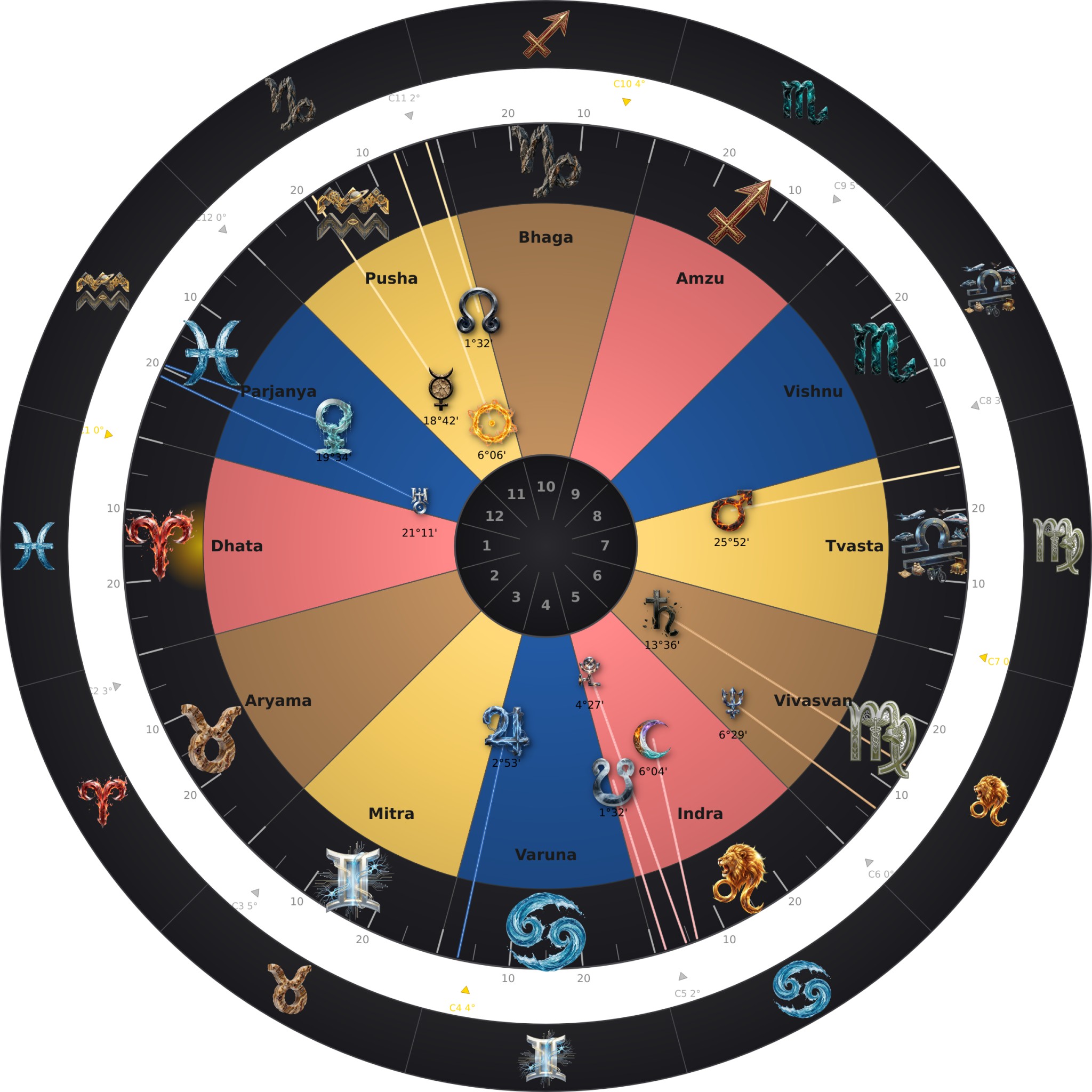
Tajika Aspects (15 within orb, 6 involve Sun/Moon)
| Pair | Aspect | Dist | Strength | Orb | Status | Relationship |
|---|---|---|---|---|---|---|
| Sun-Moon | ☍ Opposition | 0.0° | 59.9 VR (100%) | 13.5° | — | Openly Inimical |
| Moon-Pluto | ☌ Conjunction | 1.6° | 56.8 VR (95%) | 10.0° | Separating | Openly Inimical |
| Venus-Uranus | ☌ Conjunction | 1.6° | 56.8 VR (95%) | 7.5° | Applying | Openly Inimical |
| Sun-Pluto | ☍ Opposition | 1.7° | 56.7 VR (94%) | 11.5° | Separating | Openly Inimical |
| Venus-Saturn | ☍ Opposition | 6.0° | 48.0 VR (80%) | 8.0° | Separating | Openly Inimical |
| Saturn-Neptune | ☌ Conjunction | 7.1° | 45.8 VR (76%) | 8.5° | Applying | Openly Inimical |
| Saturn-Uranus | ☍ Opposition | 7.6° | 44.8 VR (75%) | 8.5° | Separating | Openly Inimical |
| Ascendant-Pluto | △ Trine | 3.7° | 39.5 VR (66%) | 8.5° | — | Openly Friendly |
| Mars-Jupiter | △ Trine | 7.0° | 38.0 VR (63%) | 8.5° | Applying | Secretly Inimical |
| Mars-Mercury | △ Trine | 7.2° | 37.8 VR (63%) | 7.5° | Separating | Openly Friendly |
| Ascendant-Moon | △ Trine | 5.3° | 37.0 VR (62%) | 10.5° | — | Openly Friendly |
| Jupiter-Neptune | ✶ Sextile | 3.6° | 37.0 VR (62%) | 8.5° | Separating | Secretly Friendly |
| Sun-Mars | □ Square | 10.2° | 25.2 VR (42%) | 11.5° | Separating | Openly Friendly |
| Ascendant-Jupiter | □ Square | 2.1° | 17.1 VR (28%) | 9.0° | — | Secretly Inimical |
| Ascendant-Sun | ✶ Sextile | 5.3° | 8.2 VR (14%) | 12.0° | — | Secretly Friendly |
Window: November 28, 1917 – January 28, 1918
The first total eclipse in the series. The transition from partial to total coincides with the most destructive war in human history to that point.
The Halifax Explosion — The Apocalypse Before the Atomic Age
On the morning of December 6, 1917, at 9:04 AM, the French cargo ship SS Mont-Blanc — loaded to capacity with 2,925 tons of war munitions including TNT, picric acid, benzol fuel, and gun cotton — collided with the Norwegian vessel SS Imo in the narrows of Halifax Harbor, Nova Scotia. The Mont-Blanc caught fire. Her crew, knowing what was aboard, abandoned ship without warning the city. The burning vessel drifted toward Pier 6 in the Richmond neighborhood.
For twenty minutes, Halifax residents gathered at windows and along the waterfront to watch the spectacular fire. Many children pressed their faces against the glass for a better view.
At 9:04:35 AM, the Mont-Blanc exploded.
The blast was the largest man-made explosion in history prior to the atomic bomb. It vaporized the ship and everything within a half-mile radius. A fireball rose over a mile high. A tsunami wave 18 meters tall surged through the harbor. The blast wave flattened the entire Richmond neighborhood — 1,600 homes, factories, churches, and schools reduced to kindling in an instant. The pressure wave shattered windows 100 kilometers away. People who had been watching from their windows were blinded by flying glass — over 600 people lost their eyesight that morning, many of them children.
1,963 people were killed. 9,000 were injured. The following day, a blizzard struck Halifax, burying the wounded and homeless under snow. Rescue workers dug through rubble in freezing conditions, often finding entire families crushed together.
The Halifax Explosion became the first modern disaster studied by social scientists — Samuel Henry Prince's Columbia University dissertation (1920) on the community's response is considered the founding document of disaster sociology.
The Fall of Jerusalem — 400 Years of Ottoman Rule Ends
Three days after the explosion, on December 9–11, one of the most symbolically charged military victories of the entire war took place. British and Commonwealth forces under General Sir Edmund Allenby captured Jerusalem from the Ottoman Empire, which had held the Holy City for exactly 400 years (since 1517).
The Ottoman mayor came out with a white flag to surrender on December 9 after Turkish forces had withdrawn during the night. Allenby made his formal entry on December 11, but in a carefully staged gesture: he walked through the Jaffa Gate on foot, deliberately contrasting himself with Kaiser Wilhelm II, who had entered Jerusalem in 1898 on horseback in a display of imperial arrogance (the Ottoman government had even widened the gate for the Kaiser's mounted procession). Allenby's humility was calculated propaganda, but it resonated powerfully. The capture of Jerusalem electrified the Christian world and the Jewish diaspora, especially in light of the Balfour Declaration (issued just weeks earlier, on November 2), which promised British support for "a national home for the Jewish people" in Palestine — a promise whose consequences continue to shape world history today.
Russia Exits the War — The World Order Cracks Open
On December 15, Bolshevik Russia signed the Armistice of Brest-Litovsk with the Central Powers, ending fighting on the Eastern Front. Lenin's government, barely two months old and still fighting for survival in a civil war, desperately needed peace. The armistice was a strategic earthquake: Germany could now redeploy over a million troops from the Eastern to the Western Front for a massive spring offensive in 1918.
Formal peace negotiations began at Brest-Litovsk on December 22. The talks exposed a bitter debate within the Bolshevik leadership between those who wanted "revolutionary war" (Bukharin), those who wanted to stall (Trotsky's "neither war nor peace"), and Lenin, who insisted on accepting humiliating terms to save the revolution. The Treaty of Brest-Litovsk (signed March 3, 1918) would strip Russia of a third of its European territory, including Ukraine, Poland, Finland, and the Baltic states.
Meanwhile, just ten days after the eclipse, on January 8, 1918, President Woodrow Wilson addressed Congress and laid out his Fourteen Points — his vision for a just and lasting peace: freedom of the seas, open diplomacy, arms reduction, national self-determination, and the creation of a League of Nations. It was the most idealistic foreign policy speech any American president had ever delivered, and it became the foundational document for the 1919 Paris Peace Conference. Whether Wilson's idealism was naive or visionary — or both — is still debated a century later. The League of Nations he envisioned would be created, but without America's participation, and would fail its greatest tests within two decades.
Eclipse #22 — January 8, 1936 (Total, mag. 1.017)
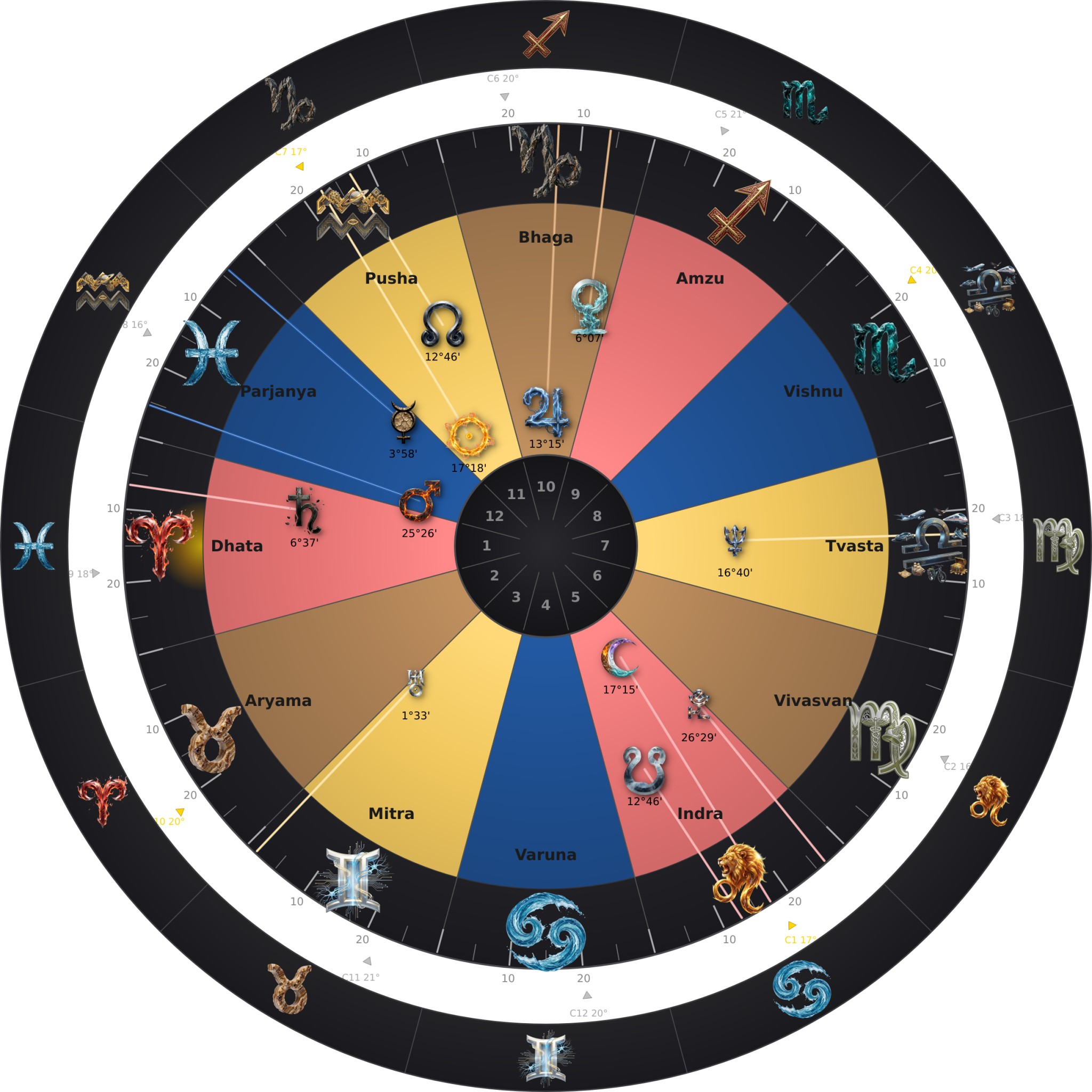
Tajika Aspects (20 within orb, 8 involve Sun/Moon)
| Pair | Aspect | Dist | Strength | Orb | Status | Relationship |
|---|---|---|---|---|---|---|
| Sun-Moon | ☍ Opposition | 0.0° | 59.9 VR (100%) | 13.5° | — | Openly Inimical |
| Ascendant-Sun | ☍ Opposition | 0.7° | 58.6 VR (98%) | 12.0° | — | Openly Inimical |
| Ascendant-Moon | ☌ Conjunction | 0.7° | 58.5 VR (98%) | 10.5° | — | Openly Inimical |
| Jupiter-Venus | ☌ Conjunction | 7.1° | 45.7 VR (76%) | 8.0° | Applying | Openly Inimical |
| Mercury-Pluto | ☍ Opposition | 7.5° | 45.0 VR (75%) | 7.5° | Separating | Neutral |
| Sun-Neptune | △ Trine | 0.6° | 44.0 VR (73%) | 11.5° | Separating | Openly Friendly |
| Ascendant-Pluto | ☌ Conjunction | 8.5° | 43.0 VR (72%) | 8.5° | — | Openly Inimical |
| Sun-Pluto | ☍ Opposition | 9.2° | 41.6 VR (69%) | 11.5° | Applying | Openly Inimical |
| Moon-Pluto | ☌ Conjunction | 9.2° | 41.6 VR (69%) | 10.0° | Applying | Openly Inimical |
| Moon-Neptune | ✶ Sextile | 0.6° | 39.2 VR (65%) | 10.0° | Separating | Secretly Friendly |
| Ascendant-Neptune | ✶ Sextile | 1.3° | 38.2 VR (64%) | 8.5° | — | Secretly Friendly |
| Mars-Uranus | ✶ Sextile | 6.1° | 34.9 VR (58%) | 8.0° | Applying | Secretly Inimical |
| Saturn-Uranus | ✶ Sextile | 5.1° | 33.2 VR (55%) | 8.5° | Separating | Secretly Friendly |
| Sun-Saturn | ✶ Sextile | 10.7° | 25.8 VR (43%) | 12.0° | Separating | Secretly Friendly |
| Jupiter-Saturn | □ Square | 6.6° | 20.5 VR (34%) | 9.0° | Separating | Secretly Inimical |
| Uranus-Pluto | □ Square | 5.1° | 19.2 VR (32%) | 8.0° | Separating | Secretly Friendly |
| Mercury-Uranus | □ Square | 2.4° | 17.0 VR (28%) | 7.5° | Separating | Secretly Inimical |
| Venus-Saturn | □ Square | 0.5° | 15.5 VR (26%) | 8.0° | Applying | Secretly Inimical |
| Jupiter-Neptune | □ Square | 3.4° | 14.4 VR (24%) | 8.5° | Applying | Secretly Inimical |
| Mercury-Venus | ✶ Sextile | 2.1° | 9.3 VR (16%) | 7.0° | Applying | Secretly Friendly |
Window: December 8, 1935 – February 8, 1936
The Hoare-Laval Pact — When Appeasement Began
On December 9, 1935, the British press broke one of the most damaging political scandals of the interwar period. British Foreign Secretary Samuel Hoare and French Prime Minister Pierre Laval had secretly negotiated a deal to end the Second Italo-Ethiopian War — by giving Mussolini most of what he wanted. Under the Hoare-Laval Pact, Italy would receive the fertile Ogaden and Tigray regions of Ethiopia plus economic dominance over the south. Ethiopia — a sovereign member of the League of Nations — would receive only a meaningless "corridor for camels" to the sea.
The public reaction in Britain was volcanic. Crowds protested. Newspapers ran furious editorials. The League of Nations, which had been created specifically to prevent exactly this kind of territorial aggression, was being betrayed by its two most powerful members. Hoare was forced to resign in disgrace on December 18. But the damage was done. Mussolini and Hitler drew the obvious conclusion: the Western democracies would not fight to defend the post-WWI order. They would talk, protest, and then cave. The Hoare-Laval Pact is widely identified by historians as the moment when appeasement became the de facto Western strategy — the same dynamic that would lead to Munich in 1938 and the outbreak of World War II.
Poison Gas Returns to the Battlefield
On December 28, 1935, Mussolini personally authorized Field Marshal Badoglio to use chemical weapons — mustard gas and phosgene — against Ethiopian forces and civilians. This was in direct violation of the 1925 Geneva Protocol, which Italy itself had signed. The gas was dropped from aircraft onto Ethiopian troops and villages, burning skin and lungs. Ethiopian soldiers, many fighting with swords and spears, had no gas masks and no concept of chemical warfare. The Red Cross documented the attacks, but the League of Nations, already discredited by the Hoare-Laval scandal, did nothing effective.
The use of gas in Ethiopia was a harbinger: the norms that had (mostly) held since WWI were being broken. If chemical weapons could be used against Africans with impunity, what other norms would fall?
The Iran Veil Ban — Eclipse Day Itself
On the exact date of the eclipse, January 8, 1936, Iran's autocratic ruler Reza Shah issued the Kashf-e hijab decree, banning all forms of Islamic veiling (hijab, chador, niqab) throughout Iran. Police were ordered to physically tear veils from women in public. Women who resisted were beaten. The decree was modeled on Ataturk's forced secularization of Turkey.
For many Iranian women — particularly in rural and religious communities — the ban was experienced as a violent assault on their identity and dignity. Many conservative women simply refused to leave their homes for years, essentially becoming prisoners in their own houses rather than appear unveiled in public. Others were publicly humiliated. The decree was enforced with particular brutality in provincial cities. The Kashf-e hijab remains one of the most contested events in modern Iranian history — cited by both secularists (as progressive modernization) and Islamists (as proof of Western-imposed cultural violence) to this day.
The Death of a King — The Abdication Crisis Begins
On January 20, 1936, King George V of the United Kingdom died at Sandringham House. His son immediately acceded as King Edward VIII. The British public mourned genuinely — George V had been a steady, dutiful presence through WWI and the Depression.
What the public did not know was that a constitutional crisis was already building behind closed doors. Edward was deeply involved with Wallis Simpson, an American divorcee — and as head of the Church of England, the King could not marry a divorced woman. The government, the Church, and the royal court all knew about the relationship and maintained a "conspiracy of silence" with the compliant British press. The crisis would explode publicly in December 1936, leading to Edward's abdication — the only voluntary abdication in British history — and the accession of his brother George VI (the future father of Queen Elizabeth II).
Edward also held troubling sympathies for Nazi Germany, which became an increasing concern for the British establishment. The intersection of personal scandal and geopolitical danger made the crisis particularly delicate.
Spain's Election — The Road to Civil War
On February 16, the Spanish general election produced a narrow victory for the left-wing Popular Front coalition. The result electrified both the Left and the Right across Spain. Conservative military officers immediately began plotting a coup. Five months later, General Francisco Franco launched his rebellion (July 17, 1936), igniting the Spanish Civil War — a three-year conflict that killed over 500,000 people, became a proxy war between fascism and democracy, and served as the military rehearsal for World War II (with German and Italian forces fighting for Franco, and Soviet advisors supporting the Republic).
Science: Discovering the Earth's Inner Structure
In a quieter but profound milestone, Danish seismologist Inge Lehmann published her discovery that the Earth has a solid inner core, derived from analysis of how seismic waves from earthquakes behave as they pass through the planet's center. This was one of the great insights in planetary science — we learned something fundamental about the structure of our own planet, invisible and unreachable 5,000 km beneath our feet.
Eclipse #23 — January 19, 1954 (Total, mag. 1.032)
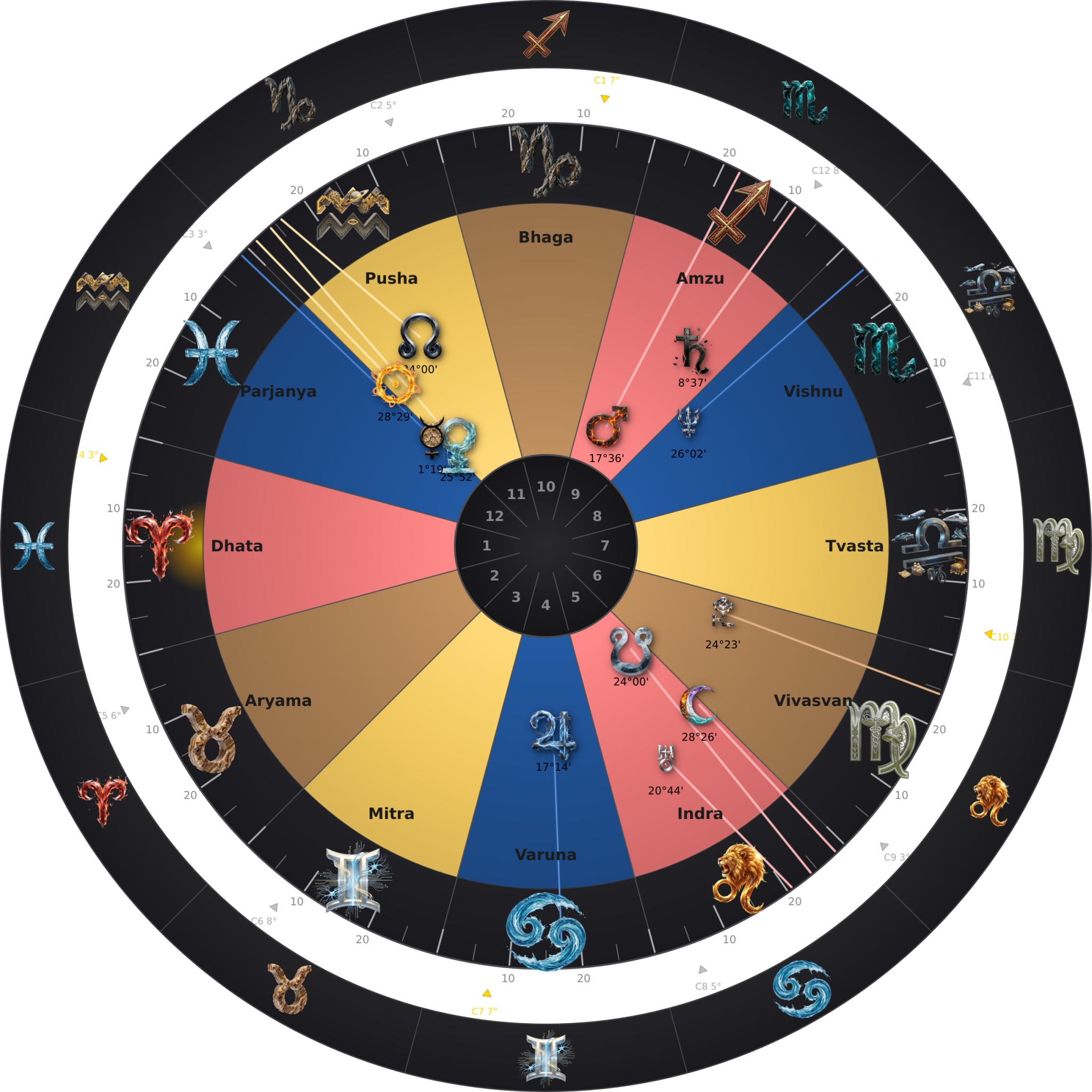
Tajika Aspects (25 within orb, 14 involve Sun/Moon)
| Pair | Aspect | Dist | Strength | Orb | Status | Relationship |
|---|---|---|---|---|---|---|
| Sun-Moon | ☍ Opposition | 0.0° | 59.9 VR (100%) | 13.5° | — | Openly Inimical |
| Moon-Venus | ☍ Opposition | 2.6° | 54.9 VR (91%) | 9.5° | Separating | Openly Inimical |
| Sun-Venus | ☌ Conjunction | 2.6° | 54.8 VR (91%) | 11.0° | Applying | Openly Inimical |
| Sun-Mercury | ☌ Conjunction | 2.8° | 54.3 VR (91%) | 11.0° | Separating | Neutral |
| Moon-Mercury | ☍ Opposition | 2.9° | 54.2 VR (90%) | 9.5° | Applying | Neutral |
| Venus-Uranus | ☍ Opposition | 5.1° | 49.7 VR (83%) | 7.5° | Separating | Openly Inimical |
| Mercury-Venus | ☌ Conjunction | 5.4° | 49.1 VR (82%) | 7.0° | Separating | Neutral |
| Moon-Uranus | ☌ Conjunction | 7.7° | 44.6 VR (74%) | 10.0° | Separating | Openly Inimical |
| Sun-Uranus | ☍ Opposition | 7.7° | 44.5 VR (74%) | 11.5° | Separating | Openly Inimical |
| Mars-Uranus | △ Trine | 3.1° | 41.9 VR (70%) | 8.0° | Applying | Openly Friendly |
| Jupiter-Pluto | ✶ Sextile | 7.1° | 34.1 VR (57%) | 8.5° | Separating | Secretly Friendly |
| Ascendant-Mercury | ✶ Sextile | 6.4° | 31.5 VR (52%) | 8.0° | — | Secretly Friendly |
| Ascendant-Moon | △ Trine | 9.2° | 31.1 VR (52%) | 10.5° | — | Neutral |
| Ascendant-Sun | ✶ Sextile | 9.2° | 27.7 VR (46%) | 12.0° | — | Neutral |
| Moon-Saturn | □ Square | 10.2° | 25.2 VR (42%) | 10.5° | Applying | Openly Friendly |
| Mercury-Neptune | □ Square | 5.3° | 20.3 VR (34%) | 7.5° | Separating | Openly Friendly |
| Uranus-Neptune | □ Square | 5.3° | 20.3 VR (34%) | 8.0° | Separating | Secretly Inimical |
| Sun-Neptune | □ Square | 2.4° | 17.4 VR (29%) | 11.5° | Separating | Secretly Inimical |
| Moon-Neptune | □ Square | 2.4° | 17.0 VR (28%) | 10.0° | Separating | Secretly Inimical |
| Venus-Neptune | □ Square | 0.2° | 15.0 VR (25%) | 7.5° | Applying | Secretly Inimical |
| Mars-Pluto | □ Square | 6.8° | 13.9 VR (23%) | 8.0° | Applying | Secretly Inimical |
| Mercury-Saturn | □ Square | 7.3° | 13.8 VR (23%) | 8.0° | Applying | Secretly Inimical |
| Sun-Saturn | □ Square | 10.1° | 13.3 VR (22%) | 12.0° | Applying | Secretly Friendly |
| Sun-Mars | ✶ Sextile | 10.9° | 11.8 VR (20%) | 11.5° | Separating | Secretly Friendly |
| Neptune-Pluto | ✶ Sextile | 1.7° | 10.3 VR (17%) | 8.0° | Separating | Secretly Friendly |
Window: December 19, 1953 – February 19, 1954
"Massive Retaliation" — The Doctrine That Could End the World
The day before the eclipse, on January 18, 1954, U.S. Secretary of State John Foster Dulles stood before the Council on Foreign Relations in New York and announced a policy that changed the logic of global conflict. The United States, he said, would henceforth respond to Soviet aggression anywhere in the world with "massive retaliatory power" — meaning nuclear weapons.
This was not a subtle diplomatic signal. Dulles was stating, in plain language, that the U.S. reserved the right to use atomic bombs in response to conventional military aggression. The doctrine reflected a Cold War calculation: maintaining conventional forces large enough to match the Soviet Union everywhere was economically unsustainable, so the U.S. would rely instead on the threat of annihilation. The world now lived under a policy that explicitly contemplated nuclear war as an instrument of statecraft. The Bulletin of the Atomic Scientists moved its Doomsday Clock forward.
USS Nautilus — The Nuclear Submarine Changes Everything
Three days after the eclipse, on January 21, the USS Nautilus — the world's first nuclear-powered submarine — was launched at the Electric Boat shipyard in Groton, Connecticut. First Lady Mamie Eisenhower smashed a bottle of champagne on the bow.
The Nautilus was not merely an improved submarine. It was an entirely new category of weapon. Conventional submarines were essentially surface ships that could submerge briefly — limited by battery power, they had to surface regularly and could be tracked. A nuclear submarine could remain submerged indefinitely, travel at high speed underwater, and (once armed with ballistic missiles) deliver nuclear warheads from undetectable positions in the ocean. The nuclear submarine made the Cold War's mutual assured destruction truly "assured" — no first strike could destroy a nation's submarine-based nuclear arsenal, guaranteeing retaliation.
The Shadow of Dien Bien Phu
In the background of these nuclear developments, the First Indochina War was reaching its climax. By January 1954, Vietnamese General Vo Nguyen Giap had secretly positioned over 200 heavy artillery pieces in the mountains surrounding the French garrison at Dien Bien Phu — a remote valley in northwestern Vietnam where the French had established a base they believed was impregnable. The siege began on March 13, 1954, and ended with France's catastrophic defeat on May 7. The fall of Dien Bien Phu ended France's colonial empire in Southeast Asia and set the stage for American involvement in Vietnam.
The U.S. was already considering intervening. Some in the Eisenhower administration — including Vice President Nixon and Admiral Radford — proposed using nuclear weapons to save the French position. The proposal was ultimately rejected, but the fact that it was seriously considered illustrates the terrifying logic of the "massive retaliation" doctrine announced just weeks earlier.
First Machine Translation — Cold War Linguistics
On January 7, IBM and Georgetown University staged the first public demonstration of machine translation — a computer translated 60 Russian sentences into English. The demonstration was explicitly framed as a Cold War tool: if the United States could automatically translate Russian scientific and military literature, it would gain a crucial intelligence advantage. The system was primitive (it used only 250 words and 6 grammar rules), but it launched the entire field of computational linguistics and natural language processing — the ancestor of every translation app and large language model used today.
Marilyn Monroe and Joe DiMaggio — America's Royal Wedding
On January 14, five days before the eclipse, Marilyn Monroe and Joe DiMaggio were married in a small civil ceremony at San Francisco City Hall. The two most famous Americans of the 1950s — Hollywood's biggest star and baseball's greatest living legend — tried to keep the wedding quiet. Over 100 journalists were waiting outside.
The marriage lasted less than a year (DiMaggio could not handle Monroe's public sexuality), but its cultural significance was enormous. Monroe and DiMaggio embodied the aspirations and contradictions of Eisenhower-era America: glamour and tradition, celebrity and privacy, female sexuality and male possessiveness.
During their honeymoon in Japan, Monroe flew to Korea to perform for 100,000 American soldiers stationed there across four days of shows in freezing cold. She came back radiant. DiMaggio was furious. The Korea trip crystallized the tension that would end the marriage: Monroe belonged to the public, not to any one man.
Eclipse #24 — January 30, 1972 (Total, mag. 1.050)
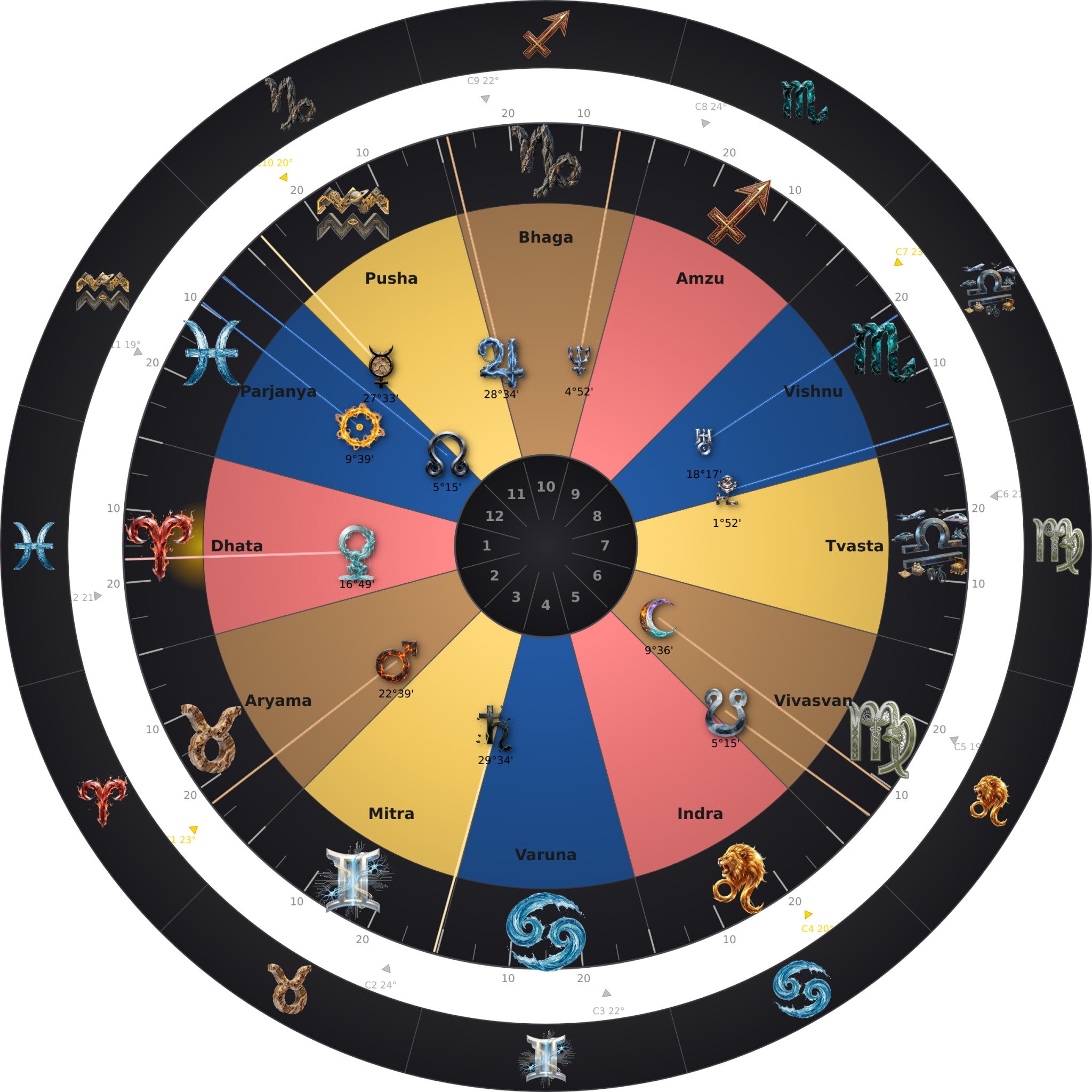
Tajika Aspects (23 within orb, 9 involve Sun/Moon)
| Pair | Aspect | Dist | Strength | Orb | Status | Relationship |
|---|---|---|---|---|---|---|
| Sun-Moon | ☍ Opposition | 0.0° | 59.9 VR (100%) | 13.5° | — | Openly Inimical |
| Ascendant-Mars | ☌ Conjunction | 1.2° | 57.5 VR (96%) | 8.5° | — | Openly Inimical |
| Mars-Uranus | ☍ Opposition | 4.4° | 51.3 VR (86%) | 8.0° | Separating | Openly Inimical |
| Saturn-Neptune | ☍ Opposition | 5.3° | 49.4 VR (82%) | 8.5° | Separating | Neutral |
| Ascendant-Uranus | ☍ Opposition | 5.6° | 48.8 VR (81%) | 8.5° | — | Openly Inimical |
| Mercury-Saturn | △ Trine | 2.0° | 42.0 VR (70%) | 8.0° | Applying | Openly Friendly |
| Saturn-Pluto | △ Trine | 2.3° | 41.6 VR (69%) | 8.5° | Applying | Neutral |
| Mercury-Pluto | △ Trine | 4.3° | 40.7 VR (68%) | 7.5° | Applying | Secretly Inimical |
| Ascendant-Jupiter | △ Trine | 4.7° | 40.3 VR (67%) | 9.0° | — | Openly Friendly |
| Moon-Neptune | △ Trine | 4.7° | 40.3 VR (67%) | 10.0° | Separating | Openly Friendly |
| Mars-Jupiter | △ Trine | 5.9° | 39.1 VR (65%) | 8.5° | Applying | Openly Friendly |
| Sun-Uranus | △ Trine | 8.6° | 36.4 VR (61%) | 11.5° | Applying | Openly Friendly |
| Sun-Saturn | △ Trine | 10.1° | 34.9 VR (58%) | 12.0° | Separating | Secretly Inimical |
| Sun-Pluto | △ Trine | 7.8° | 33.3 VR (56%) | 11.5° | Separating | Openly Friendly |
| Moon-Uranus | ✶ Sextile | 8.7° | 32.8 VR (55%) | 10.0° | Applying | Secretly Friendly |
| Moon-Pluto | ✶ Sextile | 7.7° | 29.7 VR (50%) | 10.0° | Separating | Secretly Friendly |
| Jupiter-Pluto | □ Square | 3.3° | 14.5 VR (24%) | 8.5° | Applying | Secretly Friendly |
| Ascendant-Mercury | □ Square | 3.7° | 14.4 VR (24%) | 8.0° | — | Secretly Inimical |
| Mars-Mercury | □ Square | 4.9° | 14.2 VR (24%) | 7.5° | Separating | Secretly Inimical |
| Moon-Saturn | ✶ Sextile | 10.0° | 11.7 VR (20%) | 10.5° | Separating | Secretly Inimical |
| Sun-Neptune | ✶ Sextile | 4.8° | 10.8 VR (18%) | 11.5° | Separating | Secretly Friendly |
| Neptune-Pluto | ✶ Sextile | 3.0° | 10.5 VR (18%) | 8.0° | Separating | Secretly Friendly |
| Mercury-Neptune | ✶ Sextile | 7.3° | 7.6 VR (13%) | 7.5° | Applying | Neutral |
Window: December 30, 1971 – February 29, 1972
Bloody Sunday — The Eclipse Day Massacre
On the exact date of the eclipse — January 30, 1972 — British soldiers shot fourteen unarmed people dead on a cold Sunday afternoon in Derry, Northern Ireland. To understand why, you have to go back centuries.
The Deep Roots: Plantation and Partition
The division between Catholics and Protestants in Ulster began in 1610, when the British Crown confiscated the lands of the defeated Gaelic Irish lords and settled them with English and Scottish Protestant colonists. The Plantation of Ulster was social engineering on a massive scale — the native Irish were displaced to rocky margins while Protestant settlers built fortified towns on their ancestral land. The city of Derry itself was handed to a consortium of London livery companies to develop (hence "Londonderry"). Two communities — native Irish Catholic and settler Protestant — lived side by side for centuries, separated by religion, by culture, by memory. The Catholics remembered dispossession. The Protestants remembered the 1641 massacres when Gaelic Irish turned on settler communities. Both memories were real. Both became weapons.
When Ireland was partitioned in 1920–21, six northeastern counties with a Protestant-unionist majority remained part of the United Kingdom as Northern Ireland, with a devolved parliament at Stormont. But the border was drawn to maximize territory, trapping a very large Catholic-nationalist minority inside the new state. In Derry, Catholics outnumbered Protestants nearly two to one. First Prime Minister Sir James Craig was direct: "We are a Protestant Parliament and a Protestant State."
Fifty Years as Second-Class Citizens
What followed was systematic oppression. In Derry — where Catholics were the majority — electoral boundaries were gerrymandered so that the Catholic population was packed into one enormous ward electing 8 councillors, while the Protestant minority controlled two smaller wards electing 12. A Catholic majority elected fewer representatives than a Protestant minority. This arrangement persisted for 30 years.
Housing policy enforced the gerrymander. Between 1945 and 1960, 92% of all houses allocated to Catholics in Derry went to the South Ward, regardless of need, keeping them geographically concentrated to preserve the electoral arithmetic. Catholic families lived in chronic overcrowding in the Bogside — a district of damp 19th-century terraces with shared outdoor toilets, families of ten in two-bedroom houses, children sleeping three to a bed. Protestant families on shorter waiting lists got houses first. It was systematic and brazen.
Employment was equally rigged. At Belfast's Harland & Wolff shipyard (where the Titanic was built), 95% of 10,000 workers were Protestant. In Derry, where 60% of the population was Catholic, Catholics held only 30% of public jobs. Overall, Catholics were 40% of Northern Ireland's population but over 60% of the unemployed.
The security apparatus completed the system. The Royal Ulster Constabulary (RUC) was an overwhelmingly Protestant police force (88% Protestant by the 1960s). Alongside it operated the B-Specials — an armed, Protestant-only auxiliary force recruited heavily from the Orange Order, described by a government commission as "a partisan and paramilitary force." The Special Powers Act allowed internment without trial, banning of organizations, and suspension of civil liberties at will. A visiting South African ANC lawyer reportedly said the Pretoria government would "willingly exchange all its legislation for one clause" of the Special Powers Act.
The Civil Rights Movement (1967–1969)
By the mid-1960s, Catholics in Northern Ireland were watching the American civil rights movement — Martin Luther King, Selma, Birmingham — and recognizing their own story. The Northern Ireland Civil Rights Association (NICRA) was formed on January 29, 1967, with demands that were moderate to the point of mundanity: one man one vote, an end to gerrymandering, fair housing allocation, disbandment of the B-Specials. As activist Bernadette Devlin said: "We were not asking for anything that any British citizen in Britain took for granted. We just wanted to be treated like human beings."
On October 5, 1968, a civil rights march in Derry changed everything. When marchers encountered an RUC cordon, officers waded into the crowd with batons — not making arrests, simply beating people. Westminster MP Gerry Fitt was struck on the head and bled openly. Television cameras captured it all. The footage broadcast internationally that evening — peaceful marchers clubbed by police — transformed the Northern Ireland civil rights movement from an obscure local dispute into a global story overnight.
The Army Arrives — Then Turns Hostile (1969–1971)
By August 1969, after the Battle of the Bogside (51 hours of street fighting between residents and the RUC), British troops were deployed. In a surreal scene, Catholic women brought cups of tea to the soldiers. The army was not the RUC, not the B-Specials — and the people of the Bogside, however paradoxically, trusted British regulars more than their own state's police.
The trust lasted roughly a year. In July 1970, the army sealed off the Lower Falls Road in Belfast for 34 hours — the Falls Road Curfew — conducting house-to-house searches that destroyed furniture, ransacked homes, and killed four civilians. Families who had welcomed the soldiers in 1969 watched their homes trashed and their neighbors shot. The conclusion was obvious: the army was not a neutral force. It was an army of occupation. IRA recruitment soared.
Internment Without Trial (August 9, 1971)
On the morning of August 9, 1971, at 4:17 AM, the army launched Operation Demetrius — simultaneous raids across Catholic areas. Over 340 men were dragged from their beds, uncharged, untried, and imprisoned. The intelligence was catastrophic: many arrested had no IRA connection; many actual IRA members weren't on the lists. Not a single Protestant or loyalist was arrested, despite loyalist paramilitaries killing people throughout 1971.
Fourteen detainees were selected for "deep interrogation" — forced into stress positions for days, hooded with black bags, subjected to continuous white noise, deprived of sleep, food, and water, and thrown from helicopters (low-hovering, but the hooded men couldn't know that). One later said: "They asked me to count to ten. I refused, in case I couldn't do it." The European Court of Human Rights ruled the treatment "inhuman and degrading." In 2021, the UK Supreme Court found it had constituted torture all along.
Internment radicalized the Catholic community more than any single act. Young men who had watched their fathers dragged away at 4 AM didn't join the civil rights movement. They joined the IRA.
The Ballymurphy Massacre — A Rehearsal (August 9–11, 1971)
During the same Operation Demetrius raids, the unit conducting operations in the Ballymurphy district of Belfast was the 1st Battalion, Parachute Regiment — "1 Para." Over three days, soldiers of 1 Para killed 11 civilians. Father Hugh Mullan, a Catholic priest, was shot while waving a white cloth as he went to help a wounded man. Joan Connolly, mother of eight, was shot repeatedly — in the legs and then in the face — while going to aid a dying 19-year-old. In 2021, a Coroner's Inquest found all the civilians were innocent and the use of lethal force "not justified."
This was the regiment that would be sent to Derry five and a half months later.
The Decision to Send the Paratroopers
On January 7, 1972, Major General Robert Ford, Commander of Land Forces in Northern Ireland, wrote a memo proposing to "shoot selected ringleaders" among stone-throwing teenagers in Derry. The local Derry commander, Brigadier MacLellan, had planned to use local troops who knew the community. Ford overruled him and chose the Parachute Regiment — knowing, as the Saville Inquiry later found, that 1 Para had "a reputation for using excessive physical violence." Ford had watched them at Ballymurphy. He had watched them beat protesters at Magilligan Strand eight days earlier.
The Saville Report concluded that Ford's "decision to use 1 Para as the arrest force is open to criticism." The judicial language is measured. The implication is not.
January 30, 1972 — The Day Itself
Tens of thousands came to Derry that morning — by bus, by car, on foot. They came because they were angry about internment, angry about fifty years of discrimination. Families walked together. Children sat on shoulders. The IRA had told its volunteers to stay away — they didn't want armed men near a civilian march.
Among those who came were 17-year-old Jackie Duddy, a keen boxer who worked in a local factory, and 17-year-old Michael Kelly, training as a sewing machine mechanic. They had no idea they were marching toward their deaths.
At approximately 4:07 PM, 1 Para moved. Armored vehicles drove fast into the crowd in the Rossville Flats area. Soldiers jumped out and began chasing people. Within minutes, live rounds were being fired.
In twenty-six minutes, fourteen people were shot dead or fatally wounded. None was armed. None posed any threat.
Jackie Duddy, seventeen, was shot in the back while running away. Father Edward Daly — later Bishop of Derry — crouched over him as he lay dying. The photograph of Father Daly waving a blood-stained white handkerchief, a young man's body being carried behind him, became one of the defining images of the Troubles.
Bernard McGuigan, forty-one, father of six, saw Patrick Doherty lying wounded in the open and could not stand by. He walked out waving a white handkerchief, offering himself as clearly non-threatening as a man can make himself. He was shot in the back of the head.
James Wray, twenty-two, was shot twice. The Saville Inquiry found he had been wounded by the first shot and was lying on the ground, no threat to anyone, when he was shot a second time.
The soldiers claimed they had been fired upon first. This was a lie. The Widgery Tribunal, hastily convened, largely exonerated the army — a whitewash that deepened the wound for 38 years.
The Aftermath — 38 Years for the Truth
IRA recruitment surged beyond anything the organization had previously achieved. Young men and women who had marched for civil rights, who had believed peaceful change was possible, who had seen their friends killed on a Sunday afternoon while carrying nothing but their anger — they joined. Within three days, the British Embassy in Dublin was burned to the ground by 30,000 marchers (February 2). The Troubles escalated into a full-scale armed conflict lasting 26 years and killing over 3,500 people.
It took until June 15, 2010 — 38 years — for the truth to be officially acknowledged. When Prime Minister David Cameron stood in the House of Commons and read the findings of the Saville Inquiry — that the killings were "unjustified and unjustifiable," that the victims were innocent, that the soldiers had lied — survivors and families watched from the public gallery. Some wept. Some could not speak.
Outside the Guildhall in Derry, 40,000 people had gathered to hear the findings on screens. When Cameron spoke those words, there was silence — then the square erupted. People embraced strangers. Old men who had waited 38 years stood with their fists raised, or fell into each other's arms.
They had been waiting for those words since they were young.
Nixon Goes to China — The Cold War Realigns
Three weeks after Bloody Sunday, on February 21–28, President Richard Nixon made the most dramatic diplomatic journey of the Cold War: the first visit by a U.S. President to the People's Republic of China.
For 23 years, the United States had refused to recognize the government that controlled a quarter of the world's population. Nixon — who had built his career as a fierce anti-communist — flew to Beijing and met with Mao Zedong, the man Americans had been taught to fear. The irony was not lost on anyone: "Only Nixon could go to China" became a political axiom.
The visit was choreographed for maximum visual impact. Nixon and Mao shook hands; Nixon toasted Zhou Enlai; the leaders walked the Great Wall. On February 27, Nixon and Zhou signed the Shanghai Communique, which acknowledged that "there is but one China and Taiwan is a part of China" while committing both nations to seek "normalization of relations."
The geopolitical implications were profound. By opening relations with China, Nixon created a triangular dynamic between Washington, Moscow, and Beijing that gave the U.S. leverage over both communist powers. The Soviet Union, suddenly facing the possibility of a U.S.-China alignment, became more willing to negotiate arms control (SALT I was signed in May 1972). The opening to China is widely considered one of the most consequential diplomatic moves of the 20th century.
The Iran Blizzard — The Deadliest in Human History
Between February 3 and 9, a catastrophic blizzard struck rural Iran. Snow fell for a solid week. Drifts reached 8 meters deep. Temperatures plummeted to -25°C with winds howling at 177 km/h. In remote mountain villages, people were buried alive in their homes. Entire communities — every man, woman, and child — perished under the snow.
Over 4,000 people died, making it the deadliest blizzard in recorded human history. The remoteness of the affected areas meant that rescue was slow and many deaths were not discovered for weeks. Entire villages were found completely buried, their inhabitants frozen in place. The blizzard received minimal international attention — it was overshadowed by the political dramas of Bloody Sunday and Nixon's China trip — but in terms of human suffering, it was the most devastating natural disaster of the entire Saros 133 series.
The Birth of Bangladesh
The eclipse window also followed one of the 20th century's worst atrocities. In December 1971 — just weeks before the eclipse — Bangladesh had won independence from Pakistan after a nine-month liberation war in which the Pakistani military committed systematic mass murder. Estimates of the death toll range from 300,000 to 3,000,000, with widespread rape used as a weapon of war. On January 19, Sheikh Mujibur Rahman was inaugurated as the first President of the new nation.
In response to its military humiliation, Pakistan under Prime Minister Zulfikar Ali Bhutto secretly convened a meeting of nuclear scientists in late January 1972, launching what would become Pakistan's nuclear weapons program. The birth of a nation and the birth of a nuclear arsenal happened within the same month.
Technology: The Slide Rule Dies, the Space Shuttle Is Born
On January 4, Hewlett-Packard introduced the HP-35 — the world's first hand-held scientific calculator. At $395 (roughly $2,900 in 2026 dollars), it was expensive, but it rendered the slide rule obsolete overnight. Engineers and scientists who had used slide rules for centuries threw them away within a year. The democratization of computation had taken another step.
The next day, January 5, Nixon announced that the United States would develop the Space Shuttle — committing the nation to a reusable spacecraft program that would define American space policy for the next four decades. The decision represented a compromise between NASA's ambitions and fiscal reality: the grand plans for Mars missions and space stations were shelved in favor of a "space truck" that could carry payloads to orbit and return.
Eclipse #25 — February 9, 1990 (Total, mag. 1.075)
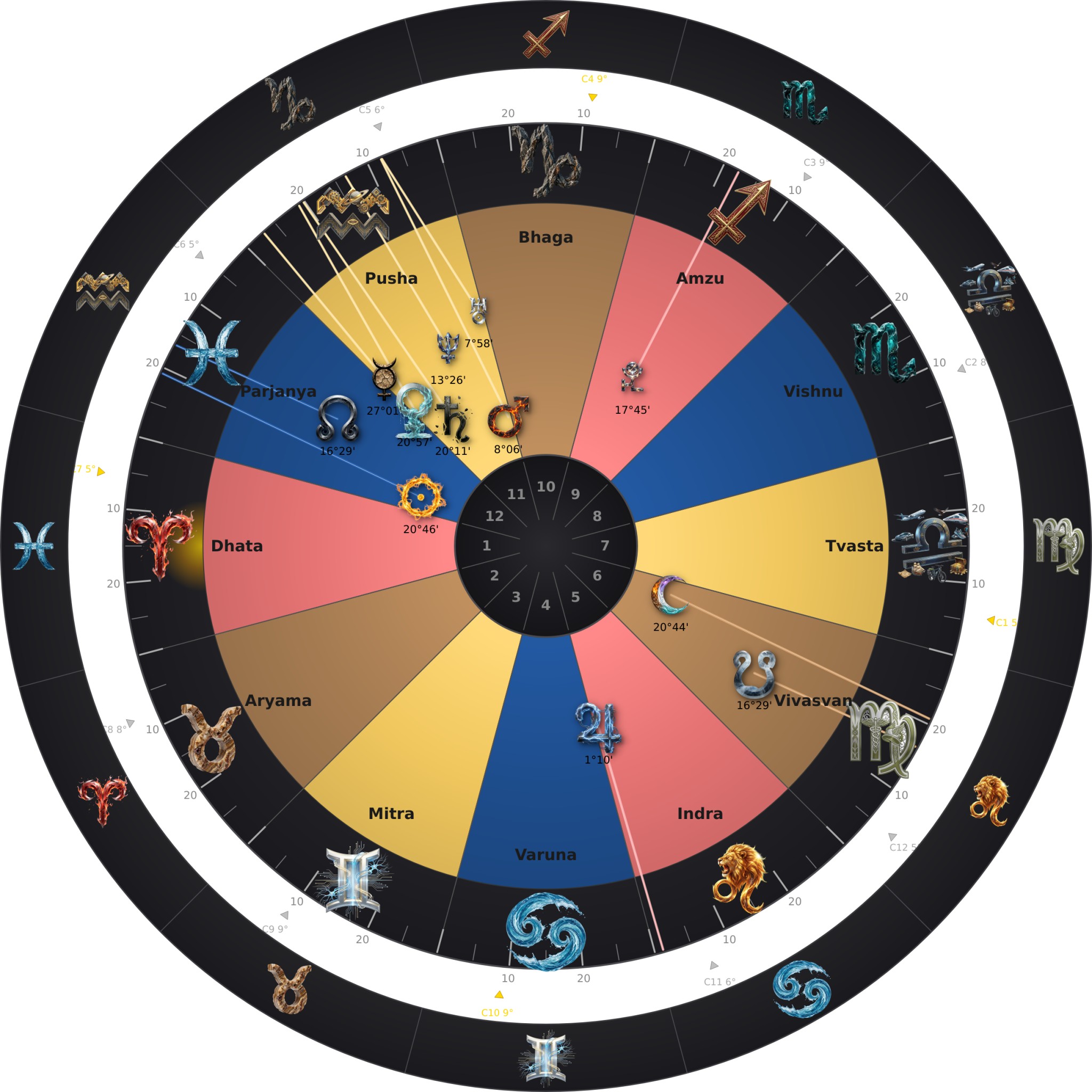
Tajika Aspects (21 within orb, 5 involve Sun/Moon)
| Pair | Aspect | Dist | Strength | Orb | Status | Relationship |
|---|---|---|---|---|---|---|
| Sun-Moon | ☍ Opposition | 0.0° | 59.9 VR (100%) | 13.5° | — | Openly Inimical |
| Mars-Uranus | ☌ Conjunction | 0.1° | 59.7 VR (100%) | 8.0° | Separating | Openly Inimical |
| Venus-Saturn | ☌ Conjunction | 0.8° | 58.5 VR (97%) | 8.0° | Applying | Openly Inimical |
| Mars-Neptune | ☌ Conjunction | 5.3° | 49.3 VR (82%) | 8.0° | Applying | Openly Inimical |
| Uranus-Neptune | ☌ Conjunction | 5.5° | 49.0 VR (82%) | 8.0° | Applying | Openly Inimical |
| Mercury-Venus | ☌ Conjunction | 6.1° | 47.9 VR (80%) | 7.0° | Separating | Openly Inimical |
| Saturn-Neptune | ☌ Conjunction | 6.7° | 46.5 VR (78%) | 8.5° | Separating | Openly Inimical |
| Jupiter-Uranus | ☍ Opposition | 6.8° | 46.4 VR (77%) | 8.5° | Separating | Openly Inimical |
| Mercury-Saturn | ☌ Conjunction | 6.8° | 46.3 VR (77%) | 8.0° | Separating | Openly Inimical |
| Mars-Jupiter | ☍ Opposition | 6.9° | 46.2 VR (77%) | 8.5° | Separating | Openly Inimical |
| Ascendant-Uranus | △ Trine | 2.4° | 41.4 VR (69%) | 8.5° | — | Openly Friendly |
| Ascendant-Mars | △ Trine | 2.5° | 41.2 VR (69%) | 8.5° | — | Openly Friendly |
| Ascendant-Neptune | △ Trine | 7.9° | 33.2 VR (55%) | 8.5° | — | Openly Friendly |
| Sun-Jupiter | △ Trine | 10.4° | 29.4 VR (49%) | 12.0° | Applying | Neutral |
| Sun-Pluto | □ Square | 3.0° | 18.0 VR (30%) | 11.5° | Separating | Secretly Inimical |
| Moon-Pluto | □ Square | 3.0° | 17.5 VR (29%) | 10.0° | Separating | Secretly Inimical |
| Ascendant-Jupiter | ✶ Sextile | 4.4° | 10.7 VR (18%) | 9.0° | — | Secretly Friendly |
| Venus-Pluto | ✶ Sextile | 3.2° | 10.5 VR (18%) | 7.5° | Separating | Secretly Friendly |
| Saturn-Pluto | ✶ Sextile | 2.4° | 10.4 VR (17%) | 8.5° | Separating | Secretly Friendly |
| Neptune-Pluto | ✶ Sextile | 4.3° | 8.6 VR (14%) | 8.0° | Applying | Secretly Friendly |
| Moon-Jupiter | ✶ Sextile | 10.4° | 6.5 VR (11%) | 10.5° | Applying | Neutral |
Window: January 9 – March 9, 1990
Three months after the Berlin Wall fell (November 9, 1989). The Cold War order is dissolving in real time.
Nelson Mandela Walks Free
Two days after the eclipse, on February 11, 1990, at 4:14 PM South African time, Nelson Mandela walked out of Victor Verster Prison after 27 years of imprisonment. He was 71 years old. His hair was gray; the world had changed beyond recognition since he had been jailed in 1964. But his step was steady and his fist was raised.
The moment was broadcast live to a global audience estimated at 600 million people. In South Africa, people danced in the streets. In townships that had been under brutal police repression for decades, there was both euphoria and disbelief — many had believed this day would never come.
The release had been set up nine days earlier, on February 2, when President F.W. de Klerk delivered a speech at the state opening of parliament that stunned the nation. De Klerk — a lifelong member of the ruling National Party, the party that had invented apartheid — announced the lifting of the ban on the African National Congress, the Pan-African Congress, and the South African Communist Party. He promised Mandela's unconditional release. He committed to negotiations toward a new constitutional order.
De Klerk explicitly cited the collapse of Soviet communism as a key factor in his decision. For decades, the apartheid government had justified its repression by claiming that the ANC was a front for Soviet communism. With the Soviet Union disintegrating, that justification evaporated. The Cold War had kept Mandela in prison; its end set him free.
Germany Reunification — Gorbachev Says Yes
On February 10–11 — the same weekend Mandela was released — West German Chancellor Helmut Kohl flew to Moscow for a meeting with Soviet leader Mikhail Gorbachev. What Gorbachev said at that meeting changed the map of Europe: the Soviet Union was "ready to respect the right of Germans to decide if they wanted to live in a single state."
This was the green light for German reunification. The Berlin Wall had fallen three months earlier, but the question of whether the two Germanys could actually merge — and whether the Soviet Union would allow its most strategically important satellite state to simply walk away — had been uncertain. Gorbachev's statement removed the final obstacle. By October 3, 1990, Germany was officially reunified. The Cold War's most visible wound was healed.
Lithuania — The First Domino
On February 24, Lithuania held its first free multiparty elections since 1918. The pro-independence Sajudis movement won 91 seats out of 141, an overwhelming mandate. On March 11 — just outside the 1-month window but a direct consequence of the February vote — Lithuania declared independence from the Soviet Union, becoming the first Soviet republic to do so.
The Lithuanian declaration triggered a chain reaction. Over the next 18 months, every Soviet republic would follow. The Soviet Union itself would cease to exist on December 26, 1991. The February 1990 election in Lithuania was the first domino in the cascade that ended the greatest geopolitical entity of the 20th century.
The Pale Blue Dot — Humanity Sees Itself
On February 14, five days after the eclipse, NASA's Voyager 1 spacecraft — now 6 billion kilometers from Earth, far beyond the orbit of Pluto — turned its cameras back toward the inner solar system for a final time. At the urging of astronomer Carl Sagan, it took a "family portrait" of the solar system. In one frame, Earth appeared as a tiny pale blue speck — a fraction of a single pixel, suspended in a sunbeam.
Sagan later wrote about the photograph with words that have become some of the most quoted in the history of science:
"Look again at that dot. That's here. That's home. That's us. On it everyone you love, everyone you know, everyone you ever heard of, every human being who ever was, lived out their lives... on a mote of dust suspended in a sunbeam."
The Pale Blue Dot photograph was taken in the same week that Mandela walked free and Gorbachev agreed to German reunification. In the context of a world undergoing its most rapid geopolitical transformation since 1945, Voyager's image offered a perspective that transcended politics entirely: from far enough away, all of human history — every war, every revolution, every eclipse — is invisible.
Eclipse #26 — February 21, 2008 (Total, mag. 1.106)
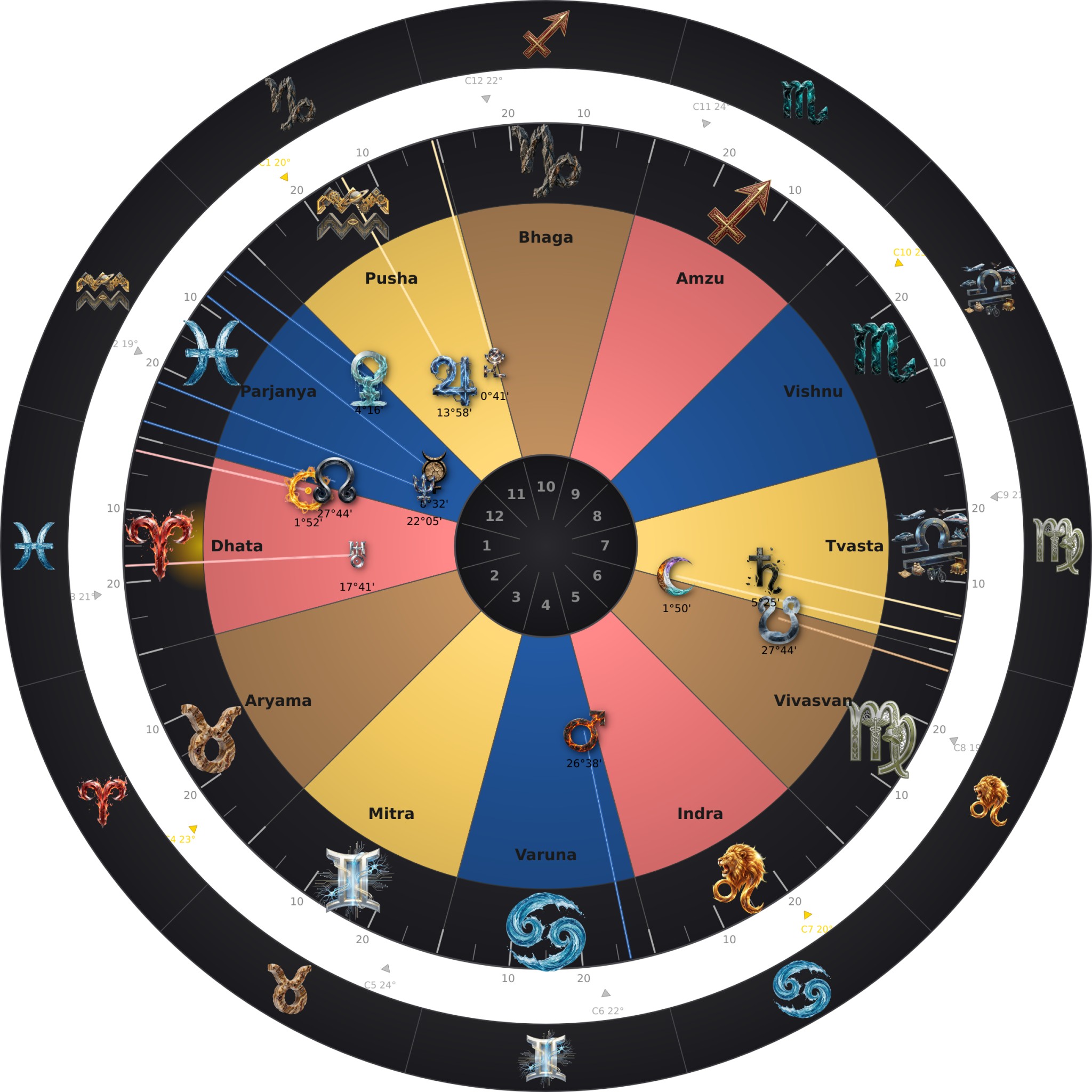
Tajika Aspects (17 within orb, 9 involve Sun/Moon)
| Pair | Aspect | Dist | Strength | Orb | Status | Relationship |
|---|---|---|---|---|---|---|
| Sun-Moon | ☍ Opposition | 0.0° | 59.9 VR (100%) | 13.5° | — | Openly Inimical |
| Sun-Saturn | ☍ Opposition | 3.6° | 52.9 VR (88%) | 12.0° | Applying | Openly Inimical |
| Moon-Saturn | ☌ Conjunction | 3.6° | 52.8 VR (88%) | 10.5° | Applying | Openly Inimical |
| Mars-Pluto | ☍ Opposition | 4.1° | 51.9 VR (86%) | 8.0° | Applying | Neutral |
| Mercury-Venus | ☌ Conjunction | 4.3° | 51.5 VR (86%) | 7.0° | Applying | Openly Inimical |
| Ascendant-Jupiter | ☌ Conjunction | 6.3° | 47.4 VR (79%) | 9.0° | — | Openly Inimical |
| Moon-Pluto | △ Trine | 1.1° | 43.9 VR (73%) | 10.0° | Separating | Openly Friendly |
| Moon-Neptune | ☍ Opposition | 9.7° | 40.5 VR (68%) | 10.0° | Separating | Neutral |
| Sun-Neptune | ☌ Conjunction | 9.8° | 40.4 VR (67%) | 11.5° | Separating | Neutral |
| Saturn-Pluto | △ Trine | 4.7° | 40.3 VR (67%) | 8.5° | Applying | Openly Friendly |
| Sun-Mars | △ Trine | 5.2° | 39.8 VR (66%) | 11.5° | Separating | Secretly Inimical |
| Mars-Neptune | △ Trine | 4.5° | 38.2 VR (64%) | 8.0° | Separating | Openly Friendly |
| Jupiter-Uranus | ✶ Sextile | 3.7° | 36.9 VR (62%) | 8.5° | Applying | Secretly Friendly |
| Ascendant-Uranus | ✶ Sextile | 2.6° | 36.5 VR (61%) | 8.5° | — | Secretly Friendly |
| Jupiter-Saturn | △ Trine | 8.6° | 32.2 VR (54%) | 9.0° | Separating | Openly Friendly |
| Moon-Mars | ✶ Sextile | 5.2° | 10.9 VR (18%) | 10.0° | Separating | Secretly Inimical |
| Sun-Pluto | ✶ Sextile | 1.2° | 10.2 VR (17%) | 11.5° | Separating | Secretly Friendly |
Window: January 21 – March 21, 2008
Kosovo Declares Independence — Europe's Newest Fault Line
On February 17, four days before the eclipse, the parliament of Kosovo declared independence from Serbia, creating the newest nation in Europe. The declaration was the culmination of nearly a decade of international administration following the 1999 NATO bombing of Serbia (which stopped Slobodan Milosevic's ethnic cleansing of Kosovo Albanians).
For Kosovars — 90% ethnic Albanian — independence was a moment of delirious celebration. Pristina erupted in fireworks and flag-waving. For Serbs, Kosovo was the cradle of their national identity — the site of the 1389 Battle of Kosovo Polje, where Serbia's medieval kingdom fell to the Ottoman Empire. Losing Kosovo was like losing their national soul.
The geopolitical fallout was immediate. The United States, Britain, France, and Germany recognized Kosovo within days. Russia furiously refused, calling the declaration illegal and warning that it set a "dangerous precedent." Serbia recalled ambassadors. The Kosovo precedent was later explicitly invoked by Russia to justify its recognition of South Ossetia and Abkhazia (August 2008) and, more consequentially, its annexation of Crimea (2014). The February 2008 Kosovo declaration thus drew a direct line to the Russia-West confrontation that defined the following two decades of geopolitics.
Castro Steps Down — The End of the Cold War's Longest Chapter
On February 19, two days before the eclipse, Fidel Castro announced his resignation as President of Cuba. He was 81, in declining health, and had already handed day-to-day power to his brother Raul in 2006. But the formal announcement was still a shock: Castro had ruled Cuba since 1959 — 49 years, through the Bay of Pigs, the Missile Crisis, the collapse of the Soviet Union, and the tenures of 10 American presidents.
For Cuban exiles in Miami, it was a moment of mixed emotions — many had waited decades for this news, but Castro was leaving on his own terms, not in defeat. For Cubans on the island, the change was less dramatic: the system continued under Raul. But symbolically, the resignation closed the Cold War's longest-running chapter. The revolutionary who had defied the United States for half a century was finally, voluntarily, stepping aside.
Obama vs. Clinton — The Historic Race
On February 5 — Super Tuesday — 22 states voted simultaneously in the largest single-day primary contest in American history. The Democratic race between Barack Obama and Hillary Clinton was unlike anything in American politics: for the first time, the two frontrunners for a major party's nomination were a Black man and a woman. The race was not about policy — their platforms were nearly identical — but about identity, history, and what America was ready for.
Super Tuesday ended in a near-tie (Obama won 13 states, Clinton won 9 including California), which meant the race would continue for months. Obama's eventual victory and election as the 44th President in November 2008 was a transformative cultural moment — but in February, the outcome was uncertain, and the intensity of the contest reflected a nation wrestling with its own history.
China's Winter of Paralysis
Between January 25 and February 6, a series of catastrophic ice storms struck southern and central China during Chunyun — the Lunar New Year mass migration, when hundreds of millions of Chinese citizens travel home for the holiday. It was the worst winter weather China had experienced in 50 years.
The storms created a cascading infrastructure collapse. Railway lines froze. Power lines snapped under the weight of ice. The electrical grid in multiple provinces failed, plunging millions into darkness in freezing temperatures. At Guangzhou Railway Station alone, 500,000 to 800,000 people were stranded simultaneously — sleeping on floors, waiting in the cold for trains that weren't coming. In total, 6 million railway passengers were stranded. 129 people died from cold, accidents, and the collapse of buildings under ice loads. The economic damage exceeded $22.3 billion.
For the Chinese government, the crisis was a test of its ability to manage a modern industrial state. The response was mixed — the military was mobilized effectively, but the cascading failures revealed the fragility of infrastructure that had been built for rapid growth rather than resilience.
The Seeds of the Great Recession
In January and February 2008, most people had no idea that the global financial system was on the brink of the worst economic crisis since the Great Depression. But the warning signs were everywhere for those who could read them. The U.S. subprime mortgage crisis, which had been building since 2006, was entering its acute phase. Banks were writing down billions in losses on mortgage-backed securities. Bear Stearns hedge funds had already collapsed in June 2007. The Federal Reserve was making emergency interest rate cuts.
In March 2008 — just after the eclipse window — Bear Stearns would be rescued in a forced sale to JP Morgan. In September, Lehman Brothers would collapse, triggering a global panic that wiped out $10 trillion in market value and pushed the world economy into recession. The February 2008 eclipse sat in the eye of the storm — the moment between the first cracks and the full collapse.
Heath Ledger and the Brightest Flash in the Universe
On January 22, actor Heath Ledger was found dead in his New York apartment at age 28, from an accidental overdose of prescription medications. He had just completed filming The Dark Knight, in which his performance as the Joker would be universally acclaimed as one of the greatest villainous performances in cinema history. He was posthumously awarded the Academy Award for Best Supporting Actor. His death — young, sudden, at the height of creative brilliance — became a symbol of the human cost of the celebrity-pharmaceutical complex.
In a cosmic counterpoint, on March 19, astronomers recorded GRB 080319B — a gamma-ray burst from 7.5 billion light-years away that was so extraordinarily powerful it was briefly visible to the naked eye. This was the intrinsically brightest event ever observed in the known universe at that time — a dying star producing more energy in seconds than the Sun will emit in its entire 10-billion-year lifetime. For about 30 seconds, the most distant object ever visible without a telescope shone in Earth's sky.