The Solar Zodiac of Adityas: A Revolution in Self-Knowledge
Discover the oldest and deepest astrological system ever recovered - a zodiac that begins 30° before conventional Aries and reveals the 12 divine laws governing your essential nature.
Beyond Signs: Who Are You Really?
Have you ever felt that your astrological sign doesn't tell the whole story? If you've felt that conventional descriptions of your sun sign only capture one facet of your personality, you're touching on an ancient truth.
Behind the zodiac we all know lies a deeper, more original layer of wisdom: the Solar Zodiac of Adityas. This is a system that connects us to the fundamental archetypes governing creation.
A Revolution That Changes Everything
Imagine discovering that your astrological sign has hidden chapters that explain everything - dimensions you've always felt but never been able to name. The Adityas Zodiac works so well it can create shock, like discovering color after always seeing in black and white.
Clear Physical Evidence:
-
Body and Physical Traits: Observe how body parts and physical characteristics align perfectly with your dominant Aditya
-
Clarified Elements: See how fire, earth, air, water reveal their true patterns
-
Crystalline Logic: The house system works with clarity you can immediately verify
Begin Your Journey Immediately
To explore your inner sky with the Adityas Zodiac, use our specialized calculator:
Discover Your Aditya Nature
How to Use the Adityas Calculator
Our specialized calculator integrates Aditya calculations to reveal the positions of your planets at birth:
Required Information:
-
Exact birth date: Day, month and year
-
Birth location: City and country
-
Birth time: If possible, check your official birth certificate
Important Advice:
The birth time is crucial for determining your Aditya Ascendant. If you're unsure, try to remember whether it was day or night, and what events surrounded your birth.
What You'll Discover with the Aditya System
Once your Aditya chart is generated, you can explore:
-
Your dominant Aditya: The solar facet influencing your deep nature, determined by the number of planets (also called Stellium in classical astrology). The more planets you have in an Aditya, the more this Aditya will reflect your behavior and what you manifest in your life. For example, if you have many planets in Varuna, you're a person connected to intuition, especially if the Moon is present in this Sign. We must remember that some planets don't like being in certain Signs, like Saturn, Mercury or Venus.
-
Your associated Rishi: The cosmic law you've come to master in this life
-
Your Aditya Ascendant: How you present yourself to the world according to this system
-
Secondary positions: How each Aditya-Rsi pair influences different aspects of your life
Aditya-Specific Interpretations
The calculator will provide interpretations based on:
-
Colors and Elements: How the colors and elements of your Adityas influence your energy
-
Body Correlations: Which parts of your body are particularly sensitive or developed
-
Laws of the Rishis: Which cosmic laws you've come to master
-
Love Archetypes: How you express and receive love according to the Adityas
Understanding Your Aditya Chart
The Adityas Zodiac offers a unique perspective on your essential nature. Unlike conventional systems, it reveals:
-
Deep causes of your behavioral patterns through the laws of the Rishis
-
Your soul mission manifested by your dominant Aditya
-
Your natural gifts revealed by the love facets of the Adityas
-
Your evolutionary challenges indicated by the laws to be mastered
To begin:
Use the calculator below to generate your Aditya chart. Then explore the 12 Aditya-Rsi pairs described earlier to understand how these archetypes manifest in your life. Pay special attention to physical correlations and behavioral patterns that confirm the system's accuracy.
 My Saved Charts
Example with Morgan Freeman
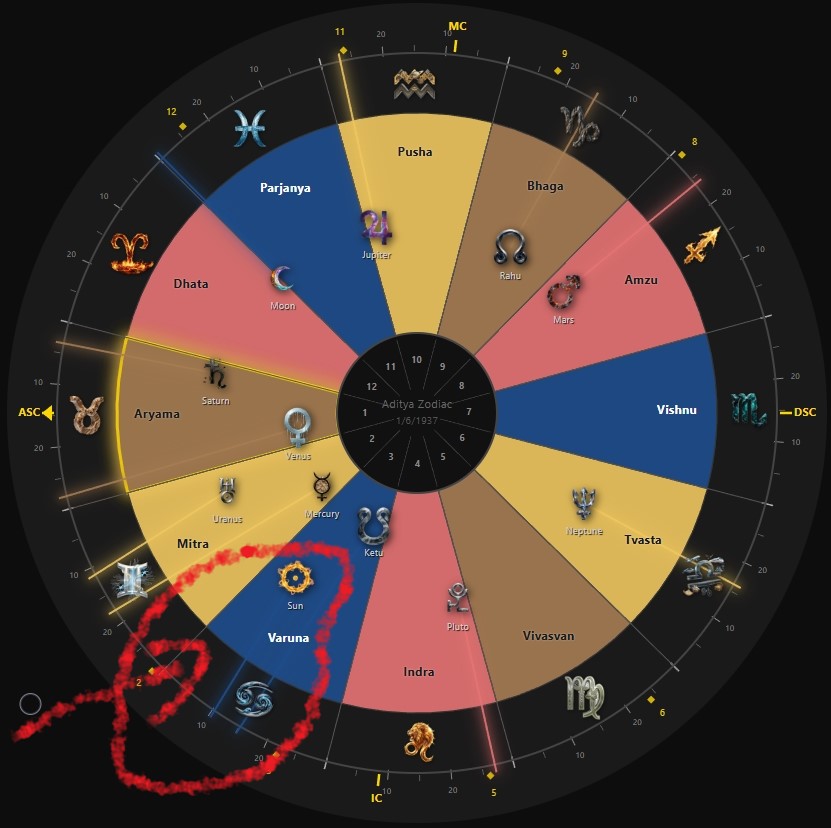
In the image above, you can see that Morgan Freeman's chart has the Sun in Varuna Aditya, which corresponds to Cancer in this new zodiac system. In the classic Tropical zodiac, he would have the Sun in Gemini. You can also see that the Moon is in Parjanya Aditya, which is the equivalent of Pisces.
Morgan Freeman would therefore have a Sun in Cancer, which represents a much more spiritual side. In one of his films, he plays God in "Bruce Almighty," which corresponds exactly to Cancer. If we then read the Varuna Aditya, it will allow us to understand a new perspective. Because we have often associated Cancer with another part of the Zodiac (the next 30°). If we read the description of Varuna, we will see that the spiritual side in the description stands out much more. Varuna is also described as someone who can be happy anywhere; in one of his films, he is happy even in prison (The Shawshank Redemption). Varuna is also often linked to rapid learning or technologies (like classic Gemini), and we often see him in films related to technology. The difference between Gemini and Varuna is that Varuna's learning comes from his ability to adapt quickly, like a child who learns fast. See the Moon section.
He also has the Moon in Parjanya. Often, actors will have placements in this Sign because it is the equivalent of Pisces. Pisces is linked to the imaginary, so films or animated drawings. I have often seen people with placements in Aquarius (classic zodiac) who love Marvels, for example, or anything that touches the imaginary. They are also sometimes teachers because this Sign is linked to Jupiter.
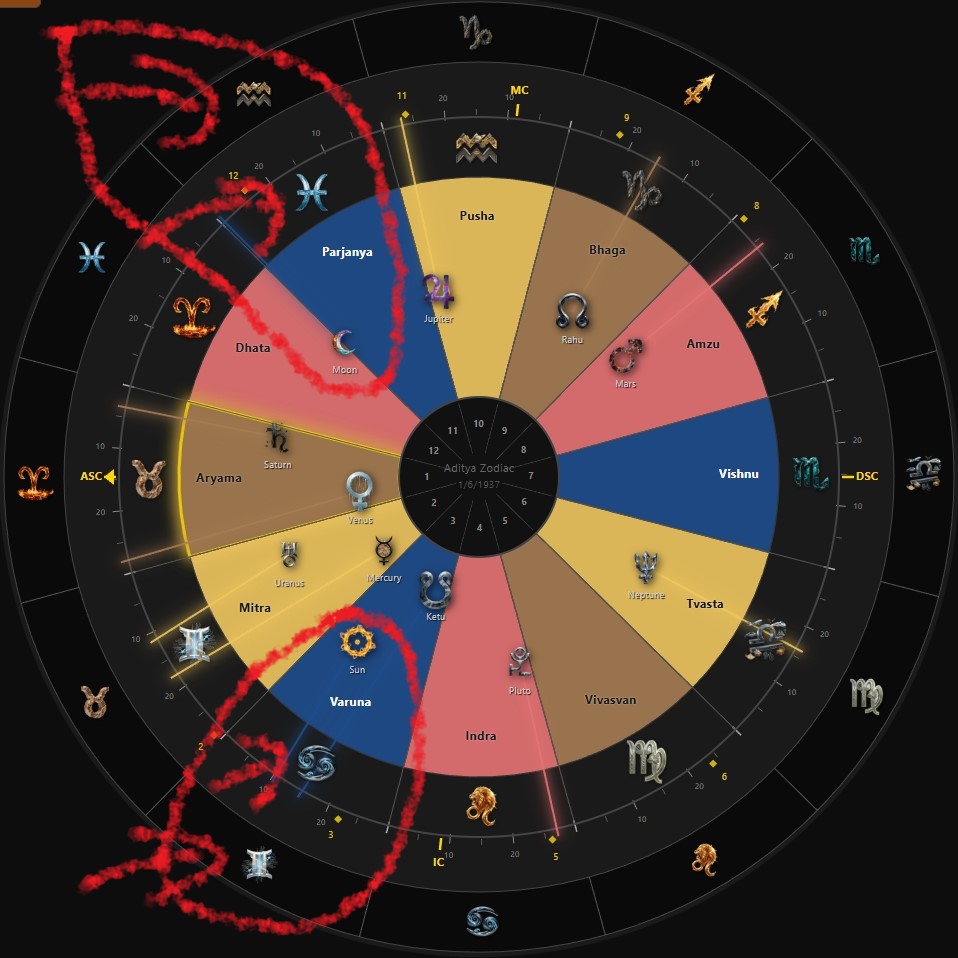 Above you can see Morgan Freeman's chart with the classic wheel. The inner wheel is that of the Adityas, the outer wheel is the classic tropical wheel. You can see here that Morgan Freeman's Moon is in Parjanya/Pisces/Aquarius respectively, while his Sun is in Varuna/Cancer/Gemini.
I invite you to read your own chart with the description of the Adityas. Preferably use the description of the Adityas rather than the old tropical description, as it can be difficult at first to differentiate the Pisces of classic astrology from the Pisces of the Aditya Zodiac. It may take a long time to adapt to this new foundation.
The 12 Solar Laws that Shape Our Being
Each portion of the sky, traversed by the Sun throughout the year, is governed by a divine duo: an Aditya (a facet of the Sun) embodying a facet of love, and a Rsi (enlightened sage) revealing a fundamental law of creation. Together, they offer us a roadmap to understand our deep nature.
1. Dhata: The Love that Carries and the Law of Protection
Meaning: The one who carries, supports and establishes.
Associated Love: The love of bearing and giving birth to life.
Dhata Aditya is the divine creator and celestial carrier, the one who carries, supports and establishes life as a whole. His essence is to offer unconditional support, from generation to prosperity, particularly associated with creativity, children, ideas and the creative fire Agni. Dhata is the first to start the entire creation process, which requires immense strength - like a volcano that erupts once to bring prosperity. His love is the Love of Carrying, a fundamental force that supports existence itself and allows life to flourish. Dhata has a sister, Lakshmi, who represents prosperity, not wealth. Prosperity is not having a fortune in the bank; it is the ability to get what you need when you need it. This distinction matters: Dhata's support is sustained by resourcefulness, not by accumulation. His four wives are the four phases of the moon: Kuhu (new moon, when nothing is given), Sinivali (waxing, when support builds), Raka (full moon, when everything is poured out), and Anumati (waning, when support recedes). The rhythm is the lesson: support that never ebbs is not support, it is suffocation. The circle of responsibility starts small and expands outward: self, family, village, wider community. The diagnostic of how wide a person draws that circle reveals the health of their Dhata.
Element: Structural Fire (Agni) Body Part: Head, Skull and Bone Structure - Represents the head, source of inspiration, thoughts and concentration, where our ideas and ability to focus are born. The bones are Dhata, the skeleton being the fundamental structure that supports the entire body. The head, connected to the spine, establishes the central axis of our being and the creative axis that connects the Earth's Volcano (inspiration) to the Air element that cools the volcano to give it form (manifestation). This connection with Tvashta (the 7th Aditya, divine architect) reveals how Dhata establishes the foundations that Tvashta shapes. The skeleton is the incarnation of Dhata, the fundamental structure that supports all creation. Linked with Tvashta (the divine architect), Dhata provides the bone structure on which Tvashta sculpts forms. The well-being of the skull, brain, pituitary and pineal glands, hypothalamus, hair and bone structure depends on the state of Dhata. The skull, brain and bones represent our ability to establish solid foundations for our creations, children and ideas. Dhata is an inspired and concentrated Rasi whose goal of protection is constant, but whose methods adapt to the moment. The Sun constantly works to improve, finding new ideas and new approaches while never abandoning what it has committed to carry.
His companion is Pulastya Rsi, keeper of the Law of Sacred Progeny. This alliance reveals the cosmic mystery: what is carried must be protected, and what is protected must multiply. Pulastya, born from Brahma's pure consciousness, begets the Rakshasas not as demons, but as the initial guardians of the order established by Dhata. Together, they weave the web where unconditional support meets evolutionary protection, where carrying love becomes the fertile ground for all sacred creative lineages.
Stories:
- Dhata and his shadow twin Vidhata work together, one establishing and the other disposing. They represent the dual nature of creation and dissolution.
- As the carrier, Dhata is invoked during marriage ceremonies to establish the sacred bond between partners.
- The Rishi Pulastya, associated with Dhata, is one of the sons born from Brahma's mind and the father of many beings, including the Rakshasas.
Attributes:
- Carrier and supporter of cosmic order
- Establisher of marital bonds
- Foundation of family and progeny
- Works in tandem with Vidhata
- Represents stability and establishment
2. Aryamaa: The Love of Companionship and the Law of Customs
Meaning: The intimate friend and companion.
Associated Love: The love of liberality.
Aryamaa Aditya is the embodiment of lasting companionship and divine generosity. He represents the enduring bonds that unite beings through devotion, kindness and the spirit of giving. His love is that of eternal partnership, sealing the sacred pacts of marriage and honoring social commitments that maintain collective harmony. He embodies long-term friendship, the faithful traveling companion who walks beside you throughout life. What makes Aryama's love structurally different from Dhata's bearing is that it is a two-way street. Dhata's love was one-directional: the mother gave, the infant took. Aryama is what becomes possible once the infant has grown into someone who can give back. Two self-reliant beings, each capable in their own way, walking together. Both contributing. Neither carrying all the load. When one of those channels becomes a one-way pipe for too long, the relationship slowly reverts to a Dhata-shaped dynamic, and Aryama cannot hold it.
Element: Earth Body Part: Face/Neck - The Sanskrit word "Anana" refers to the mouth and, by extension, the face and neck. This area contains our main sensory organs (eyes, tongue, nose, ears) that allow us to perceive the world and interact socially, as well as vital pathways for food (mouth, esophagus, trachea) and air. Aryamaa governs our ability to communicate, listen and express our emotions, creating the sensory bridges that nourish our lasting relationships. He essentially represents what nourishes us and keeps us alive, offering the capacity for pleasure and affecting organs like the thyroid and parathyroid glands.
He is accompanied by Pulaha Rsi, who represents the Law of Customs. His name means "extended," suggesting what is lasting and enduring. Aryamaa's lasting love finds its structure in Pulaha's customs. He is the progenitor of many creatures like lions and tigers, symbolizing the continuity of life.
Stories:
- Aryama is invoked in marriage ceremonies alongside Mitra, representing the social and friendly aspects of the marital bond.
- He is associated with the Milky Way and the path of the ancestors (Pitris).
- The Rishi Pulaha teaches the law of hospitality, showing how generosity and friendship create social harmony.
- When Yama, the god of death and dharmic judgment, was cursed to live as a laborer for a hundred years, Aryama took his place. For that century, Aryama judged the sins of the dying, provided restraint, and measured dharma. This capacity lives inside the companionship: the willingness to tell the truth, to draw lines, to say "no more" when a relationship has degenerated into the subsidy of helplessness.
Attributes:
- Companion and intimate friend
- Incarnation of liberality and generosity
- Guardian of social bonds and contracts
- Associated with the Milky Way
- Represents the spirit of giving
3. Mitra: The Friend, Lord of Day and the Law of Human Potential
Meaning: The friend who creates concord and social harmony.
Associated Love: The love of relational harmony and mutual respect.
Mitra Aditya is the incarnation of friendship, goodwill and agreement. He is the master of day, favoring integrity and concord. His love is the Love of Friendship, a force that unites beings in mutual respect and expands social circles. Unlike Aryama, the constant friend, Mitra's social circles are not meant to be fixed; they are dynamic and evolving, creating healthy neutrality between friends. The Chandogya Upanishad (7.14) identifies Mitra as the Sankalpa Devata: the god who produces will and determination in all creatures. During daytime, one makes determination and remains awake; at night, when Sankalpa is absent, one sleeps. Mitra's friendship is not passive warmth but an active force of intention, the subtle planting of purpose that eventually creates action.
Mitra's Advice: Mitra's social circles are not meant to be permanent; they evolve naturally. Learn to appreciate the healthy neutrality in friendships, where bonds form and dissolve without excessive attachment. This energy helps you maintain harmony without forcing permanence, honoring the natural flow of relationships.
Element: Air Body Part: Arms - Symbolizes the arms, which give us the ability to work with and create from elements in our environment, or to destroy them. The organs and body parts of the arm area, including shoulders, clavicles, scapulas, hands and upper lungs, are governed by Mitra. The arms represent our ability to establish connections and maintain social harmony.
His Rsi is Atri, guardian of the Law of Human Potential. Facing darkness that obscured the Sun and Moon, Atri drew on Mitra's divine friendship to restore light. This synergy reveals that it's in the kind gaze of a friend that we discover our own inner light, even when we doubt our potential.
Stories:
- Mitra and Varuna are often associated, representing day and night. Mitra governs the conscious will; Varuna holds the unconscious depths. What you think about during the day (Mitra's domain) enters the unconscious at night (Varuna's domain). The seeds planted by will during daylight grow in the darkness of sleep, then emerge back into consciousness as new capacities and insights. Social harmony rests on this balance between personal relationship and universal order.
- The Rishi Atri, whose name means "devourer," represents the devouring power of friendship that dissolves barriers and allows human potential to emerge even in darkness.
- Mitra is invoked to witness oaths and contracts, ensuring their fulfillment through the power of friendship, mutual goodwill and integrity.
Attributes:
- Reconciler of relational harmony and social concord
- Guardian of sacred commitments and friendship pacts
- Incarnation of reciprocal trust and authentic bonds
- Mythological partner of Varuna, balancing friendship and universal law
- Guarantor of social order through the power of mutual goodwill
4. Varuna: The All-Encompassing One, Lord of Sky and Ocean, God of Meditation
Meaning: The one who envelops and binds everything, lord of sky and ocean. Guardian of immortality, he hates lies and binds liars with his noose, but also forgives sins.
Associated Love: The love of consciousness and truth.
Varuna Aditya is one of the oldest Vedic gods, the ancient lord who envelops all existence in his penetrating gaze. God of the night sky and ocean depths, he resides in the very heart of the ocean, where he watches over immortality and cosmic law (Ṛta). His wisdom and influence transcend even that of Indra himself. Hating lies above all else, he binds transgressors with his formidable noose (pāśa), while possessing the grace to forgive sins. His love is an All-Encompassing Love that knows no limits or boundaries - a love that meditates deeply to discern the hidden truth beneath deceptive appearances. Through meditation (Dhyāna), the instrument created by Brahman, he distinguishes authentic order from disguised chaos. He waxes and wanes with the Moon (Candra), reflecting the cycles of consciousness. Those who bear the imprint of this Aditya possess a remarkable capacity for rapid adaptation, changing and evolving with the fluidity of the waters they govern, while remaining anchored in a deep consciousness of universal order.
Element: Water - Varuna rules over cosmic waters, oceans, rivers and rains. He lives in the heart of the ocean and all waters of the world obey him.
Body Part: Chest - The chest, or "Hrit" in Sanskrit, is the seat of feelings and emotions, just as Varuna resides in the heart of the ocean. It also contains much of the lungs, which reflects how our first reaction to an emotion is a change in breathing, mirroring Varuna's meditation (Dhyāna). It is in Varuna that we feel and react to changing emotions that wax and wane like lunar tides, just as Dhata feels and reacts to changing thoughts. The heart, lower lungs, sternum, breasts and ribs are associated with Varuna.
He travels with VasiSTha Rsi, whose name means "the Richest, the Best," chief of the Sapta Rishis and living incarnation of the Spiritual Law that unites Consciousness and Abundance. Preceptor of the solar dynasty (Ishvahu) and guru of Rama and Dasharatha, VasiSTha had three remarkable births: first as a son born from Brahma's mind, then reborn from Brahma's sacrificial fire, and finally born from the union of Mitra and Varuna themselves (hence his name Maitrā-Vāruṇī). He possesses the divine cow Nandini, descendant of Indra's Kamadhenu, capable of manifesting any desire. In the heavens, VasiSTha and his wife Arundhati shine as the stars Mizar and Alcor in the constellation of the Seven Sages. His children are none other than the five Panchabhutas, the primordial elements of all creation. Varuna's all-encompassing love cannot be fully perceived without the expanded spiritual consciousness that VasiSTha embodies, revealing the fundamental truth: true abundance is not separate from consciousness - it is its direct and natural fruit.
Stories:
- Varuna, one of the oldest Vedic gods, hates lies and binds with his noose (pāśa) those who violate cosmic law. He also forgives sins and is the guardian of immortality.
- In Kṛtayuga, the Devas approached and anointed him as king of all waters. He lives in the heart of the ocean and is associated with the western direction. All rivers and the ocean obey him. He waxes and wanes with Candra (the Moon).
- When Rāvaṇa attacked King Marutta's sacrifice, Varuna escaped in the form of a swan (Hamsa) - a very important archetypal behavior seen in these people.
- Varuna rides the mythical Makara, a ferocious beast that devours all smaller creatures. He can also be represented on a swan or a chariot pulled by seven swans.
- During the burning of the Khāṇḍava forest, Agni prayed to Varuna to provide weapons. Varuna gave Arjuna the Gāṇḍīva bow, an inexhaustible quiver, a banner with a monkey, and the Pāśa weapon to fight alongside Krishna against Indra.
- Varuna has four prominent children: Puṣkara (pious demi-god), Bāla (simple and childlike), Surā (spirituous liquor), and Adharmaka (injustice, destroyer of elements).
- The Rishi Vasiṣṭha is sometimes considered his son, hence the name Maitrā-Vāruṇī.
- The famous rivalry between Vasiṣṭha (Varuna's Rishi) and Viśvāmitra (Vishnu's Rishi, the 8th Aditya) represents the deep tension between contemplative spiritual law of consciousness (Vasiṣṭha) and transformative love that transcends laws (Viśvāmitra). Their conflict began when King Viśvāmitra tried to forcibly take Vasiṣṭha's divine cow Kāmadhenu, whose arrows turned into flowers upon contact with the sage. After millennia of penance and intense rivalry, they even transformed into fighting birds until Brahma freed them. Finally, Viśvāmitra abandoned all pride and the two sages embraced, ending their enmity. This reconciliation symbolizes the ultimate union between meditative consciousness and love that transforms all.
- Varuna, Lord of the Seas, took the form of a frog and praised Hari with the hymns of the Māṇḍukya Upaniṣad.
Attributes:
- One of the oldest Vedic gods, whose influence surpasses that of Indra.
- All-encompassing ("all enveloping") god of sky and ocean.
- Guardian of cosmic law (Ṛta) and immortality.
- Lord of night and meditation (Dhyāna).
- Wields the noose (pāśa) that binds transgressors, but also forgives sins.
- Associated with waters, the west, and the Moon (waxes and wanes with Candra).
- Embodies power derived from wisdom and deep understanding.
- Executor of moral and cosmic order, distinguishing truth from lies.
- Rides the ferocious Makara or the swan (Hamsa).
5. Indra: The King of Heaven, God of Thunder and Inner Conquest
Meaning: The self-love that elevates to the rank of king of the heavens. (Indriya means senses)
Associated Love: The love of self-conquest.
Indra Aditya is the conqueror who won his throne not by inheritance, but by victory over himself. As king of the gods, he embodies the mastery of the senses and the authentic power that comes from inner discipline. His love is Self-Love, the force that allows one to dominate one's own impulses and become the sovereign of one's inner kingdom. Indra is not a personality type. Indra is a position: the throne earned through self-mastery, held through will, tested by everything that approaches it, and lost the moment pride replaces the self-love that built it. The Manvantara doctrine confirms this: across fourteen vast cosmological ages, fourteen different beings hold the post of Indra in turn. The post is earned, not inherited. This means Indra is the Aditya that rewards spiritual development with a position of worldly power, then asks whether the holder can manage that power without falling from it.
Three fires structure the vertical axis of existence. Surya burns in the heavens: the constant, central fire of the Sun itself. Agni burns in the earth: the sacrificial fire, the warmth that sustains. Between them, in the sky, Indra's fire burns as lightning. Not constant. Not domestic. A sudden, decisive flash of intelligent energy that illuminates everything it touches and then disappears. It is no coincidence that Nikola Tesla, whose Sun was in Indra, literally harnessed this lightning and gave the world alternating current, or that Elon Musk named his company after Tesla and now runs much of the planet's electrical infrastructure. Indra's fire made material.
Element: Fire Body Part: Abdominal cavity - Represents the abdominal cavity, which houses most vital organs such as the stomach, liver, kidneys, spleen and gallbladder, as well as energy-regulating glands like the pancreas and adrenal glands. As he governs these vital, energizing organs, Indra is the sign of vitality and, by extension, self-esteem and self-confidence.
He is accompanied by Aṅgiras, guardian of the Law of Essence. His name means "the vital sap" or "the very essence of the body," referring to the breath that animates all organs. He represents the Law of Essence and became as bright as Agni, being adopted as his son. Aṅgiras is the father of Bṛhaspati (Jupiter), Indra's guru, illustrating the divine hierarchy: Power (Indra) must serve Wisdom (Bṛhaspati) which itself emanates from Essence (Aṅgiras). When Indra forgets this truth and insults his guru, he immediately loses his connection to his own essence and his power collapses.
Stories:
- Victory over Vṛtra: Indra faced the great demon Asura Vṛtra who had blocked all the world's rivers, causing catastrophic drought. To defeat him, the Ṛṣi Dadhichi sacrificed his life, and his spine (bones) was forged into Vajra, the divine, indestructible thunderbolt weapon that allowed Indra to triumph, restore the flow of vital waters, and bring life back to earth.
- Self-conquest: Indra earned his title as King of the Devas not by birthright, but by "conquering himself." This story teaches that true power lies not in domination but in self-mastery.
- The test of humility: Despite his status as king of the gods, Indra was constantly tested by trials that humiliated him. Each trial reminded him that true power lies not in domination but in the ability to remain humble in the face of adversity. His conflicts with other deities often led him to learn important lessons about pride and humility.
- The Rishi Aṅgiras: Rishi Aṅgiras represents the glowing embers of spiritual fire that illuminate through humility, teaching that enlightenment and spiritual power are inseparable from humility.
- The seduction of Ahalyā: Indra took the form of the sage Gautama to seduce his wife Ahalyā. When discovered, he was cursed by Gautama to be covered with a thousand vaginas on his body, and his penis and scrotum fell off. Later, Adi Parāśakti transformed these vaginas into a thousand eyes and restored his virility. This story illustrates how uncontrolled desires can corrupt even the noblest of rulers and the consequences that ensue.
- The insult to guru Bṛhaspati: During a divine assembly, Indra, blinded by pride, remained seated on his throne when his guru Bṛhaspati entered, failing to stand to greet him. Offended, Bṛhaspati disappeared. Without the wisdom guiding him, Indra lost his power and was defeated by the Asuras, until he accepted Triśiras as his new guru. This story teaches that even the greatest warrior must honor the wisdom that elevates him and the importance of humility before wisdom.
- The test of Bala: Bala, son of Diti and Kaśyapa, had acquired immense power through the practice of celibacy and austerities that made him capable of reaching Indra's stature. Diti warned Indra of the growing threat to the Devas' kingdom, and Indra struck Bala during his meditations, an unarmed adversary. Although morally reprehensible and considered a sin, this act was necessary to protect the cosmic order that Indra had a duty to maintain.
- Anger against Vṛndāvana: When Kṛṣṇa instructed the inhabitants of Vṛndāvana to worship Govardhana hill instead of Indra, the latter, in his wounded pride, unleashed incessant torrential rain on the region in anger. Kṛṣṇa simply stopped the rain by lifting Govardhana hill like an umbrella, immediately stopping the rain and humiliating Indra.
- Tester of Sanyāsīns: Indra regularly tests the best Sanyāsīns (spiritual renouncers) whose spiritual efforts make them capable of reaching his own stature, thus verifying the solidity of their detachment and spiritual attainments.
Fundamental Attributes:
- Self-conqueror: Gained his position by conquering himself first and foremost.
- King of the Devas: Rules the celestial kingdom of Amarāvatī with legitimate authority.
- Wielder of the Vajra: Brandishes the divine thunderbolt forged from the sacrifice of the sage Dadhīci.
- Celestial fire: Represents vitality and the power to be oneself, something that remains fixed.
- Spiritual tester: Constantly verifies the attainments of ascetics who might equal him.
- Source of vitality: Governs the vital organs that generate energy and confidence.
- Vulnerable to pride: His weakness is the pride that comes from his accomplishments. This Aditya cannot hide and must know when to conquer, what is his territory, because he cannot conquer something outside himself without being rejected.
6. Vivasvaan: Love for Humanity and the Law of Man
Where Divine Light Meets Earthly Condition
Meaning: The one who shines in all directions; the radiance that touches all without discrimination.
Associated Love: The love for humanity, universal compassion that accepts and sustains all.
Vivasvān, whose name means "shining in all directions," marks the point where divine light meets human condition. After Indra—the 5th Āditya, whose brilliance represents direct divine presence—comes Vivasvān, who fathered Vaivasvata Manu, the first man and lawgiver. Like Adam establishing foundations for the human world, Manu created laws and norms governing humanity for all ages. Vivasvān also fathered Yama, who became lord of justice and death, and the Aśvins, the divine physicians.
Vivasvān's central story begins with his marriage to Saṃjñā, "clear consciousness," daughter of the divine architect Tvaṣṭā. But the radiance of the Sun proved unbearable—even for one who loved him. Unable to remain in his burning presence, Saṃjñā placed her servant Chāyā—the "shadow"—in her place and fled in the form of a mare.
Unknown to Vivasvān, he lived with shadow, fathering with her Śani (Saturn) and Sāvarṇi Manu. But shadows have their own loyalties: Chāyā cherished her own children while neglecting Yama and Yamī, children of clear consciousness. When Yama, wounded by this maternal rejection, raised his foot toward her—without striking—she cursed him anyway. This curse revealed truth: the one he took for mother was merely shadow.
The Samjna-Chaya split produces the most characteristic psychological signature of this Aditya. Samjna is what we are conscious of, what we have focused our intelligence upon. Chaya is everything we have not focused on, everything in the shadow of our attention. Vivasvan produces the specialized intelligence: the expert, the genius-of-one-thing, the person who knows their domain at exceptional depth and is in the dark about everything outside it.
Discovering the substitution, Vivasvān understood something essential. He consulted Tvaṣṭā, who on his divine lathe reduced the Sun's rays—tempering what was previously unbearable. Only then, in stallion form, could he find Saṃjñā the mare. From their reunion came the Aśvins, bringing medicine and healing to humanity.
The portions of effulgence that fell during this reduction gave birth to the twelve Ādityas—showing how that which seems diminished can actually multiply blessings. Vivasvān became one who nourishes without depleting: when the Pāṇḍavas were exiled, he offered Yudhiṣṭhira a copper pot providing endless nourishment, demonstrating how tempered love can sustain infinitely.
Element: Earth Body Part: Hips
The hips govern circular movement—this ability to open, receive, dance among humans. Anatomically, this region extends from the top of the ilium to femur insertion, including lumbar vertebrae. Deeper still lie the intestines, center of discernment: assimilate what nourishes, reject what doesn't. This is also the sacred place where children are born, where life is transmitted generation to generation.
But the intestines teach us a humble earthly truth. Jesus said: "You are dust, and to dust you shall return." The hips remind us constantly. We live by what the earth produces; our existence depends on digestion's silent alchemy. Here the divine meets earthly, where sacred touches elemental.
When the intestines degrade—through disease, neglect, refusal to accept our condition—our connection to life itself breaks. We cease assimilating, growing, participating in human community.
Those who honor this region accept being human, earthly, mortal. They maintain body and mind mobility. They naturally discern what nourishes from what destroys. They can be open without losing limits, generous without consuming themselves, creators of life without losing themselves. Flexible hips carry this wisdom: the sacred and base inhabit the same place. Creation and elimination, children and waste, are inseparable. Being human means accepting this duality.
Companion Rshi: Bhṛgu
Bhṛgu, whose name means "divine light," is a monumental figure—father of astrology, author of the Bhṛgu Saṃhitā where legend tells he interpreted 5 million horoscopes and divined the destiny of all living beings. He was also a great author of Vāstu, the sacred architecture guiding physical manifestation.
But his most essential role was receiving and transmitting the Laws of Man. Contemporary with Manu, Bhṛgu received directly from him the principles governing humanity and transcribed the Manusmṛti, the eternal code he then recited to selected Rishis. His genealogy reveals his power: with his wife Khyāti, he fathered Dhātā, Vidhātā and Lakṣmī; with Pulomā, he had Cyavana, whose meditation was so intense an anthill grew around him, until Princess Sukanyā served him with loyalty. From this lineage emerged Venus himself, as well as sacred warriors Jamadagni and Paraśurāma.
Bhṛgu's defiance toward the gods themselves demonstrates his unshakeable authority. When Mahāviṣṇu killed his wife Pulomā, Bhṛgu feared not to curse the supreme god, condemning him to be born mortal and suffer separation. Even gods must obey the universal laws Bhṛgu guarded. The Laws of Humanity he codified are not arbitrary—they are founded on the same principles of harmony and relationship that the Lajitadi Avastha system describes in detail, where each cosmic entity must accept relationships of friendship, hostility, or neutrality governing the universe.
Stories
-
Martāṇḍa, the Resurrected Embryo: Chandra (the Moon) cursed the child in his mother Aditi's womb because she didn't rise to greet him. The child died as fetus, but Kaśyapa resurrected him. Vivasvān was born thus as Martāṇḍa—symbol of rebirth after curse, showing even the brightest light can know death before shining fully.
-
Saṃjñā Flees the Intensity: Saṃjñā, clear consciousness, could not remain in the Sun's radiance. She placed her servant Chāyā (shadow) in her place and took mare form seeking refuge. This flight invites considering a truth: the brightest light can be too intense, even for those who love it.
-
Shadow and Children: With Chāyā, Vivasvān fathered Śani (Saturn) and Sāvarṇi Manu. Chāyā cherished her own children in certain ways, while Yama and Yamī found themselves in different spaces—neither explicitly rejected nor truly loved. Clear consciousness children and shadow children coexisted under same roof, but in separated worlds.
-
Yama's Restraint: Yama, wounded by this maternal ambiguity, raised his foot toward Chāyā—but restrained himself. Chāyā cursed him anyway. This unperpetrated act allowed Vivasvān to perceive troubling truth: he may have lived with shadow for years.
-
Cosmic Reduction: Vivasvān consulted Tvaṣṭā who reduced his rays on divine lathe, making them perhaps more bearable. Portions of effulgence that fell gave birth to the twelve Ādityas. This transformation suggests possibility: that sacrifice of one's own intensity creates multiplicity and blessings for all.
-
Reunion in Animal Form: As stallion, Vivasvān pursued Saṃjñā as mare and mated with her. From this union came the Aśvins, divine physicians healing humanity. Transformation into animals may evoke abandoning divine grandeur to regain simpler connection.
-
Endless Nourishment: During Pāṇḍava exile, Vivasvān appeared to Yudhiṣṭhira and offered a copper pot providing endless food. This generosity suggests the tempered Sun can nourish without condition, without exhaustion, giving constantly to humanity.
Attributes
- Universal Radiance: Shines without discrimination—his light touches all, regardless of merit or status
- First Source of Life: Nourishes humanity through grain and earthly vitality, sustaining physical existence
- Progenitor of Law: Father of Manu, suggesting his role in establishing principles governing civilization
- Father of Death and Justice: Father of Yama, perhaps indicating understanding of eternal cycle of creation and dissolution
- Spouse of Two Worlds: Married to Saṃjñā (clear consciousness) and Chāyā (shadow)—representing totality of experience
- World's Healer: Father of the Aśvins, divine physicians, suggesting role in restoration and healing
- Embodiment of Resilience: Martāṇḍa, the resurrected embryo—perhaps incarnating capacity to be reborn after curse and death
- Wisdom of Moderation: Discovered that reducing one's intensity allows others to approach—lesson of conscious sacrifice
7. Tvashta: Love of Creation and the Law of Fatherhood
The Divine Architect Who Gives Form to All Dreams
Meaning: The one who shapes, sculpts, and builds; the cosmic artisan.
Associated Love: The love of creation and shaping of forms.
Tvashta Aditya is the divine architect, supreme artisan who shapes all forms of the universe. After Vivasvaan—who establishes human foundations and laws—comes Tvashta, the one who transforms that vision into concrete reality. Tvashta represents the power of creative manifestation, the capacity to transform abstract thoughts and intentions into tangible forms the world can perceive and use.
Tvashta is the great shaper, wielding cosmic tools to create. He forged the weapons of gods, built Shiva's bow, and sculpted bodies of all living creatures. Every being that exists, from microscopic insect to majestic mountain, bears his divine chisel's signature. He presides not only over physical creation but procreation itself—why he is invoked during conception and birth rituals. His love is the creator's love, seeing hidden beauty in raw matter and liberating it in living form.
He was also father of Saṃjñā (clear consciousness), she who could not bear Vivasvaan's brilliance. When she fled, Tvashta's task was tempering the Sun's excessive luminosity, reducing his rays for human presence acceptability. This reduction gave birth to the twelve Adityas themselves—showing how creative limitation multiplies forms and blessings. Tvashta understands that creating doesn't mean giving everything at once; creating means knowing how to adjust, refine, distribute.
His love is not impulsive creator's love producing without thought. It's master artisan's love understanding every detail, knowing how pieces fit together, seeing finality before beginning. When Tvashta shapes a form, he embraces not only present beauty but also future evolution, the growth and decline cycles it will traverse. The love-language of Tvashta is giving through creating. The person with strong Tvashta shows love by building things for others. They may not say "I love you," but they build you a bookshelf, design your logo, cook the meal that fits your specific craving, solve the problem you could not solve. The form IS the love.
Element: Air Body Part: Pelvic Triangle
The pelvic triangle, containing bladder, rectum, and internal reproductive organs, plus the sacrum, governs most fundamental transmission and creation functions. Here future forms take root, where life itself prepares to emerge from chaos into order.
Tvashta also governs reproductive organs because he presides over procreation—greatest creativity an incarnate soul can exercise. These delicate organs, protected deep within pelvis, symbolize creative process vulnerability. Creativity demands trust, exposure, willingness to share creative essence with world. Like the intestines under Vivasvaan, this region reminds us of silent alchemy that must occur: how to transform intention into manifestation, how to filter ideas so only most viable can be born.
This region fundamentally means knowing what to release and what precious to keep, what leads to good decisions in creation and business. This Rasi symbolizes growth through procreation, mutual exchange, understanding that creating together multiplies results. The sacrum itself—"the sacred bone"—reminds us procreation and creation are never entirely ours; they participate in larger divine plan.
Companion Rshi: Jamadagni
Jamadagni, guardian of the Law of Fatherhood, signifies "one who consumed fire"—a man of intense tapasya and discipline. Father of the formidable Parashurama (he who eliminates impious kings), Jamadagni illustrates sometimes austere requirements of laws governing lineages and inheritance. Unlike Bhṛgu (Vivasvaan's Rshi) who codified humanity's laws, Jamadagni represents the father's law which must sometimes act with absolute rigor to preserve lineage integrity. His meditation was so intense it caused an anthill around him—image of total stillness and absolute concentration. Tvashta's creative act—engendering form—can only be durable rooted in Jamadagni's paternal discipline. Creation without discipline becomes degeneration; therefore all we create must submit to parental responsibility law.
Stories
-
Tvashta Shapes the Devatas: Tvashta created bodies of all gods and goddesses. Every divine form bears his artistic perfection's mark—proportion harmony, energy balance. This creation was not accidental but deeply intentional, each being designed for specific functions.
-
Creation of Saṃjñā: Tvashta gave birth to Saṃjñā, incarnate consciousness, daughter of his creativity. She became Vivasvaan's wife, but his radiance was too intense. When she fled, Tvashta intervened not to create new wife but to transform source itself, reducing Sun's rays so life could continue.
-
Cosmic Reduction and Multiplication: When Tvashta reduced Vivasvaan's rays on his divine lathe, portions of effulgence that fell transformed into twelve distinct Adityas. This story teaches profound truth: sometimes creating means dividing, limiting, dispersing. Greatest creation is not producing immense form but multiplying useful and beautiful forms.
-
Creation of Vajra: Tvashta forged divine weapon Vajra for Indra, enabling sky king to defeat demon Vrtra. This creation was not simply destruction weapon but cosmic order instrument, manifesting how creative power serves good's victory.
-
Shiva's Bow: Tvashta created Shiva's great bow, the Pinaka, greatest bow ever existed. The gods themselves could not lift it, such was power infused in his creation.
-
Relationship with Jamadagni: Though Jamadagni is austere ascetic, Tvashta recognized him as necessary balance to his creativity. Because creator without discipline becomes chaos creator. Jamadagni, through merciless rigor, taught Tvashta that creating also means knowing when to destroy what is imperfect or harmful.
-
The Vritra Mispronunciation: When Tvashta's son Trisiras was killed by Indra, Tvashta performed a sacrifice to create a being that could kill Indra. He mispronounced the mantra. Instead of creating the being who would kill Indra, he created the being who would be killed by Indra. The grief-driven architect failed at the one thing he never normally fails at. When Tvashta serves private grievance, the forms it builds misfire.
Attributes
- Divine Architect: Shapes all forms of universe, from microscopic to cosmic
- Master of Procreation: Presides over birth and creation in all aspects
- Cosmic Blacksmith: Creates gods' weapons and tools, infusing divine power in each creation
- Light Refiner: Understands how to adapt and adjust energies for accessibility
- Creator of Beauty: Combines function with aesthetics in every work
- Sage of Detail: Sees perfection in small things as much as great creations
- Worlds' Connector: Transforms invisible intention into visible manifestation, linking divine to material
8. Vishnu: Universal Love and the Law of Transgression
The All-Pervasive One Who Transforms Everything Through Unconditional Acceptance
Meaning: The All-Pervasive One, the one who saturates the entire universe and preserves its cosmic balance.
Associated Love: Universal love, radical and unconditional acceptance of all existence.
Vishnu Aditya is the Aditya of below-the-surface awareness. Where other Adityas operate on what is visible, Vishnu operates on the energy that persists when the visible form dissolves. A cricket turns into a lizard: the form is unrecognizable, but the energy that animated both is the same. Every form is temporary. What is sustained is not the form but the intelligent energy the form was carrying.
Vishnu is the All-Pervasive, the one who saturates every atom and every instant of the universe. After Tvashta—who creates distinct forms—comes Vishnu, the one who unifies everything into single immanent reality. Vishnu is not forms' creator but their sustainer, preserver, and transformer. His love is Universal Love, a radical acceptance of existence transcending distinctions between good and evil, sacred and profane, just and unjust.
In the cosmos, Vishnu represents conservation and preservation force. While Brahma creates and Shiva destroys, it's Vishnu who maintains balance, intervening when chaos threatens order destruction. He does this not through brute force (belonging to Indra) nor rigorous discipline (belonging to Bhṛgu), but through radical transformation absorbing chaos and converting it to harmony. Every Vishnu incarnation—every Avatar—represents vulnerability acceptance, willingness to descend into corruption's very heart to transform it from within.
Vishnu is the God sleeping on serpent Ananta at the cosmic ocean's bottom. This image is profound: he rests on what could kill him, sleeps fearlessly at chaos's heart. His dream is the universe itself. Every reality we live exists in Vishnu's dream. Therefore existence is not theater—it's divine love in action, recognition that reality itself is love's expression. Vishnu says: "I will not accept a universe where evil exists only partially. I accept all, unite all, transform all by bringing my love."
His love is not selective like Dharma's; it doesn't choose noble and reject vile. It's love seeing transformation capacity in each being, even the most corrupted. When demon Hiranyaksha oppresses the world, Vishnu takes Varaha (wild boar) form and battles the demon in his own ocean home. When Ravana, demon king, dominates world with pride, Vishnu is born as Rama and lives the tragedy of loving a wife, losing what one cherishes, making impossible choices. This willingness to descend into chaos, completely transform, endlessly rebirth—this is Vishnu's signature.
Element: Water Body Part: Intimate Parts
The intimate parts—sexual organs and elimination system—represent what we usually hide, what we sometimes find shameful or repugnant. They're unprotected by bone or thick musculature like abdomen; they're naked, vulnerable, exposed. These zones also govern most intimate functions: elimination of waste and procreation—two acts binding us inseparably to our animality.
Vishnu governs this region because he accepts what we usually reject. He is the God of miraculous transformations—feces into fertilizer, death into new life, shame into honor. He understands our body's most vulnerable parts are also most alive, most creative. Through our vulnerability we're capable of true intimate connection, true creation, true transformation.
This region also symbolizes capacity to receive and give, release and create. As Vishnu rests on chaotic serpent without fear, we must learn to accept our vulnerability, dependence on forces beyond our control, connection to eternal birth and death cycle. Precisely in this acceptance we find our greatest transformative power.
Companion Rshi: Viśvāmitra
Viśvāmitra, guardian of the Law of Transgression, means "friend of the whole world." Unlike other Rishis born pure and spiritual, Viśvāmitra was a warrior king who transgressed all social and divine conventions to achieve Brahmarshi status (highest Rshi status). He categorically defied established law. His eyes created a river, his thoughts engendered entire worlds. This Rshi refused established hierarchies and insisted each could achieve spiritual realization through willpower alone, regardless of birth or social status. To love all like Vishnu, sometimes we must transcend frameworks Jamadagni established, refuse Bhṛgu's rigid laws, and create new law founded on equality and human dignity. Viśvāmitra and Vasishtha were rivals for millennia, but it was creative tension between rigid order and necessary transgression.
Stories
-
Vishnu on Serpent Ananta: Vishnu rests on cosmic serpent Ananta at primordial ocean heart, sleeping eternal sleep from which the universe springs. This image teaches that true rest comes from acceptance, not domination. Ananta means "infinite"—Vishnu rests on infinity, supported by the very chaos other gods would fear.
-
Varaha Avatar: When demon Hiranyaksha stole Earth and hid it at cosmic ocean's bottom, Vishnu took Varaha (wild boar) form. This creature usually associated with filth and vulgarity became cosmic salvation's instrument. Vishnu didn't hesitate to wear form most humble, most rejected, to restore order.
-
Narasimha Avatar: When Hiranyakashipu received blessing of invulnerability toward all divine and human beings, Vishnu became Narasimha—half-man, half-lion—creature neither one nor other, to kill the demon. This incarnation shows how Vishnu even transgresses physics laws to restore balance.
-
Krishna and the Gita: When Krishna revealed the Bhagavad Gita to Arjuna, he made the most radical declaration: "Surrender to me completely. I'll accept you regardless devotion state." Whether warrior, priest, or merchant; whether you've disobeyed; whatever your weakness, I accept you totally. This is universal love.
-
Rama and Doubt: Rama, incarnation of absolute virtue, doubted his wife Sita's chastity and exiled her pregnant. This transgression of his own perfection shows even gods must live doubt and guilt. Vishnu accepted this vulnerability rather than remain in unrealistic perfection.
-
Endless Incarnation: Vishnu accepts infinite rebirth, each dark age, to save humanity. This eternal death and rebirth cycle acceptance shows universal love never exhausts itself.
Attributes
- All-Pervasive: Saturates every atom, every instant, every possible reality
- Universe's Conservator: Preserves universal balance against chaos and destruction
- Radical Accepter: Loves unconditionally without judgment or discrimination
- Transformer: Absorbs evil and transforms it to good by mere presence
- Incarnator: Accepts taking vulnerable, mortal human form
- Divine Transgressor: Breaks established rules when higher order demands it
- Cosmic Rest: Sleeps fearlessly on chaos itself, showing absolute trust
- Unifier: Connects all beings and realities into single immanent existence
9. Amzu: Love of Intrinsic Goodness and the Law of Caring for Children
The Sunray That Illuminates Everything It Touches
Meaning: The ray, the individual light, the one who shines through its natural purity.
Associated Love: The love of what is good and beautiful in itself, without external reason or justification.
Amzu Aditya is the individuated ray. Amzu means "a ray, a portion": a single beam of sunlight leaving the Sun's surface and landing on something specific. The sunbeam that falls on an ant is exactly the size of the ant. The sunbeam that falls on you is exactly your size. Each ray carries the Sun's full intelligence and energy, yet it belongs to one being alone.
Tvasta (sector 7) gives the body, the DNA, the genetic container given at birth. Vishnu (sector 8) gives the capacity to transform, to move from one form of being to another. Amzu (sector 9) gives what does NOT change through every transformation: the constant under the variable. The good in you that was the same when you were a struggling nobody and when you were at the height of your power.
Amzu is also the ray that divides: a beam diverging from its source to illuminate its own path. This represents child care, inheritance, and creativity: how the good in us continues shining through what we transmit. The parent's light shining in the child, the creator's excellence manifesting in the creation. When something is made from your individual ray, whether a child, a work of art, or an act of pure generosity, it carries your light forward even after it separates from you.
His love is not Vishnu's encompassing universal love; it is the love that recognizes the specific, unique, particular goodness in one being. The parent watching their own light shine through their child. The artist whose creation embodies something that was always inside them. The person whose quiet radiance needs no justification because it simply is their nature.
Element: Fire Body Part: Buttocks
The buttocks, the largest muscles responsible for walking and long-distance running, govern our direction and purpose. They symbolize how we propel ourselves forward, how we maintain constant trajectory. Amzu governs this region because he represents clear direction toward goodness and light.
The buttocks also maintain our vertical balance—how we stay upright against gravity. This symbolic stability extends to coccygeal vertebrae supporting the entire spine. Together, they represent balance and wisdom guiding actions. Amzu understands each step must be guided by inner light, each action expressing intrinsic goodness rather than obligation or fear.
This body region also reminds us we're constantly moving, constantly propelling ourselves forward. Amzu asks: How do you propel yourself? Where are you going? Do your actions reflect your inner light's purity, or have you accepted walking in darkness for convenience?
Companion Rshi: Kashyapa
Kashyapa, the great guide of universal development, embodies the Law of Caring for Children. Kashyapa means "one who sees," and he indeed saw all beings' essence. Responsible for the Adityas' (solar gods') well-being and growth, the Daityas' (complex entities'), humans', and all creatures', Kashyapa is infinite creation's protector. His numerous marriages to different wives—Aditi (luminous gods' mother), Diti (dark entities' mother), Kadru (serpents' mother), Vinata (eagles' mother)—show his universal vision: each creature, whether divine or asura, deserves excellent care. Amzu's goodness love becomes fuel for Kashyapa's cosmic pediatrics. Without Amzu's recognition that what is created is good and worthy of attentive care, children—broadly speaking—couldn't flourish.
Stories
-
Amzu the Ray: Amzu is literally a Sun ray detaching to become independent Aditya. This separation shows how light, even divided, retains its shining nature. Each ray continues radiating, exactly as each child, even separated from parent, conserves the essence of their natural goodness.
-
Natural Excellence: Unlike other Adityas who must learn lessons or overcome challenges, Amzu is simply good by nature. This story teaches virtue needs no justification—it is its own purpose.
-
Light Transmission: When illuminated parents raise children, it's Amzu ensuring parent's light continues shining in the child. Even if the child takes own paths (as the ray divides), the shining nature is transmitted. Good pediatrics—conscious education—nourishes this natural light rather than suffocating it.
-
The Virtuous Child: Kashyapa fathered the Adityas themselves through marriage with Aditi. Each Aditya exemplifies different intrinsic goodness form. Amzu represents excellence needing no explanation—it simply shines.
-
Creative Excellence: Each creation Amzu inspires bears his natural goodness mark. A song, painting, action—if it emanates from Amzu, it shines with beauty no one can deny.
-
Light's Responsibility: Though naturally good, Amzu understands his light bears responsibility toward those he guides. A ray that shines can illuminate or blind, warm or burn. This story teaches even natural goodness requires wisdom in its expression and care brought to others.
Attributes
- Divine Ray: Light portion detached yet always capable of shining
- Naturally Virtuous: Good and excellent by own nature, effortlessly
- Beautiful and Gracious: Embodies intrinsic beauty attracting and inspiring
- Goodness Transmitter: Transmits excellence through creation and care
- Clear Director: Guides by light rather than constraint
- Balanced and Stable: Maintains stability even in constant movement
- Generations' Caregiver: Cultivates what inherits his shining nature with professional attention
10. Bhaga: Love of Concentration and the Law of Intelligent Will
The Dispenser Whose Eyes Were Torn Out Then Restored to See More Clearly
Meaning: The dispenser, the one who distributes shares according to merit of each.
Associated Love: The love of focused concentration that creates expansion and abundance.
Bhaga Aditya is the great wealth dispenser. After Amzu, who names the individual ray, the unchanging good inside a being, comes Bhaga, the one who takes that good into the world through disciplined contribution and transforms it into a merited share. Bhaga represents the capacity to concentrate attention, direct energy with intention, and manifest expansion through sustained focus. His love is Concentration Love, for through focused, intelligent, unwavering attention one creates true expansion.
Bhaga is the negating Aditya. The share is not primarily about what you gain. It is about what you are willing to take energy away from. The would-be writer who sits down to work, decides to check social media, and three hours later has written nothing: that is afflicted Bhaga. People do not sit in a coma; they put their energy into the wrong things. A healthy Bhaga is the Aditya that says no to the second thing in order to keep saying yes to the first.
Contribution heals. The act of contributing is not merely economic exchange; it is medicine. Contributing heals the psyche, heals the lack of self-worth, heals the poor image. A share given without contribution is not nutrition; it is slow poison. The being who receives without having merited cannot integrate what they receive.
Bhaga distributes shares to each according to merit, according to past actions and karma. He doesn't give by favoritism or whim; he gives according to immanent justice. Therefore Bhaga is invoked at every wealth distribution, inheritance, property division. Each being receives exactly what they've merited, no more, no less. This just distribution wisdom is equitable order's foundation.
Bhaga's most significant story concerns Daksha's sacrifice. After the Devas' age, the gods gathered to decide each god's sacrificial share, but in setting these shares, they left Rudra aside. Enraged by this neglect, Rudra built a bow and battled the gods. During this combat, Rudra tore out Bhaga's eyes, Savitri's arms, and Pushan's teeth. Eventually, the gods appeased Rudra, who restored Bhaga's eyes—but these were then decorated with rays, transforming his vision into something clearer and more powerful.
However, this story reveals deeper truth: Bhaga believes he's responsible for everything, that he does everything by his own force. This belief creates perpetual pain, because his plans are constantly thwarted by forces he doesn't control. Only when he learns to renounce action fruits—Karma Yoga's first step—does he discover peace. His restored eyes finally see that he doesn't do everything; he's simply a channel through which universal wealth flows for distribution.
Element: Earth Body Part: Thighs
The thighs, often mistakenly thought to do all body movement work, govern our apparent efforts. They are where we believe "our work," "our responsibility," "our strength" resides. Bhaga governs this region because he represents precisely this illusion: that we do everything.
Yet anatomically, the buttocks (Amzu) generate most movement power; thighs merely transmit. Symbolically, Bhaga learns this crucial lesson: he believes he's responsible for everything and feels intense effort pain, but his plans are often thwarted until he learns results are ultimately planned by superior intelligence. The more he insists on being the controller, the more he suffers. Only when he accepts cooperating with greater force does his resistance dissolve and true work begin.
This body region also symbolizes passage between raw power (buttocks) and stability (feet). Thighs are where we feel effort, where we believe "our" work is. Bhaga must learn honoring this effort while accepting he's not alone, not responsible for everything.
Companion Rshi: Ayu (also called Kratu)
Ayu, guardian of the Law of Intelligent Will, means "life" but is also the root meaning "take possession." Kratu means voluntary intelligent intention and conviction. Kratu also means sacrificial rites, particularly those requiring a Yupa (sacrificial post). Kratu is one of Brahma's mind-born sons; he married Kriya and fathered 60,000 Balakhilyas. Kratu was a counselor in Brahma and Indra's councils.
The connection between Bhaga and Ayu/Kratu reveals essential truth: authentic focus requires intelligent will—not blind obstinacy, but clear intention guided by wisdom. How will and intelligence are used paves the road and determines your share. Your share (what Bhaga distributes) is never arbitrary; it's earned by how you apply your intelligent will. Focus without intelligence leads to frustration; intelligence without focus leads to dispersion. Their union creates expansion and abundance.
Stories
-
Bhaga and Daksha's Sacrifice: At Daksha's sacrifice, the gods omitted giving Rudra a share. Enraged, Rudra tore out Bhaga's eyes. This loss symbolizes how believing you alone do everything leads to losing true vision. Later, Rudra restored Bhaga's eyes, but decorated with rays—his vision was now clearer and more powerful.
-
Bhaga Winks at Daksha: At the sacrifice where Shiva was insulted, Bhaga winked at Daksha in silent complicity. For this, Vīrabhadra tore out his eyes. Shiva then ordered Bhaga to see with Mitra's eye, teaching him to see with friendship and compassion rather than selfish complicity.
-
Marriage to Siddhi: Bhaga married Siddhi (perfection), and together they fathered three sons—Mahiman (greatness), Vibhu (expansion), and Prabhu (supremacy)—and three daughters—Suvrata (good wishes), Varāroha (noble ascension), and Āśīs (blessing). These children symbolize authentic focus's true fruits.
-
Thwarted Effort: Bhaga works hard, concentrating all energy on objectives, but constantly discovers his plans are thwarted by forces beyond his control. This series of failures gradually teaches him humility and Karma Yoga's first step.
-
Ayu's Intelligent Will: Alone, Bhaga suffers isolation and total responsibility weight. But when he accepts Ayu's guidance and his intelligent will, his efforts begin bearing fruit—not because he changed effort method, but because he stopped believing he alone was responsible.
-
Restored Eyes See Clearly: When Bhaga finally understands universal intelligence really distributes wealth, and he was simply a channel, his restored eyes see clearly. He ceases feeling effort pain and begins seeing beauty in simply allowing abundance to flow.
Attributes
- Just Dispenser: Distributes according to merit without favoritism or prejudice
- Energy Concentrator: Able to focus intention with intensity to create manifestation
- Wounded and Humbled: His torn eyes teach him that pride precedes fall
- Restored and Enlightened: His ray-decorated eyes symbolize vision clarified by wisdom
- Tireless Worker: Even facing repeated failures, continues efforts with determination
- Late Receiver: Slowly learns to accept Ayu's help rather than believing he must do everything alone
- Karma Yoga Master: Teaches the fundamental first step: renouncing action fruits
- Expansion Creator: Through intelligent focus, creates expansion and abundance
11. Puushaa: Love That Traces Paths and Nourishes Travelers
The Guide of Lost Souls Who Protects Travelers on All Roads
Meaning: The nourisher, the discrete guide of travelers and lost souls.
Associated Love: Nourishing and guiding love accomplished through humble, constant service.
Puushaa is one of the twelve Ādityas, the "Nourisher" whose sacred function is tracing paths, nourishing and protecting all who travel. The Rig Veda celebrates him thus: "Pūṣan was born on the best path of paths, on the best path of heaven, on the best path of earth. He goes forward and backward over both worlds, discerning the merits of the dead." Puushaa has no children—all his energy is devoted to serving those who wander, who seek, who need guidance.
Puushaa is the knower of invisible and visible paths. He leads the bride to the bridegroom at sacred wedding. He guides the souls of the dead to their appropriate destination according to their merits. He protects herds and travelers from becoming lost. He possesses golden aerial ships and draws his chariot with goats rather than horses. The goat principle: horses need careful, specific nourishment; goats eat anything. The goat herder gets the goats fed for free and gets the milk on top. The capacity to be nourished by anything means the capacity to nourish anything. Because Pusha is not picky, Pusha can feed every kind of creature.
Pusha is connected to the earth itself. The earth does not love anything in particular. The earth simply IS, and because it is, things grow, and beings are fed. This is not mothering (that is Dhata's responsive care). This is providing: the field that has grass for whoever shows up.
Without teeth, Pusha fasts naturally. Nourishment is not what you desire; it is what keeps you alive. What you desire may or may not nourish you. What actually nourishes may be something you did not want, did not choose, did not seek. The Pusha native, at their best, can receive nourishment from anything because they have stopped insisting that nourishment arrive in the form they prefer.
Pusha sits opposite Indra (sector 5) on the wheel, forming the service-sovereignty axis. Indra nourishes by conquest and sovereignty: his heaven, his throne, his victory. Pusha nourishes by self-effacement: the herder whose hand only restrains, the earth who feeds whatever walks on her. Both are necessary. A world of only Indra is kings with no one to serve them. A world of only Pusha is servants with no one directing the service.
Mythologically, Puushaa lost his teeth for laughing at Śiva during Dakṣa's sacrifice, teaching a profound lesson: even the protector and nourisher must know humility. When Rudra, enraged at being excluded from sacrifice, battled the Devas, he tore out Puushaa's teeth. Later, appeased, Rudra restored them—revealing that loss and restoration are part of the cycle of humble service.
Puushaa's archetype love is Nourishing and Guiding Love, accomplished not through spectacular force but constant, discrete service. It's love manifesting in protecting the vulnerable, guiding those lost, nourishing those hungry—physically, emotionally, or spiritually. People influenced by Puushaa manifest natural capacity to serve, protect, guide. They find deep satisfaction not in recognition but in fact that others arrive safely thanks to their efforts.
Element: Air Body Part: Shanks (Lower Legs)
The Shanks (lower legs, knees to ankles) correspond to Puushaa. These body parts are rarely consciously noticed—they "take care of themselves" without demanding attention. They're the critical intermediary linking raw power of thighs (where we believe our effort resides) to foot stability (where we ground ourselves).
Shanks symbolize aspects of our life functioning with discretion and humility, without demanding recognition. Just as Puushaa protects travelers without expecting statues honoring him, shanks carry us through the world without seeking glory. They embody security in individuality—this capacity to continue our path even when no one watches, even when our contributions go unnoticed.
This corporeal correspondence reveals essential Karma Yoga truth: humble service—that which takes care of itself, that which doesn't cry for attention, that which traces invisible paths for others—is actually the most sacred love form. Shanks allow us to move, progress, serve in silence.
Companion Rshi: Gautama
Gautama, the Rshi associated with Puushaa, represents the Law of Obtaining What One Needs. His own story reveals this law's depth. Gautama was born extraordinarily: there was such brilliance at his birth that surrounding darkness was removed, and thus the boy was named Gautama (Gau=light rays, Tamas=darkness), meaning "one who removes darkness." He's considered in many respects the holiest of all Rishis.
Gautama had three sons: Śatānanda (hundreds of joys), Śaradvān (arrow-bearer), and Cirakārī (acting slowly). Cirakārī's story reveals the heart of the Law of Obtaining What One Needs. When Indra seduced Ahalyā by taking Gautama's form, and Gautama discovered this betrayal, he ordered Cirakārī to behead his mother. But Cirakārī—meaning "one who acts slowly"—sat in deep reflection. He knew he must obey his father, but killing his own mother was an even greater sin than disobedience. He remained sitting reflecting, without acting. This non-action saved Ahalyā and taught Gautama deeper wisdom than vengeance: that sometimes the greatest act is not acting precipitously.
The connection between Puushaa and Gautama is profound: nourishing and guiding love requires the capacity to obtain what's needed for serving others. During a terrible drought lasting hundred years, Gautama obtained an inexhaustible water source from Varuṇa and nourished all sages coming to him, serving them with a father's devotion. This perfectly incarnated how Puushaa (the nourisher and guide) and Gautama (the capacity to manifest what's necessary) work together sustaining the world.
Stories
-
Puushaa Loses His Teeth and Learns Humility: At Dakṣa's sacrifice, Puushaa laughed at Śiva for being excluded. When Rudra, enraged, battled the Devas, he tore out Puushaa's teeth in punishment. Later, appeased, Rudra restored them. This loss and restoration teach that constant humility is true service's price—we lose our pride again and again, restored to continue serving.
-
Puushaa Guides the Dead According to Merit: As knower of paths between worlds, Puushaa goes forward and backward, discerning the dead's merits and guiding them to appropriate destination. His love extends even beyond physical death.
-
Puushaa Protects Herds from All Misfortunes: Vedic hymns constantly implore Puushaa: "Let our herds not perish, Puushaa. Let them not be harmed. Let them not be hurt falling into wells. Come thus with them unharmed." This vigilant protector role reveals constant attention of the nourisher toward those he keeps.
-
Gautama Obtains Inexhaustible Water and Nourishes Thousands of Sages: During hundred-year famine, Gautama obtained inexhaustible fountain from Varuṇa and nourished all sages coming to him. He served them as if they were disciples, children, or fathers—equal humility toward all. This story embodies how Obtaining Necessary Law (Gautama) unites with Nourishing Love (Puushaa).
-
Cirakārī and the Wisdom of Non-Action: When Gautama ordered his son Cirakārī to kill Ahalyā in revenge, Cirakārī refused to act precipitously. He sat in deep reflection, weighing each choice's consequences. This non-action saved Ahalyā and taught Gautama that true service requires wisdom of when not to act.
-
Gautama Forgives Even Those Who Betrayed Him: When jealous sages attempted to discredit him through tricks (creating false cow to have him accused of murder), Gautama suffered greatly. But when Śiva revealed these sages had unwittingly helped him achieve greater service acts, Gautama forgave. He said: "Blessed are the sages who pursued this activity toward me. Through their supposed bad action my great personal interest became possible."
Attributes
- The Discrete Nourisher: Nourishes and sustains all life through selfless service, without demanding recognition
- The Path Guide: Knows all visible and invisible paths; guides those lost
- Travelers' Protector: Protects and accompanies those traveling, ensuring safe arrival
- Souls' Conductor: Guides the dead's souls to the beyond according to their merits
- Without Children: All his energy devoted to service rather than personal creation
- Humble in Appearance: His goat-drawn chariot symbolizes his refusal of spectacular ostentation
- Merits' Knower: Discerns hidden qualities and conducts each to their just destination
12. Parjanya: The soft Rain That Awakens Consciousness
The God of Rain Who Fertilizes Worlds and Liberates Growth
Meaning: The god of rain, the force that acts only when called upon, growth that comes from receptivity.
Associated Love: The love of conscious growth through acceptance and receptivity.
Parjanya is the god of rain in the Vedic pantheon, a sovereign and benevolent figure who rules over the fertility of the earth and the expansion of consciousness. Unlike his brother Adityas who embody active, self-initiated principles, Parjanya represents a paradoxical wisdom: that of power which acts only when invited, of potential that waits for the right moment, of rain that falls when conditions are aligned.
In the Rig Veda, Parjanya is described as one who responds to the calls of the Maruts (wind deities), Vritra (resistance), Varuna (cosmic order), and Soma (the Moon and nectar of immortality). He does not take spontaneous initiatives; rather, he is constantly solicited by other forces of the universe to fulfill his essential role. This "non-action" until invited is a mark of his true sovereignty—for only one who does not need to act can wait patiently for the right moment.
Parjanya is also the presiding deity of Manas, the mental plane and of consciousness. His rain does not merely fertilize the physical earth, but waters the inner worlds of the soul, dissolving the dark clouds of ignorance and mental confusion to reveal the clarity of consciousness. The growth he provides is first and foremost interior—an expansion of the capacity to perceive, understand, and awaken to deeper truths.
What we dwell on, we water; what we water, we grow. If the rain of consciousness falls on a negative thought, the negative thought grows. If it falls on an appreciative thought, the appreciative thought grows. Parjanya does not discriminate between toxic and nourishing herbs. He simply rains. It is the soul's attention that chooses which plants get watered. People with this Aditya prominent carry this mechanism with more force than most.
The three water Adityas (Varuna at 4, Vishnu at 8, Parjanya at 12) form a trine of consciousness. Varuna holds, Vishnu transforms, Parjanya releases. Together they describe the complete cycle of how consciousness becomes reality.
Parjanya's cycle is the complete cycle: clouds form (obstacles), rain falls (divine grace), and vegetation grows (conscious growth). But this cycle does not begin with the rain itself; it begins with the call, with necessity, with the recognition that transformation must come from beyond ourselves. Parjanya teaches that true expansion is not born from willful force, but from receptivity to what must fall from the sky.
His love is the Love of Conscious Growth, that which comes from acceptance of our interdependence with the entire cosmos, from our need to receive, and from our capacity to transform ourselves through this reception.
Element: Water Body Part: Feet
The Feet—the extremities that ground us in the earth and carry us through the world. Located farthest from the brain in human biology, the feet initially represent an apparent loss of conscious understanding. They function largely without participation of the mind, performing automatic tasks, finding balance, navigating obstacles without thinking.
But the Zodiac is a circle: Parjanya (Pisces) is closest to Dhaataa (Aries) when the wheel closes. What we perceived as the greatest loss—complete absence of consciousness at the level of the feet—suddenly transforms into proximity to the source itself. The feet are not separate from the head; they are part of the cycle. They are the culmination of Karma Yoga, the point where everything that has been selected, refined, purified through the other stages finally finds its form.
The feet, "in the mud," also carry the symbolism of contact with the earth. Parjanya teaches that consciousness need not always remain in the clouds. There is wisdom in grounding, in service that asks for nothing, in the invisible actions that support everything else. Karma Yoga finds its completion here—at the level of the feet that accept to carry, to serve, and to renounce the image of one who understands in order to become one who simply allows others to flourish.
This is the final step of the journey, the one that returns us to humility, to interdependence, and to the recognition that our most important role can be the humblest and least recognized of all.
Companion Rshi: Bharadvaja
Bharadvaja embodies the Law of Health (Arogya Niyama)—the recognition that without a solid physical and mental foundation, no growth can manifest. His story in the Puranas is one of transmission, of personal sacrifice for humanity, and of determination to acquire the most essential knowledge.
Bharadvaja was born of the union of Brihaspati (the guru of the gods) and Mamata, but his birth was tainted by unfortunate circumstances: Mamata was already pregnant with Vasishtha when she was seduced. Brihaspati rejected this unwanted child. This initial expulsion—this loss of divine recognition—marked Bharadvaja deeply. But rather than becoming bitter, he channeled his pain into the pursuit of knowledge and service.
Parjanya, the god of rain, sought a rishi capable of transmuting the divine science of Ayurveda into a form accessible to suffering humanity. Men were dying from diseases, malnutrition, imbalances. Parjanya, unable to act alone, called upon Bharadvaja. The rishi undertook a sacred journey alongside the gods and received the complete knowledge of Ayurveda directly from Indra. He made a vow to dedicate his life to teaching this science, not for glory, but to heal those who suffered.
Bharadvaja understood an essential lesson: the growth that Parjanya brings can only take root in fertile soil constituted of physical, mental, and emotional health. Without the stability provided by health, the rain of growth only creates mud, floods, confusion. With it, everything flourishes. This understanding made Bharadvaja one of the most important rishis of human knowledge.
His love for humanity was not the dramatic love of visible sacrifice. It was the quiet love of the healer who understands that each individual is an entire microcosm, that there is no spiritual growth without physical stability, and that a well-constructed foundation of health is more powerful than a thousand proclamations of greatness.
Stories
-
The Dissolution of Dark Clouds: Before Parjanya can make redemptive rain fall, dark clouds must form and fill the sky. The Rig Veda describes how Indra, king of the gods, had to fight Vritra (the serpent of drought) to allow Parjanya to act. Parjanya waited patiently, knowing his moment would come once Vritra was vanquished. This story teaches that sometimes obstacles must fully manifest, and true warriors (Indra) must accomplish their duty, before grace (Parjanya) can fall.
-
The One Who Does Not Act Before the Right Moment: Unlike Indra who strikes with impatience, or Vivasvaan who shines ceaselessly, Parjanya masters the art of waiting. Varuna, the guardian of oceans and cosmic order, once called to Parjanya: "The world is drying up. Creatures are perishing. It is time." Parjanya answered gently: "I am ready." And he was, because he had waited for the right moment, accumulated the forces of rain in the air, secretly prepared each droplet for the moment of need. This story shows that perfect timing is born of conscious waiting, not passive ignorance.
-
The Transmission of Ayurveda to Suffering Humanity: Parjanya saw humanity suffering from disease. He alone could not heal; his strength was growth and fertility. He sought a rishi capable of receiving and translating the divine science of health. He called upon Bharadvaja, who undertook the sacred journey to receive from Indra the knowledge of Ayurveda. When Bharadvaja returned, he taught humanity how to maintain health, how to prepare the earth of one's body so that the rain of divine growth could germinate the most beautiful plants of consciousness. This alliance between Parjanya and Bharadvaja shows that external growth (rain) and internal health (Ayurveda) are inseparable.
-
The Three Mountains of Knowledge: In another story, Parjanya invited Bharadvaja to contemplate three mountains: that of Rigidity (Brahma's mountain, stagnant knowledge), that of Flux (Vishnu's mountain, knowledge that adapts), and that of Transformation (Shiva's mountain, knowledge that dissolves and renews). Parjanya teaches Bharadvaja that true growth requires understanding how to navigate between these three states. A rigid body cannot receive rain; a body too fluid drowns; only one who knows when to be stable and when to transform can use rain to flourish.
-
The Resurrection of Bharadvaja by Rain: After centuries of teaching, aged Bharadvaja fell gravely ill. Physicians despaired. Parjanya himself descended and watered the rishi with the nectar of immortality contained in the rain. Not to make him immortal, but to allow him to continue serving and teaching. This story shows that Parjanya is never selfish; his rain enriches only those who need it to give more to the world.
-
The Royal Banquet of King Bharata: Maharaja Bharata, the great king after whom India was named, organized a royal banquet where he invited Bharadvaja as guest of honor. The rishi saw the abundant harvests that had grown thanks to Parjanya's rain, the health of all people sustained by his Ayurvedic teachings, and general prosperity. Bharadvaja smiled, because he understood: neither he nor Parjanya asked for recognition. They had simply planted seeds and waited for the right moment for the harvest to mature.
Attributes
-
God of Rain and Fertility: Parjanya is the one who brings celestial water, transforming arid lands into verdant gardens. His power resides in gentleness, not brute force. Rain does not break rocks; it erodes them slowly, transforms them, creates fertile valleys.
-
Creator of Growth: Every germination, every flowering of life depends on his rain. He is the symbol of vital expansion, multiplication, endless abundance. But this growth is never artificial or forced; it is natural, organic, sustained by patience.
-
Dissolver of Dark Clouds of Ignorance: Parjanya dissolves the clouds of mental confusion and ignorance that obscure our consciousness. His rain purifies, clarifies, reveals hidden truth. It is a transformative action, even if it seems passive.
-
Presiding Deity of Manas (Mind): He rules over the mental plane, over consciousness that can develop and awaken. Parjanya encourages the expansion of consciousness, the passage from unconsciousness to consciousness, from confusion to clarity.
-
Sovereign of Conscious Waiting: Parjanya reigns only over those who know how to wait. His power comes from the capacity to remain centered, patient, prepared, until the moment of true need. He teaches that sovereignty is not the impatience of a king who strikes at every instant.
-
Master of Timing and Seasonal Wisdom: Each season brings its moment of rain, and Parjanya knows when it is the moment of abundance and when it is the moment of preserved drought. He understands the deep rhythms of the cosmos and adapts his action to the great dance of time.
-
Fecundating Power and Infinite Generativity: Parjanya never asks in return what he gives. His rain falls on the just and the unjust, on the rich and the poor, on those who thank him and those who ignore him. He is the archetype of generosity without expectation of recognition.
Interactive Hora and Trimsamsa Study Guide
The Hora and Trimsamsa system is part of Ernst Wilhelm's Adityas course, based on Srimad Bhagavatam 12.11.33-44. This interactive guide lets you explore the structure of each sign, the five beings (Gandharva, Rakshasa, Rishi, Yaksha, Apsara) and their house connections.
A New Door to Self-Knowledge
This zodiac is not an old, dusty map; it is a living sky that breathes within you. Each Aditya is an inner sun waiting to rise, each Rsi a wisdom that slumbers in your soul. These archetypes don't come to erase what you already know, but to enrich it with new depth, with a mythological layer that speaks directly to the spirit.
By learning to name these forces, you no longer read your future, you dialogue with the eternity that dwells within you. This is an invitation to return later to familiar symbols, but with renewed understanding and expanded consciousness, ready to continue this fascinating exploration of yourself.
Physical and Historical Evidence of the Adityas Zodiac
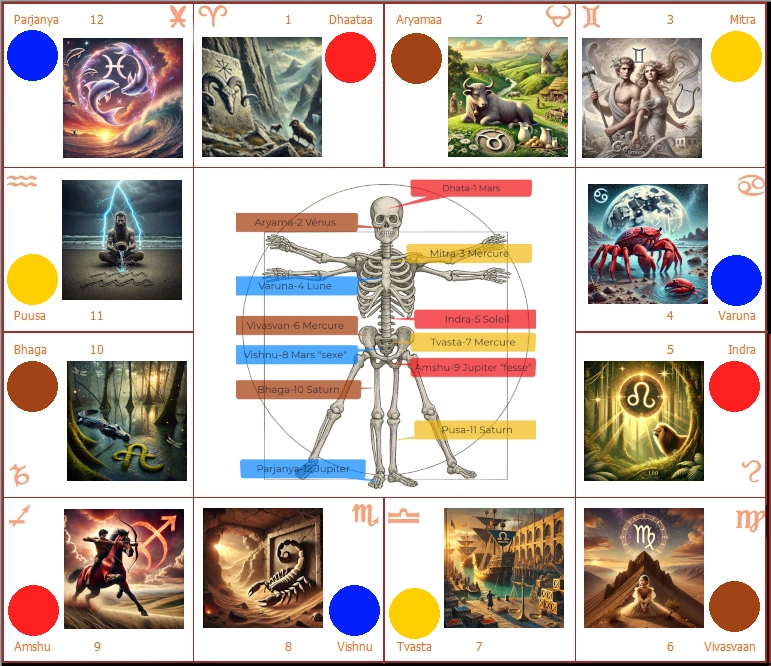
Astronomical Evidence: Alignment with Solar Cycles
The Adityas Zodiac is not an abstract theory - it aligns with observable solar cycles and documented astronomical phenomena:
- 30° Advance Cycle: The South Indian chart logically corresponds better to this tropical system that begins 30° before current Aries.
- Equinoxes and Solstices: The cardinal points (spring equinox, summer solstice, autumn equinox, winter solstice) align perfectly with the Adityas, and also align with the Chakras.
- Precession of the Equinoxes: The Aditya system can integrate the 25,800-year precessional movement, though this is another subject as complex as the Adityas themselves (see the Nakshatra section)
Historical Evidence: Ancient Traditions and Artifacts
References to the Adityas appear in humanity's oldest texts:
- Rig Veda: The Vedic texts describe the 12 Adityas as the sons of Aditi, the mother of the universe, and her husband the Rishi Kasyapa of the 9th Aditya.
- Chinese Traditions: The Chinese Lunar New Year follows this same Adityas zodiac, demonstrating its diffusion across cultures
- Archaeological Artifacts: Symbolic representations of the Adityas have been found in ancient sites throughout Asia
Physical Evidence: Observable Body Correlations
Each Aditya corresponds to specific physical manifestations that you can observe:
- Morphology: Observe how your body structure aligns with your dominant Aditya
- Physical Traits: Facial characteristics, posture and gestures reflect Aditya energies
- Body Sensitivity: Certain body parts are more sensitive or developed according to your Aditya position
Psychological Evidence: Behavioral Patterns
The Aditya-Rsi archetypes explain universal behavioral patterns:
- Emotional Reactions: How you react to challenges and opportunities
- Relational Styles: Your ways of establishing and maintaining relationships
- Decision Processes: How you make important decisions
The Aditya Revolution: Why This System Changes Everything
Clear Physical Evidence
The Adityas Zodiac is not an abstract theory - it manifests in observable physical reality:
- Body Correlations: Each Aditya corresponds to specific parts of the human body
- Physical Traits: Observe how your morphology and physical characteristics align with your dominant Aditya
- Tangible Manifestations: The energies of the Adityas are visible in your gestures, posture, and way of moving
Surprising Precision
Why the Adityas Zodiac is more effective:
- Crystalline Logic: The system works with mathematical clarity that you can verify
- Clarified Elements: The elements fire, earth, air, water reveal their true patterns
The four fundamental elements:
| Fire (Dharma) | Earth (Artha) | Air (Kama) | Water (Moksha) |
|---|---|---|---|
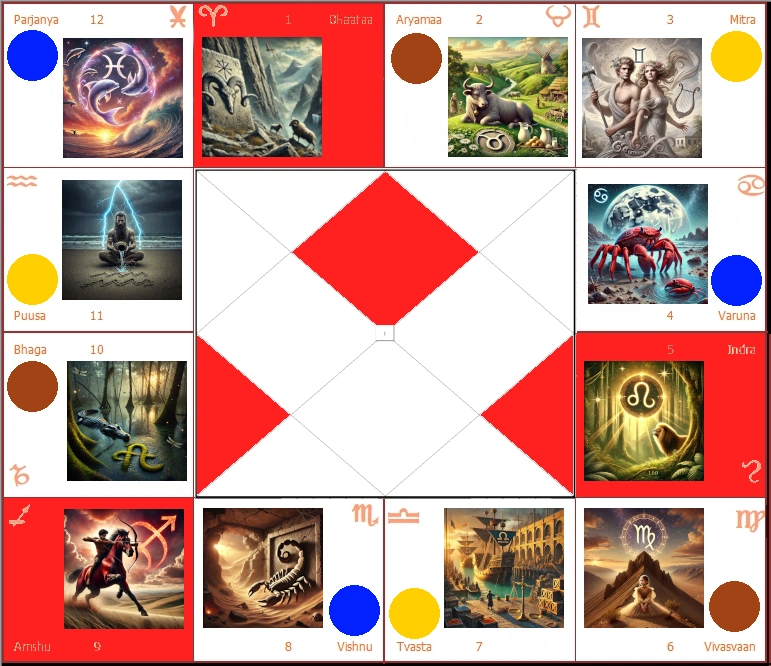 | 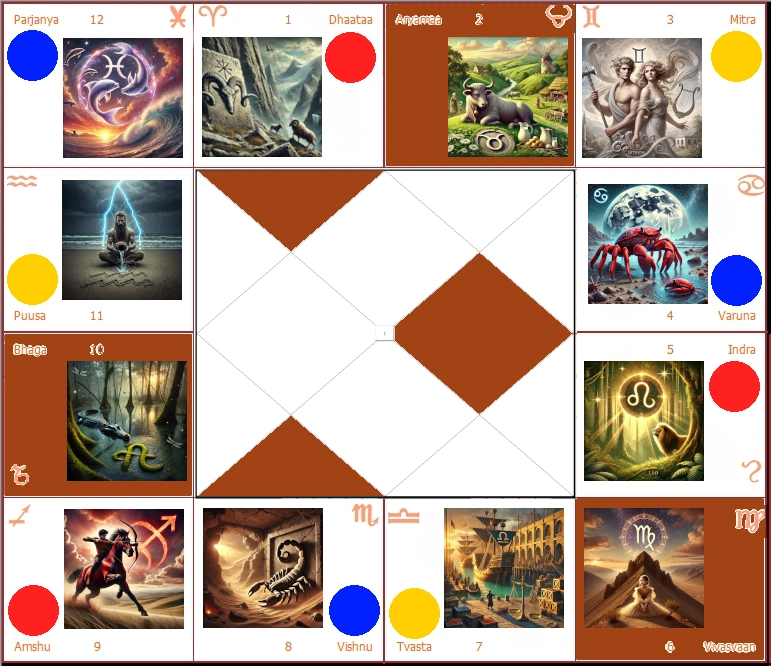 | 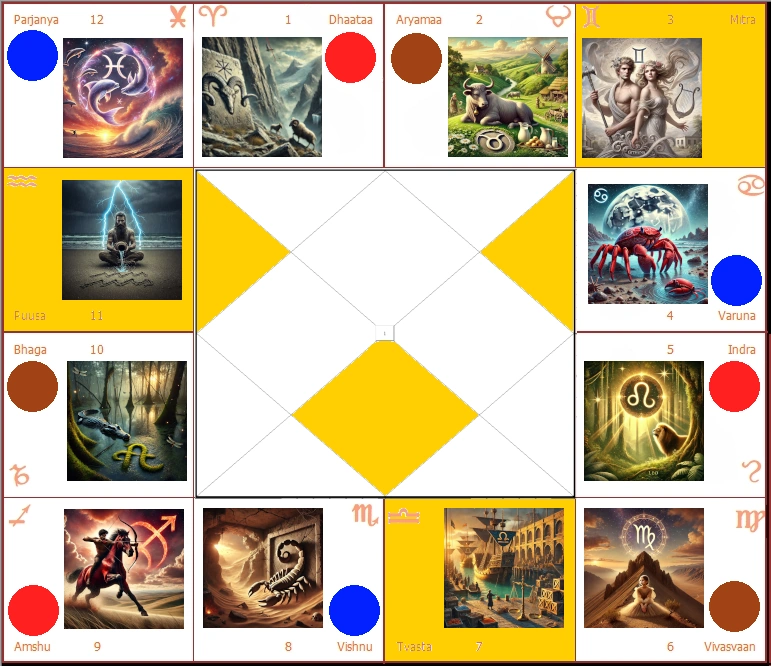 | 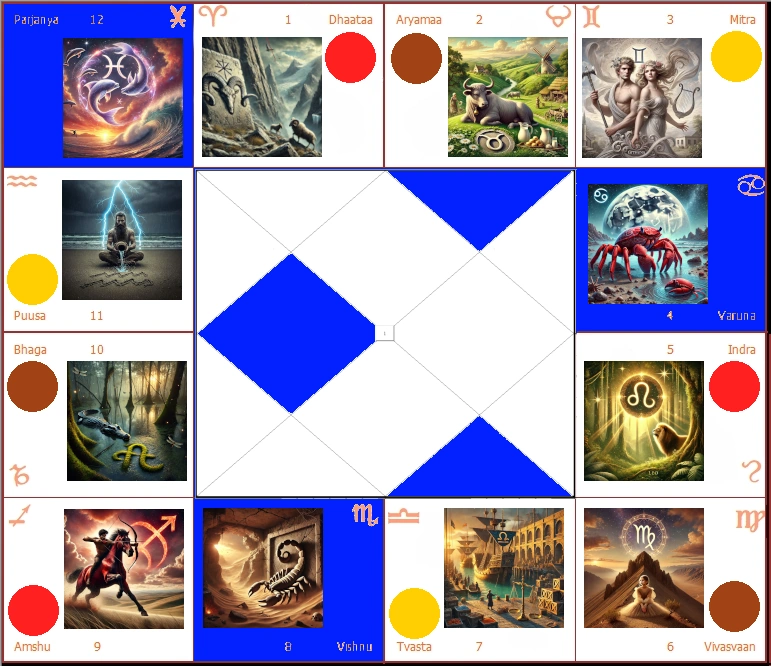 |
- Coherent Houses: The Ascendant and the ruler of the Ascendant become much more important
- Fundamental Archetypes: The 12 Aditya-Rsi pairs represent universal cosmic laws
The Shock of Discovery
Prepare for a transformative experience:
"It's like discovering color after always seeing in black and white"
The system works so well that it can create initial shock - this is normal with true revolutions. Like the arrival of the Internet or AI, the Adityas Zodiac fundamentally changes our understanding of reality.
Beyond Traditional Debates
The Adityas Zodiac transcends old controversies:
- Neither Tropical nor Sidereal: It is a fundamental solar system that predates both
- 30° Advance: It begins before conventional Aries, capturing fundamental energies
- Universality: The laws of the Adityas work independently of coordinate systems
Verify for Yourself: Use the calculator, explore your Aditya positions, and observe how these archetypes manifest in your daily life. The evidence is there, visible and verifiable.
Begin Your Aditya Journey Today
Your Next Step
Now that you understand the revolutionary power of the Adityas Zodiac, it's time to take action:
- Use the Calculator: Discover your exact Aditya positions
- Explore Your Nature: Identify your dominant Aditya and associated Rsi
- Observe the Evidence: See how these archetypes manifest in your daily life
- Go Deeper: Return to explore the 12 Aditya-Rsi pairs to understand their influence
An Invitation to Discovery
The Adityas Zodiac is not just a new astrological system - it is a door to a deeper understanding of yourself. Like many discoverers before you, prepare to be surprised by the precision and relevance of these ancient archetypes.
Your Journey Begins Now: Use the calculator above to generate your Aditya chart. Start by identifying your dominant Aditya, then explore how the other Aditya-Rsi pairs influence your life path. The answers you seek are closer than you think.
Support this project
This site offers free articles and a basic chart calculator accessible to everyone. I've dedicated hundreds of hours to writing these articles, building calculation tools, and creating quality astrological content. If my work helps or inspires you, a donation — even a small one — would help me continue to grow this site and keep articles freely accessible.
Choose an amount
Thank you so much for your support!