When the World's Resources Hit a Wall: Saturn-Mars in Aryama, April 2026

Everything broke at once. Here's what happened and when.
In April 2026, something unusual happened. Within just four days, systems across the entire world began failing simultaneously. Not one industry. Not one country. Everywhere, at the same time. Oil stopped flowing through the world's most critical shipping lane. ChatGPT went dark for millions of users. The US President declared a National Energy Emergency. A satellite launched into the wrong orbit was lost in space. Hospital emergency rooms went on red alert. A dam nearly breached. Grid outages rose 10% in a single week.
Was it coincidence? Or does the timing tell us something?
This study tracks the Saturn-Mars conjunction in Aryama (Tropical Aries) and what happened in the world during the exact days these two planets merged at the same degree of the sky.
What Is This About?
Every few years, Saturn and Mars meet at the same point in the zodiac. In the Aditya system (a tropical Vedic framework), the sign where they met is called Aryama, which corresponds to the first 30 degrees of the tropical zodiac (Aries in Western astrology).
Aryama is the sign of resources. What sustains us. What keeps things running.
Saturn represents limitation, restriction, depletion, what must be endured.
Mars represents drive, fire, metal, speed, the push to move forward.
Note on Mars and "electricity": The audio version of this study (AI-generated) incorrectly associates Mars with electricity. Mars is not electricity. Mars is metal: the minerals extracted from the earth after magma cools. The copper in cables. The silicon in processors. The raw material inside every NVIDIA chip. Mars is what conducts the current, not the current itself. Electricity flows through Mars, but the force that moves it belongs to a different domain. This is a common AI misinterpretation when processing astrological symbolism, and we leave it here as a transparent correction.
When they meet in Aryama, the expectation is: resource limitation collides with the drive to move forward. Too much demand, not enough supply. Things breaking under strain. Depletion.
The Key Dates
Calculated with Swiss Ephemeris (astronomical precision):
| Event | Date (UTC) |
|---|---|
| Saturn enters Aryama (for 2+ years) | February 14, 2026 |
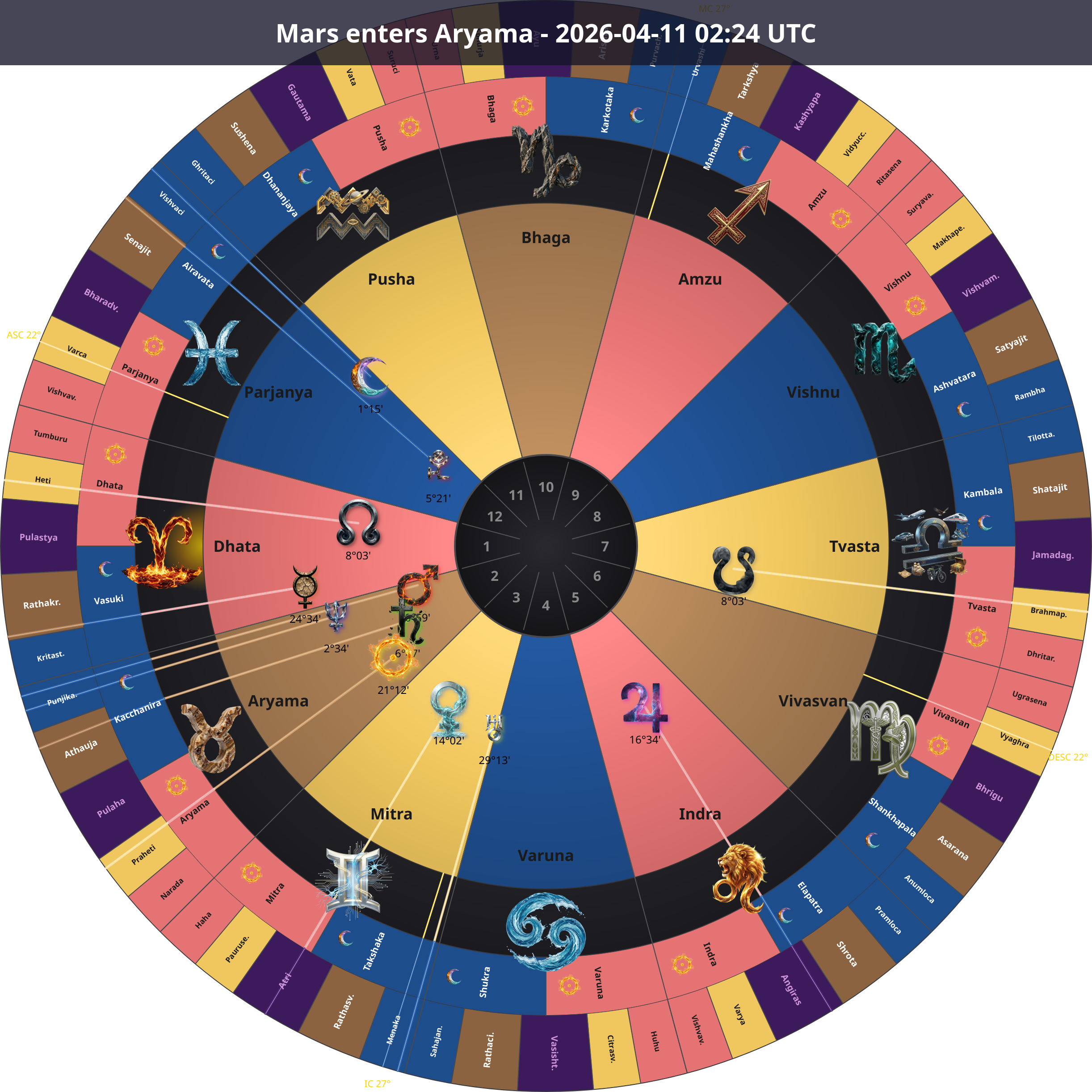
| Mars enters Aryama | April 11, 2026 |
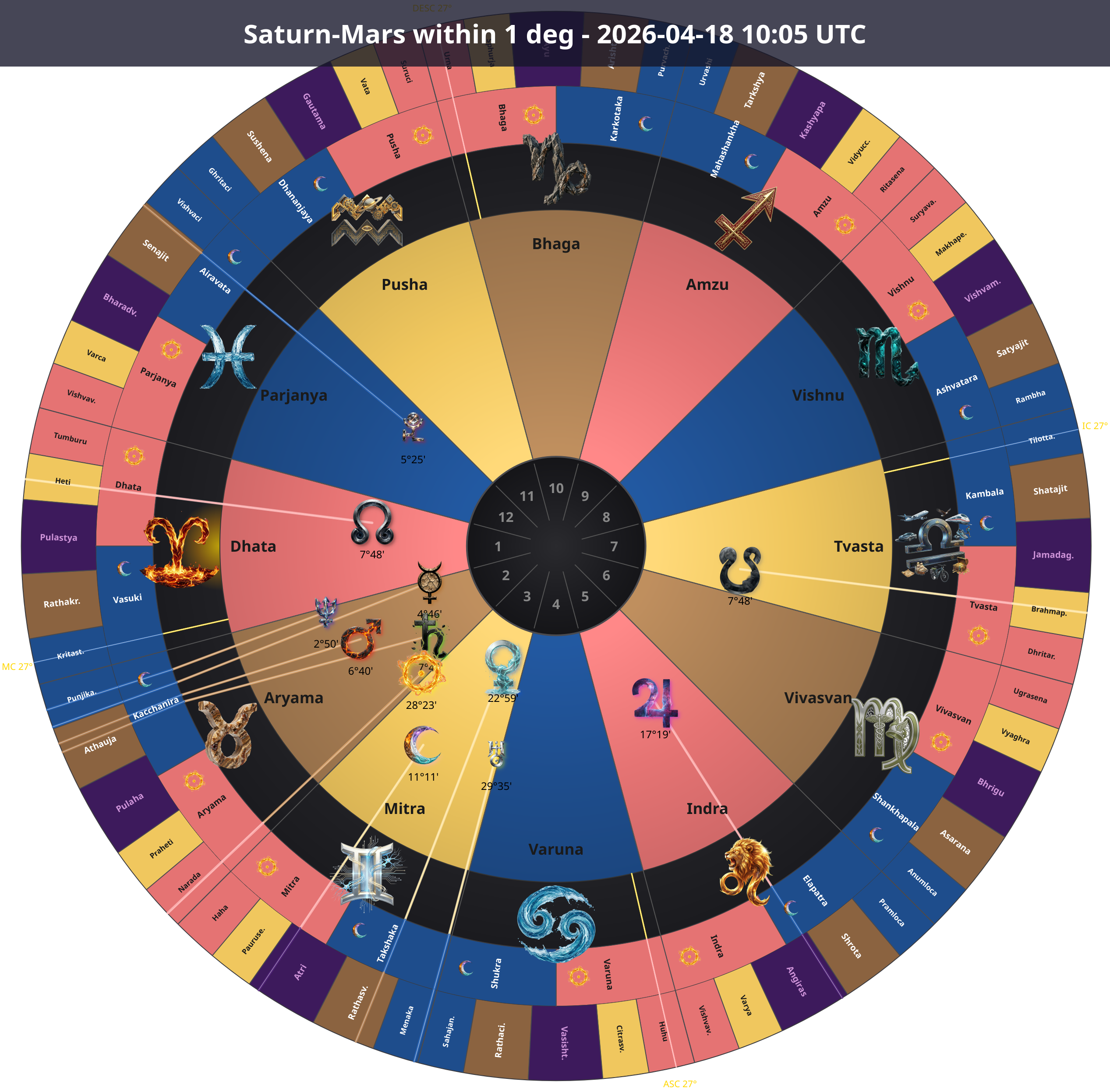
| Both planets within 1 degree of each other | April 18, 10:05 |
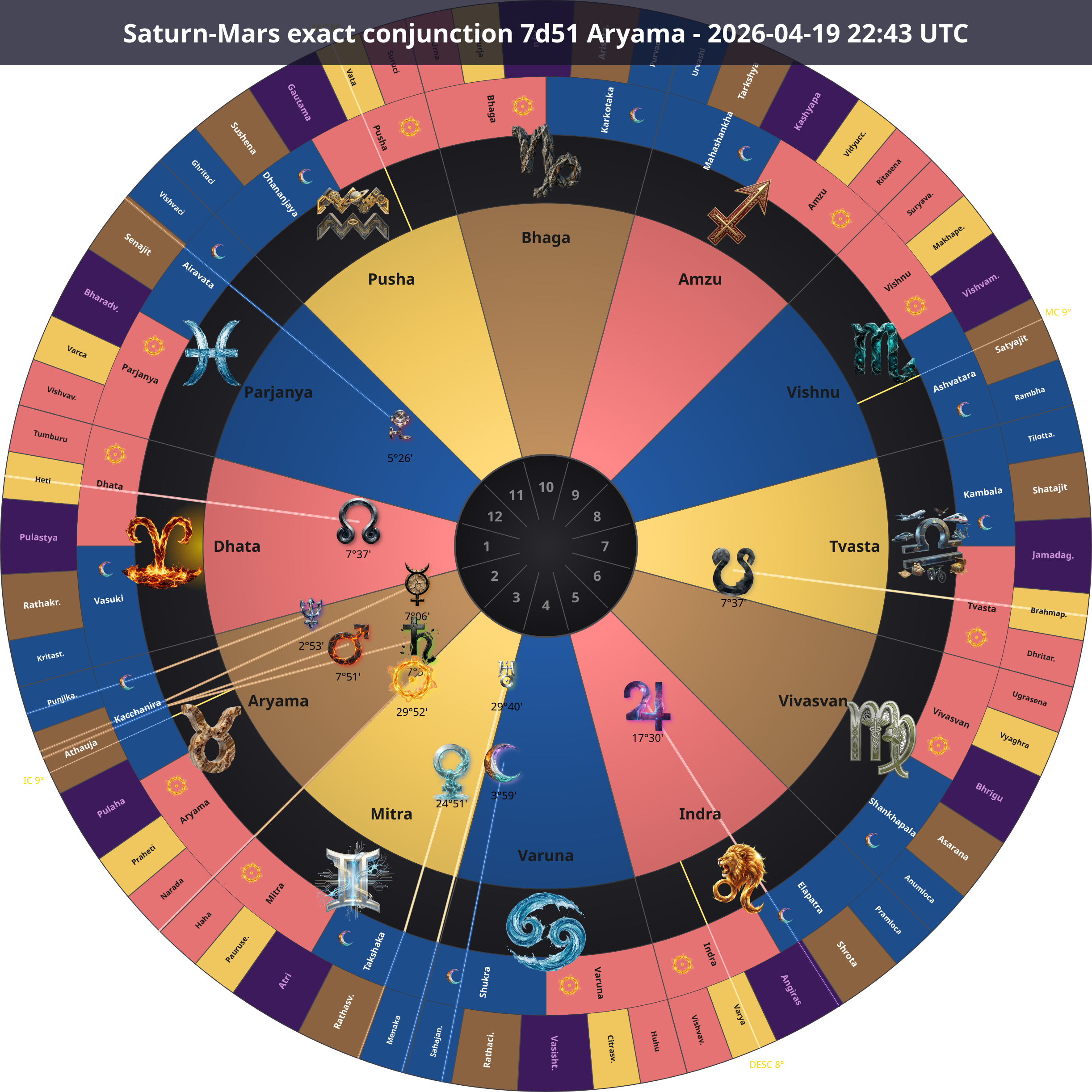
| Exact conjunction (0.0 degrees apart) | April 19, 22:43 |
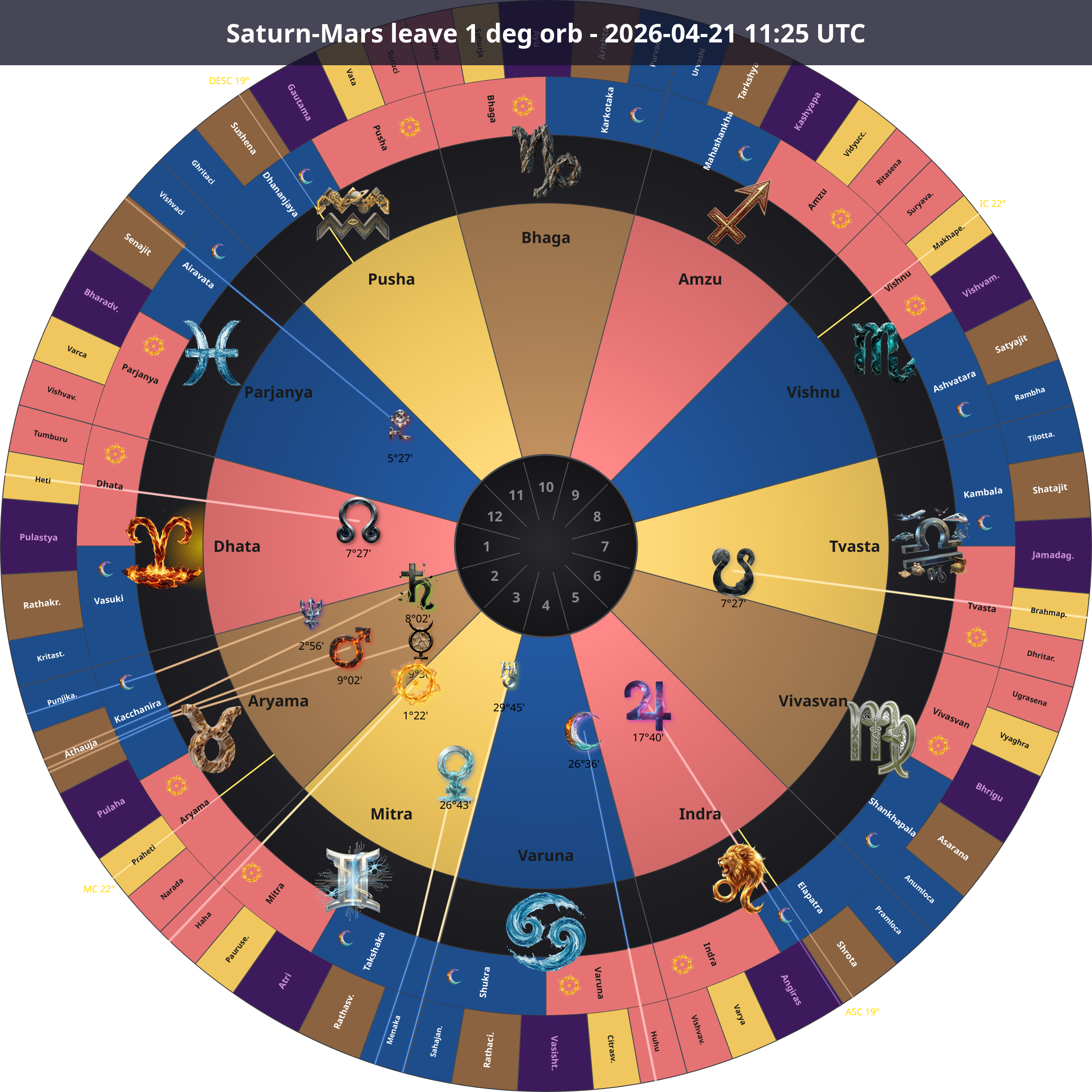
| Planets separate beyond 1 degree | April 21, 11:25 |
| Mars leaves Aryama | May 21, 2026 |
The critical window: April 18-21, 2026. Three days and one hour.
The Charts
Here is what the sky looked like at each key moment:
Mars Enters Aryama (April 11)
The 1-Degree Window Opens (April 18)
Exact Conjunction at 7 deg 51' Aryama (April 19)
The 1-Degree Window Closes (April 21)
Mars Leaves Aryama (May 21)
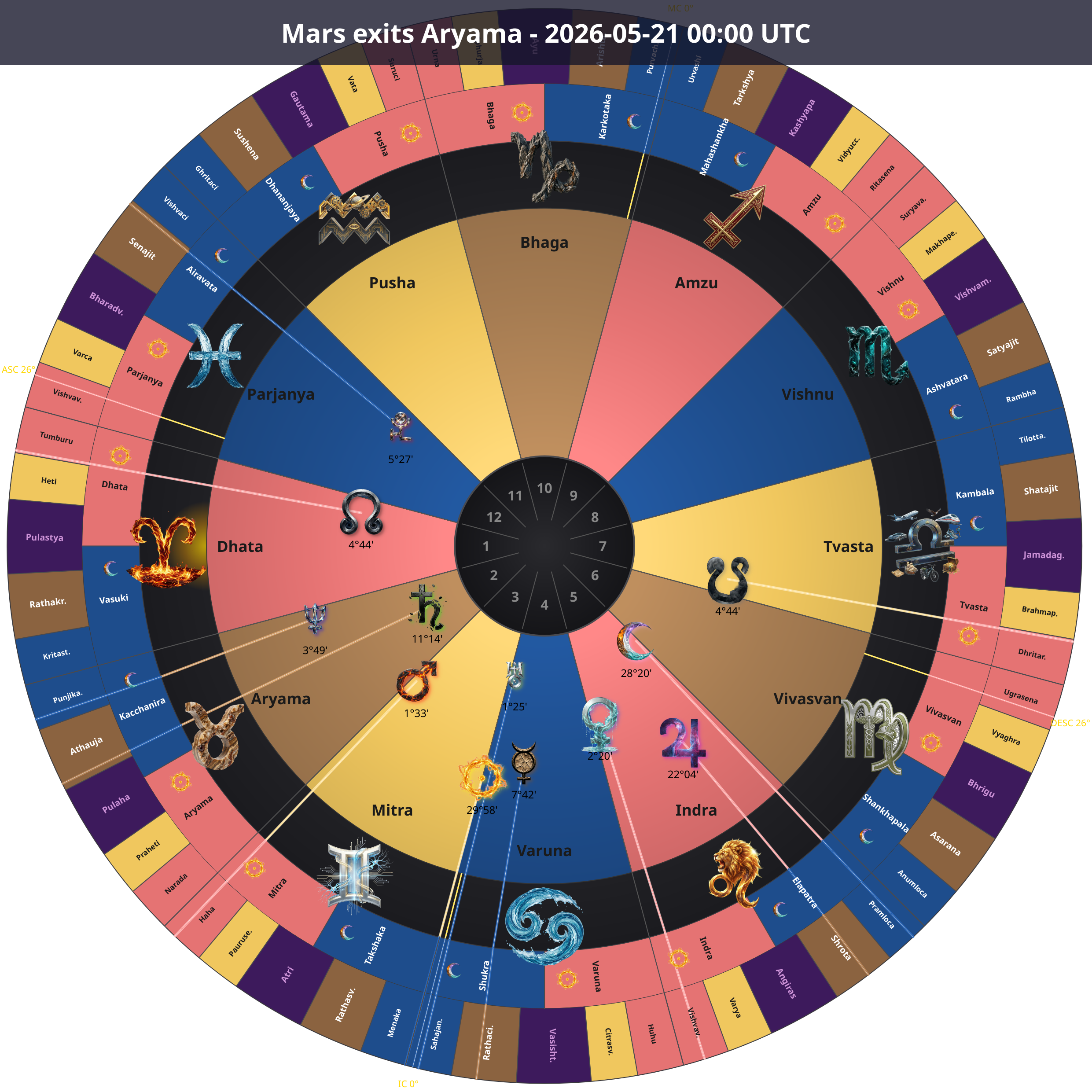
Note: Mercury was also at 7 degrees Aryama on the conjunction day. A triple conjunction zone.
What Happened in the World
Here is what we found across 20+ industries when researching events from this period. Every event below is sourced from public media.
The Major Event: The World's Oil Artery Physically Blocked
The Strait of Hormuz carries 20% of the world's oil and gas. In April 2026, following the US-Israeli strike on Iran, it was effectively shut down.
- April 18 (Day 1 of the tight window): Iran declared the strait closed again and fired on oil tankers
- April 20: 14.2 million barrels per day of production disrupted
- April 21: Only 3 ships passed in 24 hours
- Only 191 ships transited during the entire month of April
- Oil hit $127/barrel. Diesel rose from $3.72 to over $5.40
- Kuwait's crude exports fell to zero
- 34,000 ships were rerouted to alternative routes
- The IEA called it "the largest supply disruption in the history of the global oil market"
The world's primary resource channel was physically blocked (Saturn/restriction) while demand kept pushing (Mars/drive). In the sign of resources (Aryama). The escalation timing falls directly on the tight window.
April 19 (Exact Conjunction Day)
- UPS implemented emergency surcharge fees on international shipments ($0.23/lb most routes, $0.32/lb from China). A global logistics company formally pricing "capacity cannot meet demand" on the exact conjunction day.
- Blue Origin launched a satellite into the wrong orbit. The satellite was lost. The rocket was grounded. Trying to push forward, forced to stop.
- Vercel security breach: Attackers stole access keys, API credentials, source code, and database access through a compromised third-party tool.
- The Buffett Indicator hit 232% (Fortune article published the same day), framing it as a valuation crisis threshold.
April 20 (Conjunction +1 Day)
- ChatGPT went down globally. 8,700 user reports in the UK alone. 90+ minutes of partial outage. Some users had work permanently deleted.
- The President invoked the Defense Production Act for a "National Energy Emergency," targeting "dangerously limited" national capacity in transformers and power generation. This mechanism is reserved for genuine national emergencies.
- CISA added 8 actively exploited vulnerabilities to its Known Exploited Vulnerabilities catalog.
- 200+ million gallons of sewage dumped into the Potomac after sewer infrastructure collapse. EPA and DOJ filed lawsuits.
- Xcel Energy warned of Public Safety Power Shutoffs in Colorado due to drought and wildfire.
- S&P 500 dropped on Iran tensions.
- Mastodon hit by DDoS attack.
- GitHub degraded (code scanning and project boards).
April 21 (Tight Window Closes)
- WhatsApp Business API went down (Cloud Calling API outage).
- Starlink satellite network experienced a global outage, impacting maritime operations.
- NERC issued a formal alert: AI data centers are destabilizing the power grid.
- Datadog report: 5% of ALL AI requests in production were failing. 60% of those failures came from infrastructure capacity exhaustion, not software bugs.
- Iran's internet blackout reached day 53, becoming the longest national internet shutdown in history.
- Only 3 ships passed through Hormuz in 24 hours.
- Arizona: 6,000 customers lost power from wildfire-related shutoffs.
- Hennepin Healthcare hospital (Minneapolis) went on "red alert" with closure risk.
- Spotify app and search went down for 18-36 minutes.
The Days After (Cascading Aftermath)
The exact conjunction seems to act as a trigger. The most structurally damaging events came in the week after:
- April 23: GPT-5.5 launched (described as "the most intense month in AI model release history"). Rate limits immediately flagged as degradation. Same day: S&P Flash PMI showed US prices rising at the fastest pace since July 2022. Qatar helium shortage threatening semiconductor manufacturing.
- April 24: Azure East US went down for 13 hours (cascade across 3 availability zones). DeepSeek V4 launched but "fails to close US lead" per Bloomberg. Emergency water releases from Lake Powell.
- April 26: OpenAI killed Sora (AI video generator). Reason: too expensive to run. Video compute cost vastly exceeds text. Disney had already pulled its $150M contract.
- April 27-28: Microsoft 365, Outlook, and Teams all went down. An "external service dependency" caused cascading failure.
- April 29: Spotify crashed at a 55% app failure rate, 3,000+ reports. No company communication.
The Bigger Pattern
AI and Tech (Throughout April)
- Claude/Anthropic: Multiple outages on April 7, 13, 16, 28, and 30. A bug capped responses to 25 words (April 16). Insufficient compute capacity acknowledged. Usage limits introduced at peak hours. OpenAI's Chief Revenue Officer publicly called it a "strategic misstep."
- GPU Pricing: RTX 5090 projected to hit $5,000 (launched at $1,999). Gartner forecasting 17% PC price increase by year's end. Memory pricing up several hundred percent. HBM expected to rise 30-40% further.
- NVIDIA Supply Chain: Rubin GPU shipment forecasts cut from 29% to 22%. $4.5 billion impact from export restrictions.
- API Rate Limits Tightened: Google Gemini imposed new spending caps starting April 1. Anthropic: "Limits will stay tight or tighten further in 2026."
- AI Developer Burnout: Harvard Business Review: "AI isn't reducing work, it's intensifying it." 67% of AI tool users working MORE hours. Sprint targets recalibrated 40% higher. "The only bottleneck is cognitive endurance."
Energy and Power Grid
- 40% of planned US data centers cancelled or delayed (transformer/switchgear shortage)
- PJM (largest US grid operator): emergency proposal for 14.9 GW after a failed procurement auction
- Equipment lead times extended to 5 YEARS
- Energy has explicitly replaced silicon as "the binding constraint" of AI expansion
- Data centers consuming enough power for 2.25 million homes, but grids can't build fast enough
- "Bragawatt" delivery gap: physical builds delayed 2-7 years due to transformer steel shortage
- DRAM prices surged 26% in weeks
Water and Agriculture
- Oregon expanded drought emergency to 6 counties (record-low snowpack)
- Lake Powell: inflow forecast at 22% of normal
- Corpus Christi reservoirs at 7.8% capacity
- World Bank: fertilizer prices could spike 30%+, threatening food for 260 million people
- Fertilizer stress threatening 2027 grain harvests
Labor and Burnout
- LAUSD unions set April 14 strike deadline; negotiations described using the word "depletion"
- 1,300+ workers on strike at Lake City Army ammunition plant (April 13)
- 34,000 NYC building service employees authorized strike (April 15-17)
- UC service employees announced open strike across 10 campuses
- 66% of US employees reporting burnout
Physical Infrastructure
- Cheboygan Dam (Michigan) pushed near failure by flooding (April 18)
- Danish rail electrification lines collapsed (April 14)
- Multiple Colorado wildfires: Hammer Fire reached 5,000 acres in 24 hours
- Georgia wildfires destroyed 120+ homes
- 264 global grid outages in one week (April 20-26), up 10% from prior week
Was the Tight Window (April 18-21) Actually Different?
Yes.
The broader April period showed ongoing stress. But the tight 4-day window showed something qualitatively different: simultaneous emergency-level failures across independent systems.
In 96 hours:
- A global oil chokepoint was physically blocked
- The US President declared a National Energy Emergency
- The world's most popular AI chatbot went dark
- A satellite was lost in space
- A dam nearly breached
- A sewer system collapsed
- A satellite network went down
- AI infrastructure was formally measured as failing
- Grid outages measurably increased
- Multiple power shutoffs were issued
No single cause explains all of these simultaneously. The Hormuz crisis explains the oil and logistics events. But it doesn't explain the ChatGPT outage, the satellite loss, the dam failure, the sewer collapse, or the AI infrastructure failures. These are independent systems hitting their capacity limits at the same time.
Counter-Evidence (What Doesn't Fit)
Honest research requires noting what contradicts the pattern:
- The S&P 500 hit an all-time high on April 17 (the day BEFORE the tight window opened). Peak optimism immediately preceding peak stress.
- Sodium-ion batteries were commercialized during this period (a breakthrough bypassing lithium constraints).
- Goldman Sachs projected a copper surplus (not all materials were scarce).
- Natural disasters were not dramatically above seasonal norms (tornado season is annual).
- The Iran conflict began February 28, before Mars entered Aryama. The war has its own political causality.
What Does This Mean?
This study does not claim causation. It documents timing correlations.
The Saturn-Mars conjunction at 7 degrees 51 minutes of Aryama on April 19, 2026, coincides with:
- The physical blocking of the world's primary resource channel
- Emergency government action declaring national resource scarcity
- Global AI and tech infrastructure hitting measurable capacity limits
- GPU and memory prices up several hundred percent
- Power grids approaching crisis from AI demand
- Water systems running dry
- Worker burnout formally documented as epidemic
- Creative AI projects killed by resource cost (Sora)
- A satellite literally unable to reach its destination
30+ disruption events across 20 industries in 4 days. Three independent AI researchers (who received only dates and themes, not each other's results) all concluded the pattern appears stronger than chance.
Whether this constitutes evidence for the astrological framework is the reader's call. The data is there.
Study conducted May 5, 2026. Transit data calculated via Swiss Ephemeris. Events sourced from public media. Independent verification by three AI research agents operating blind.
Framework: 360HeartsInTheSky.com